

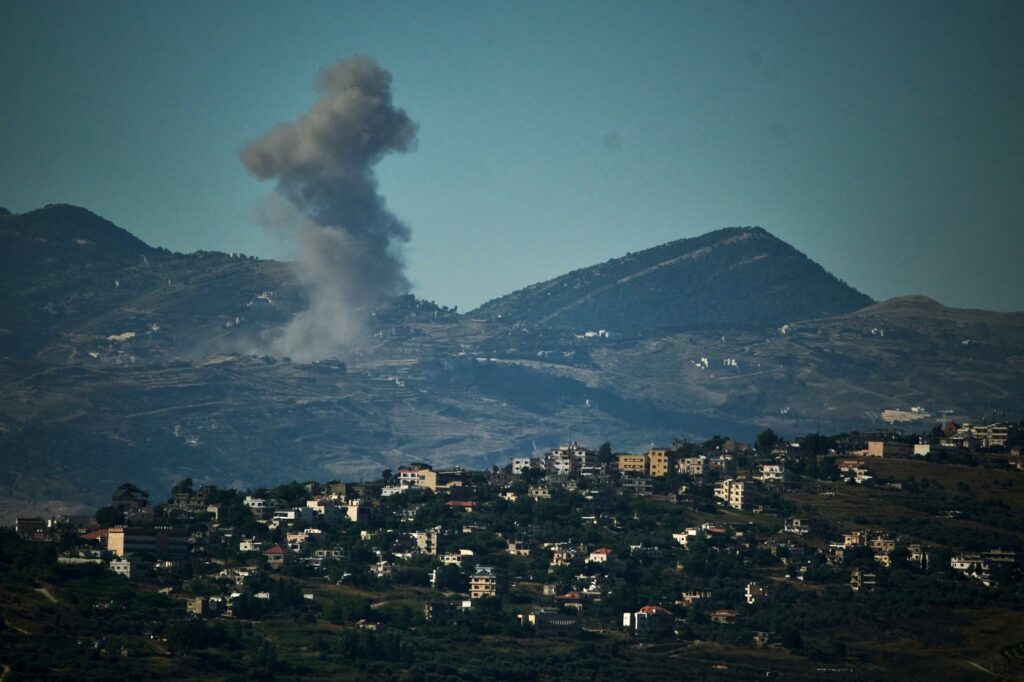
TYRE, Lebanon (AP) - On Saturday, Israeli airstrikes across southern Lebanon resulted in the deaths of at least seven individuals, including two children. This escalation came just hours after reports emerged regarding a potential ceasefire agreement. The ongoing conflict poses a serious threat to an interim agreement between the United States and Iran aimed at halting the violence in the region.
According to Lebanon's National News Agency, the airstrikes targeted the southern town of Nabatiyeh and surrounding villages, leading to at least seven individuals reportedly trapped beneath the debris. Mediation efforts to cease hostilities between Israel and the militant Lebanese group Hezbollah intensified following a violent exchange on Friday that claimed the lives of at least 47 people in Lebanon, as well as four Israeli soldiers.
An anonymous Israeli military official stated that Hezbollah had launched over 50 projectiles at Israeli forces in southern Lebanon overnight, prompting responsive military action against the militant group. Meanwhile, Israeli Ambassador to the United States Yechiel Leiter expressed Israel's commitment to an immediate ceasefire, contingent upon Hezbollah's observance of the agreement.
Hezbollah, while publicly indicating a willingness to uphold a ceasefire if Israel does the same, has refrained from confirming that a ceasefire agreement is in effect. A Hezbollah official, speaking on condition of anonymity, mentioned that mediators from Qatar, the U.S., and Iran were working to negotiate a ceasefire, but stopped short of indicating that a deal had been finalized.
The conflict erupted shortly after the U.S. and Israel conducted strikes on Iran on February 28, with Hezbollah retaliating by firing rockets and drones into civilian areas in northern Israel, while Israel has since seized control of substantial territories in southern Lebanon.
The newly established U.S.-Iran interim agreement aims to facilitate a cessation of military actions in Lebanon and respect the nation's sovereignty. However, with ongoing hostilities, the viability of the accord appears increasingly precarious. U.S.-Iran negotiations planned to commence in Switzerland on Friday have been delayed, with no new timeline provided.
Israeli Prime Minister Benjamin Netanyahu has stated that Israeli forces will remain in southern Lebanon until any potential threats to Israel are neutralized. Conversely, Hezbollah has insisted that it will not cease its attacks until Israel withdraws from Lebanon, which aligns with Iran's conditions for the interim deal.
On Saturday, plumes of smoke were observed over southern Lebanon, with Israeli jets conducting low-flying operations over the coastal city of Tyre. In the village of Barish, four family members were killed in an airstrike — two parents and their two children. Additional casualties included a body extracted from rubble in Arab Salim village, with drone strikes in Doueir and Kfar Rumman resulting in the deaths of a motorcyclist and a Lebanese soldier.
Netanyahu's office has not yet commented on the ongoing ceasefire negotiations. On Friday, he communicated via X that the Israeli army had struck around 150 Hezbollah positions, allegedly neutralizing numerous militants.
In a related development, Iranian and U.S. officials opted to postpone their travel to Switzerland. Iranian representatives maintained that the fighting in Lebanon must cease prior to the resumption of talks. U.S. Vice President JD Vance also rescheduled his visit in light of the ongoing violence.
On Saturday, Esmail Baghaei, spokesperson for Iran's Foreign Ministry, revealed that Pakistan’s interior minister was set to arrive in Iran to continue discussions regarding a possible agreement. Previously, Baghaei confirmed that consultations through mediators were still underway to structure a final U.S.-Iran agreement.
While the interim U.S.-Iran deal, finalized digitally earlier this week, allows for a 60-day window to negotiate a nuclear agreement — subject to extension — significant hurdles remain. Previous negotiations, such as the 2015 nuclear deal terminated by U.S. President Donald Trump, took over 18 months to conclude.
The interim agreement presents an array of attractive incentives for Iran, including the lifting of international sanctions and the establishment of a $300 billion fund for postwar reconstruction, contingent upon reaching a new agreement. Following the interim accord, the U.S. has lifted its blockade on Iranian ports, allowing the free sale of oil and the unfreezing of Iranian assets, although the timeline for these actions remains uncertain.








