

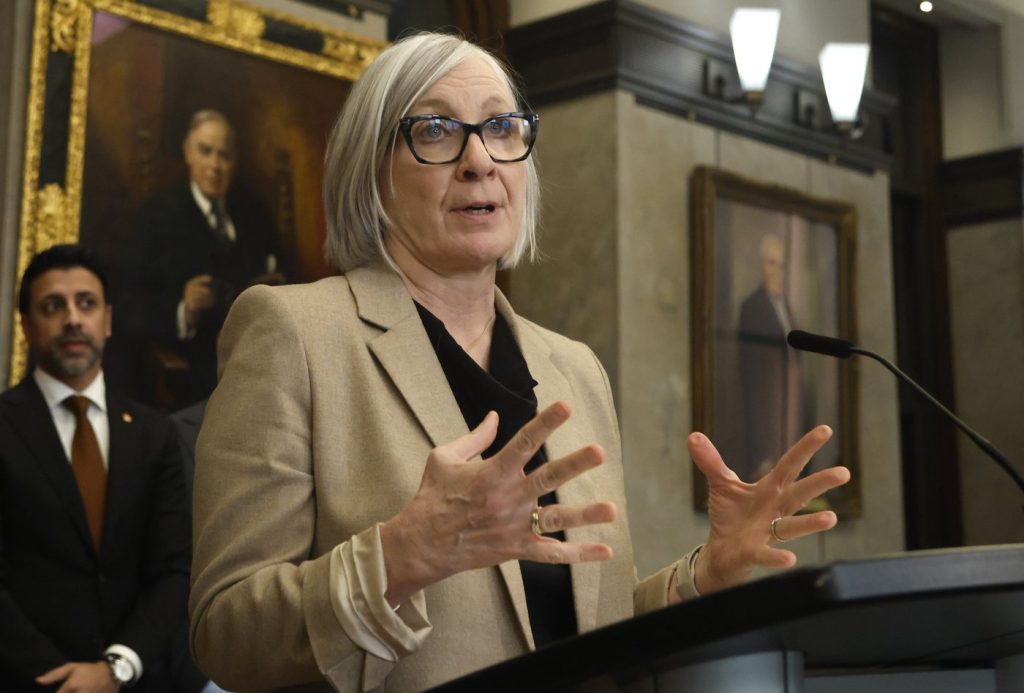
OTTAWA – Federal Jobs Minister Patty Hajdu is actively seeking strategies to ease tensions between unions and employers, especially in instances where labor disputes could disrupt essential industries. This endeavor comes amid the federal review of labor laws, which has prompted unions to assert their right to strike while opposing any government intervention in bargaining processes.
In a June 19 interview, Hajdu emphasized that the government would not interfere with the constitutional right to strike. She pointed out, however, the necessity of addressing prolonged strikes that could have significant economic repercussions on other sectors or critical industries. "The question is, when should the government intervene, and how should it do so?" she asked.
The federal Labour Code review, initiated in mid-April, aims to gather input from unions, employers, and other stakeholders regarding issues such as collective bargaining timelines, automation, and health and safety protections. These consultations follow a tumultuous period for labor relations in Canada, which has seen high-profile strikes and lockouts at major Canadian ports, railways, and critical service providers like Air Canada and Canada Post.
Minister Hajdu has echoed sentiments of her predecessors, highlighting that the best agreements are achieved at the bargaining table. Nevertheless, it’s noteworthy that during recent significant labor disputes, the federal government intervened by invoking Section 107 of the Labour Code. This controversial measure allows the labour minister to refer a dispute to the Canada Industrial Relations Board, which can declare an impasse and mandate binding arbitration to resolve the issue.
According to a Senate committee report released earlier this month, Section 107 was activated eight times between June 2024 and August 2025, a considerable increase compared to its sparse usage over the preceding 40 years. Hajdu mentioned that feedback from the labor review reflected diverse opinions on Section 107; while some unions advocate for its complete removal from the Labour Code, others feel there should be some mechanism available for mediation referrals.
Senator David Wells from Newfoundland and Labrador described Section 107 as a "hammer" that should be used cautiously. The recent Senate committee recommendations suggest involving federal mediators early in the bargaining process, especially in sectors like transportation where preventing work stoppages is deemed crucial for national interests. Should negotiations ultimately fail, the Senate report advocates that the cabinet should have the authority to mandate binding arbitration to avert strikes or lockouts.
Senators have argued that labor disruptions, which regularly halt extensive portions of the economy, damage Canada's image as a reliable trading partner, particularly during efforts to diversify into new markets. However, Bea Bruske, president of the Canadian Labour Congress, opposed the Senate report, declaring it detrimental to workers' rights in an already uncertain economic climate. She urged the Government of Canada to reject the recommendations entirely, advocating for a focus on strengthening collective bargaining and safeguarding fundamental rights for workers.
Hajdu acknowledged that widespread disruptions, such as rail strikes impacting farmers with perishable goods, create "tricky situations" for labor ministers. "You’re trying to balance all of the rights people have to strike with the short- and long-term economic impacts," she said, reaffirming the government's commitment not to infringe on the constitutional right to strike. The focal point is identifying appropriate tools for the labor minister to promote industrial peace, which is the essence of the ongoing consultations.
One area of consensus between Hajdu and the Senate's recommendations is the necessity for earlier engagement with federal mediators, especially when conflict history is noted among parties. She has received favorable feedback regarding federal mediation, which is said to preclude strikes or lockouts in 95% of cases, dubbing it "the most important tool" at the government's disposal.
Several stakeholders have advocated for a more robust industrial relations board, emphasizing the need for the capacity to quickly process disputes and grievances. Hajdu stated that unresolved grievances may carry over into subsequent negotiation rounds, heightening discordness between parties. By empowering the board to resolve disputes, she argued, the potential for alleviating labor turbulence in Canada could be enhanced.
Moreover, external economic factors increasingly influence labor negotiations, as trade disruptions from the United States and the rise of artificial intelligence loom large in the background. Hajdu expressed concerns that these discussions are not being adequately managed in various sectors. "If you’re afraid of what the future looks like, it gets really hard to commit to long-term collective agreements," she remarked, indicating that both employers and unions share anxieties about the implications for their respective workforces going forward.
Overall, Hajdu aims to facilitate stronger relationships and encourage more open dialogues earlier in the negotiation process to effectively address these concerns.








