

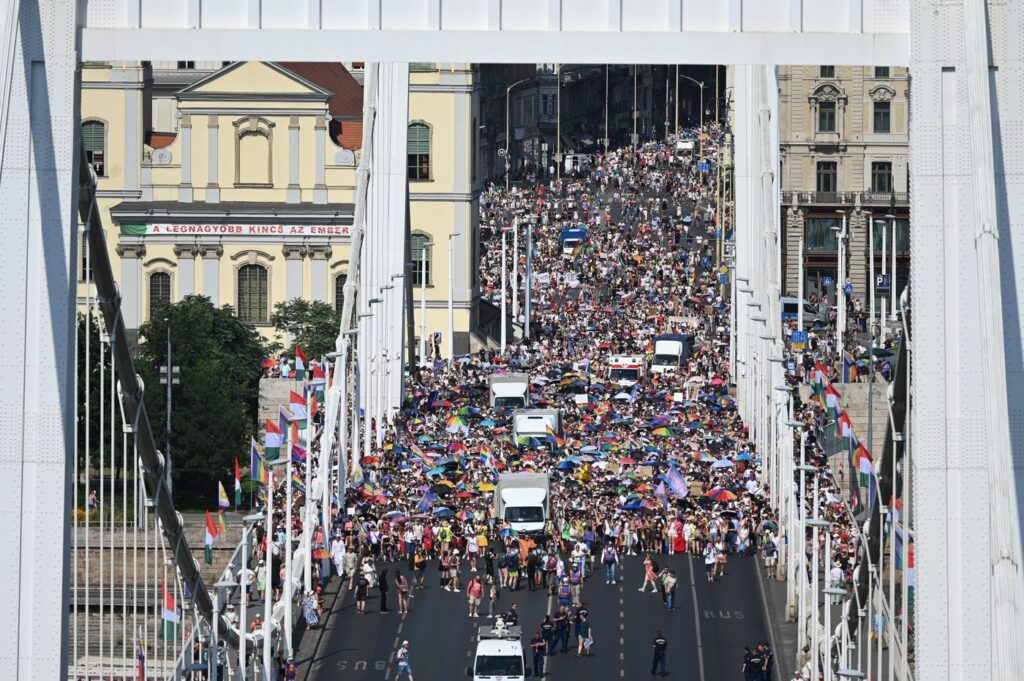
BUDAPEST, Hungary (AP) — On Saturday, tens of thousands of participants flocked to Budapest to participate in the 31st annual Budapest Pride parade. This event marks the first LGBTQ+ march since the ousting of former Prime Minister Viktor Orbán, who had previously attempted to ban the celebration. The election of a new government in April brought renewed hopes for the LGBTQ+ community in Hungary.
The march commenced in the afternoon under sweltering conditions, with temperatures soaring to at least 38°C (100°F). Despite the oppressive heat, organizers ensured the well-being of participants by distributing water bottles and collaborating with the city’s public water utility to open fountains along the parade route.
Participants, ranging from members of Hungary’s LGBTQ+ community to numerous allies, gathered at the iconic Opera House before marching through the center of Budapest and crossing the Erszébet Bridge over the Danube River. The atmosphere was vibrant, with attendees dancing to music and waving colorful rainbow flags.
Luca Szilágyi, who was experiencing her third Pride event, shared her renewed sense of optimism regarding the event's overall mood. She noted a marked difference compared to previous years under Orbán’s governance, which had seen the implementation of multiple anti-LGBTQ+ policies. "There used to be a lot of tension. But now I see people as somehow happier, and there are more older people, too," she remarked.
This year’s Pride celebration came shortly after Orbán’s nationalist-populist government passed legislation and a constitutional amendment aimed at outlawing the event. This move had drawn widespread criticism from human rights organizations and political figures across the European Union. Last year, in stark defiance of the ban, Budapest Pride proceeded as planned, achieving an unprecedented turnout estimated at over 350,000 participants, which was interpreted as a significant setback for Orbán’s administration.
Orbán was decisively defeated in April by a center-right challenger, Prime Minister Péter Magyar, representing the Tisza party. Although the new administration has yet to repeal the anti-LGBTQ+ laws enacted during Orbán's tenure, police permitted the event this year and provided security along the parade route, reflecting a shift in the political climate regarding LGBTQ+ rights.
Kristóf Györgyi, a first-time participant who traveled from Szeged, expressed his hopes for progressive reforms under the new government. "The fact that there’s already a debate in Parliament about whether an orphaned child is better off with a same-sex couple or in an orphanage is a positive sign," he stated, referencing the previous government's restrictions on same-sex adoption and marriage.
He added, "Obviously, the laws haven’t changed yet, but there are already many signs of hope for our community." This optimism is amplified by recent rulings from the EU’s highest court, which determined that Orbán-era legislation from 2021, banning LGBTQ+ content for minors, conflicts with EU law and violates fundamental human rights principles.
Overall, the 31st annual Budapest Pride not only celebrated the vibrant colors and resilience of the LGBTQ+ community but also symbolized a potential turning point in Hungarian politics, bringing renewed hope for equality and rights for sexual minorities.








