

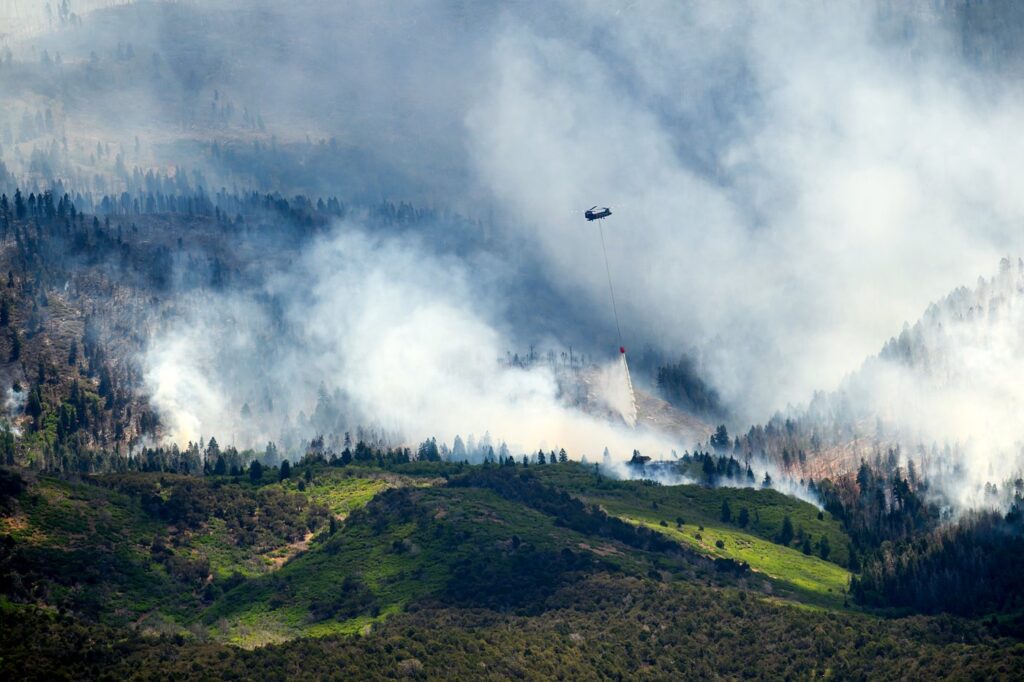
BEAVER, Utah (AP) — The U.S. Wildland Fire Service reported on Sunday that three firefighters tragically lost their lives and two others were injured while combating blazes on the Colorado-Utah border. The firefighters were part of an interagency response team addressing the Knowles and Gore fires, which flared up on Saturday.
In their statement on social media, the U.S. Wildland Fire Service expressed solidarity with the USDA Forest Service in mourning the loss, stating, “Their bravery, dedication, and sacrifice will never be forgotten.” These casualties have highlighted the grave risks faced by firefighting crews as wildfire activity intensifies across the western United States, compounded by a combination of heat, dryness, and windy conditions.
The most significant fire, known as the Cottonwood Fire, has been raging through rugged terrain in southwestern Utah. The fire escalated dramatically on Saturday, expanding to more than 144 square miles (373 square kilometers) and damaging parts of a ski resort and numerous summer cabins. Authorities in Beaver County began damage assessments, though no estimates of destruction were immediately available. Utah Governor Spencer Cox referred to the situation as “bleak” but thanked firefighting crews for their “several miraculous stops and saves.”
Alyssa Mason, a spokesperson assigned to the fire, indicated that the challenging geography has increased the complexity of firefighting efforts. “It’s hard to get dozers and other heavy equipment into that. It doesn’t make it impossible to firefight, but it does just kind of slow things down,” she explained.
Hundreds of firefighters have been deployed to Utah to confront emerging fires and manage those that have been intensifying due to what forecasters labeled critical fire conditions—dangerously low humidity levels, warm temperatures, and strong winds. The existing wildfire risk is heightened this year, given Utah's record-low snowpack and the warmest winter on record. Similar circumstances are affecting much of the western United States, as outlined by the National Interagency Fire Center.
Across the nation, firefighting crews from Alaska to Florida worked diligently on Saturday to get a grip on numerous fires, with approximately three dozen classified as large and uncontained. In total, nearly 3 million acres (1.2 million hectares) have been scorched across the United States since the beginning of the year, surpassing the 10-year average.
The critical conditions in Utah prompted Governor Spencer Cox to declare a state of emergency earlier in the week and enact a ban on fireworks ahead of the upcoming July Fourth holiday. This comes as Utah is facing one of the most severe wildfire seasons on record, exacerbated by historic drought conditions. State officials reported a recent surge in wildfire incidents, each exhibiting unprecedented behavior, straining the state’s wildfire response capabilities, as stated by State Forester Jamie Barnes.
On the same day, Colorado Governor Jared Polis also declared a state of emergency and permitted the activation of the National Guard to assist in managing the fires. In recent days, forecasters from the National Weather Service have been issuing red flag warnings across a wide area of the West, spanning from California to Arizona and New Mexico.
In northern Arizona, officials reported that the flames of a new wildfire were moving away from Grand Canyon Village and the nearby community of Tusayan. However, evacuation orders were imposed for those living near Kendrick Mountain, about 50 miles (80 kilometers) from the Grand Canyon. Some parts of northern Arizona experienced power outages as local utilities implemented safety shut-offs to mitigate fire risk. Such power shut-offs are becoming increasingly common across the West, often deployed as a last resort based on assessments of wind conditions, available fuels, and terrain.
Due to ongoing extreme fire conditions in Utah, Rocky Mountain Power also initiated power shut-offs for lines supplying Beaver County and surrounding areas.








