

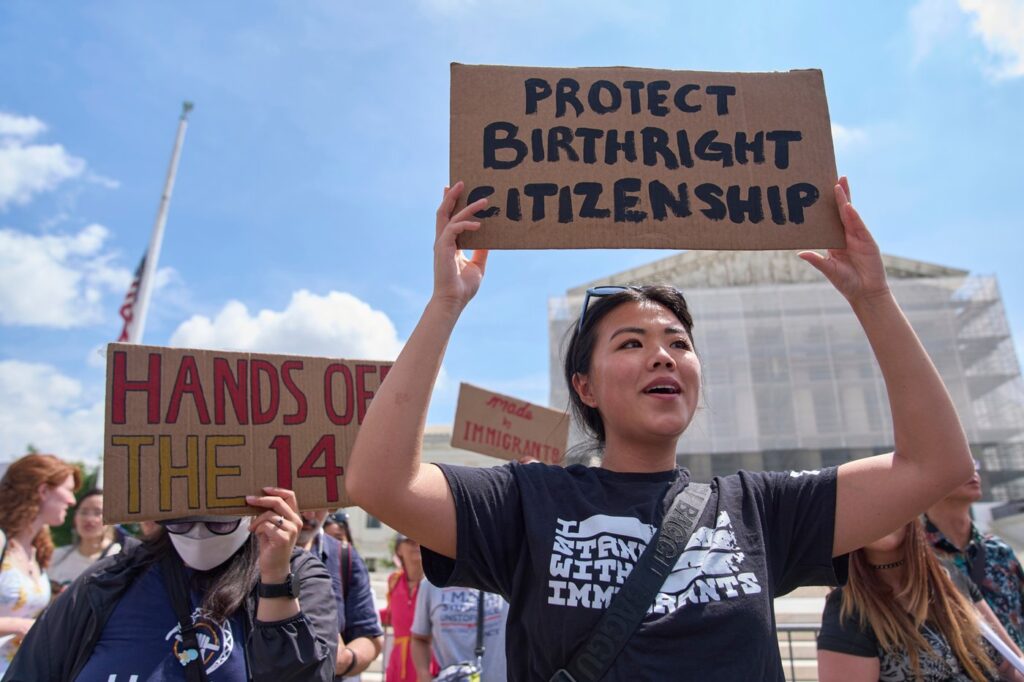
The topic of birthright citizenship has recently been thrust into the spotlight as the Trump administration expressed strong opposition to the principle. Birthright citizenship, which automatically grants citizenship to nearly all individuals born on U.S. soil, is set to be evaluated by the Supreme Court, with the administration describing it as a “disgrace.” President Donald Trump referred to it as “the gravest and most preposterous of all constitutional abominations.” The Trump administration's stance has been unequivocal, with various officials denouncing the existing policy.
Critics of birthright citizenship within the administration have vehemently opposed the practice, claiming it incentivizes illegal immigration. Vice President JD Vance, in 2025, called it “the dumbest immigration policy in the world.” The Trump administration has repeatedly claimed that the U.S. is the only country offering birthright citizenship, a statement that has been debunked. The impending Supreme Court ruling will address an executive order that seeks to transform over a century of legal precedent regarding citizenship.
Birthright citizenship was formalized into U.S. law with the ratification of the 14th Amendment in 1868, a decision made in the context of ensuring citizenship for former slaves after the Civil War. In the late 1800s, the case of Wong Kim Ark established that children born in the U.S. to immigrant parents also qualified for citizenship. Subsequent rulings reinforced this view, asserting that citizenship is granted regardless of the immigration status of the parents, with only a few exceptions that mainly apply to children born to foreign diplomats.
Historically, birthright citizenship has not sparked much contention until the Trump administration's rise, reflecting a broader shift within the Republican Party concerning immigration. Notably, President Ronald Reagan once praised immigrants at a 1984 naturalization ceremony, highlighting the positive contributions they make to society. However, under Trump, the narrative has shifted significantly, with the administration framing immigration issues as a crisis, especially during the easily observable spike in illegal border crossings during the Biden administration.
Trump views birthright citizenship as a “magnet for illegal immigration,” drawing attention to cases of illegal “birth tourism,” where non-U.S. citizens specially travel to give birth on American soil. In legal discourse against this practice, government lawyers focus on the clause within the 14th Amendment that states “subject to the jurisdiction thereof.” They argue, contrary to most legal opinions, that this clause allows the U.S. to deny citizenship to children born to individuals who are unlawfully present in the country. Despite this argument, some conservative members of the Supreme Court have exhibited skepticism towards this interpretation during oral arguments in April 2025.
When addressing whether the U.S. is unique in its provision of birthright citizenship, it is essential to clarify that this is not the case. While unrestricted birthright citizenship may be less common globally, several countries, particularly in the Americas—Canada, Mexico, and many Central and South American nations—do offer it. Furthermore, various other nations, such as Germany and Australia, employ a hybrid approach to citizenship, incorporating factors like parentage, birthplace, residency, and ethnicity into their citizenship laws.
As the Supreme Court prepares to deliberate on this significant issue, it raises fundamental questions about the future of immigration policy in the U.S. and the societal implications of revoking or maintaining birthright citizenship. The outcome of this ruling not only has constitutional ramifications but also reflects an evolving discussion around national identity and immigration in America.








