

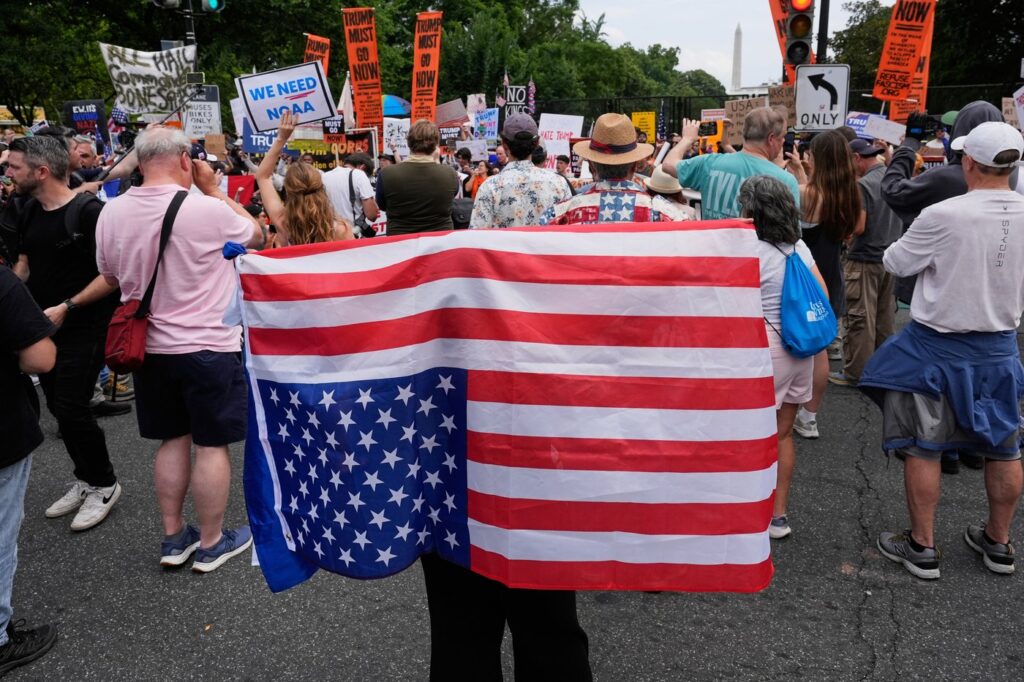
According to a recent poll conducted by the Associated Press-NORC Center for Public Affairs Research, Americans have reported a significant decline in their pride regarding the nation’s history and its democratic processes over the past decade. The survey, conducted in April, reveals a notable drop in pride concerning the U.S. military and its global political influence since 2017. This decline comes during a tumultuous period marked by conflicts, including a war involving the United States and Iran over the Strait of Hormuz.
Gallup polling has echoed these findings, indicating that only 53% of U.S. adults feel “extremely” or “very” proud to be American—the lowest percentage recorded since 2001. This sentiment points to a broader decline in patriotic feeling during a decade that encompassed significant events such as President Donald Trump's first term, the COVID-19 pandemic, and rising inflation which has influenced perceptions of President Joe Biden’s administration. Much of this decline in patriotic sentiment appears to stem from disillusionment among Democrats, who have become increasingly critical of the country’s trajectory since Trump's presidency.
Despite the declining pride in various aspects of American identity, many U.S. adults—regardless of their criticisms—maintain that being an American is “extremely” or “very” important to their identity. The AP-NORC poll indicates that pride in democratic processes has fallen from 42% in February 2017 to just 28% currently. Similarly, pride in the armed forces has dropped by 19 percentage points in the same period, while pride in U.S. history has decreased by 14 percentage points. This decrease is primarily pronounced among Democrats and also to some extent among independents.
Karla Galdamez, a 48-year-old Democrat and former history teacher, expressed her concerns about the country’s trajectory under the Trump administration. While she does not feel pride in Trump, she acknowledges the progress the nation has made over its 250-year history, emphasizing the journey toward a more egalitarian society despite its ugly past. In stark contrast, the poll indicated that only 14% of Democrats and 28% of independents identify as “extremely” proud to be American, compared to 70% of Republicans who express similar sentiments.
Among Republicans, pride in the military remains particularly strong, with approximately 90% stating the armed forces make them “extremely” or “very” proud, in contrast with about 60% of the general U.S. adult population. Samantha Fulks, a 40-year-old Texas Republican from a military family, highlights her patriotic pride through visible representations of American symbolism in her household, even as she critiques the nation’s current military actions.
Matt Stafford, a 39-year-old centrist from Massachusetts, displays pride in American identity despite frustrations with the political dynamics in the country. He emphasizes the need for bipartisanship in addressing the issues that affect middle America, asserting that the current political climate pushes both major parties to extremes.
Interestingly, the importance of national identity varies significantly by age and race. The survey reveals that Republicans and older Americans place a greater emphasis on being American as a component of their identity compared to younger adults. While about three-quarters of Americans aged 60 and older express high importance regarding their national identity, only one-third of those under 30 feel the same way.
Moreover, the survey underscores distinct differences in the perception of identity among racial and ethnic groups. A striking 73% of Black Americans prioritize their race or ethnicity as “extremely” or “very” important to their self-view—surpassing the importance attributed to being American. Vincent Harris, a 60-year-old Black man from California, articulates that racial identity is paramount for him due to the societal treatment of Black men. In comparison, about half of Hispanic Americans and only 22% of white Americans say that race or ethnicity is highly significant to their identity.
While acknowledging the significant obstacles faced, Harris expresses pride in American freedoms, stating he would not choose to live in any other country and appreciates the liberties provided to all Americans. Overall, the AP-NORC poll encapsulates a complex landscape of emotions surrounding American identity, revealing both pride and criticism as key themes across various demographics and political affiliations.








