

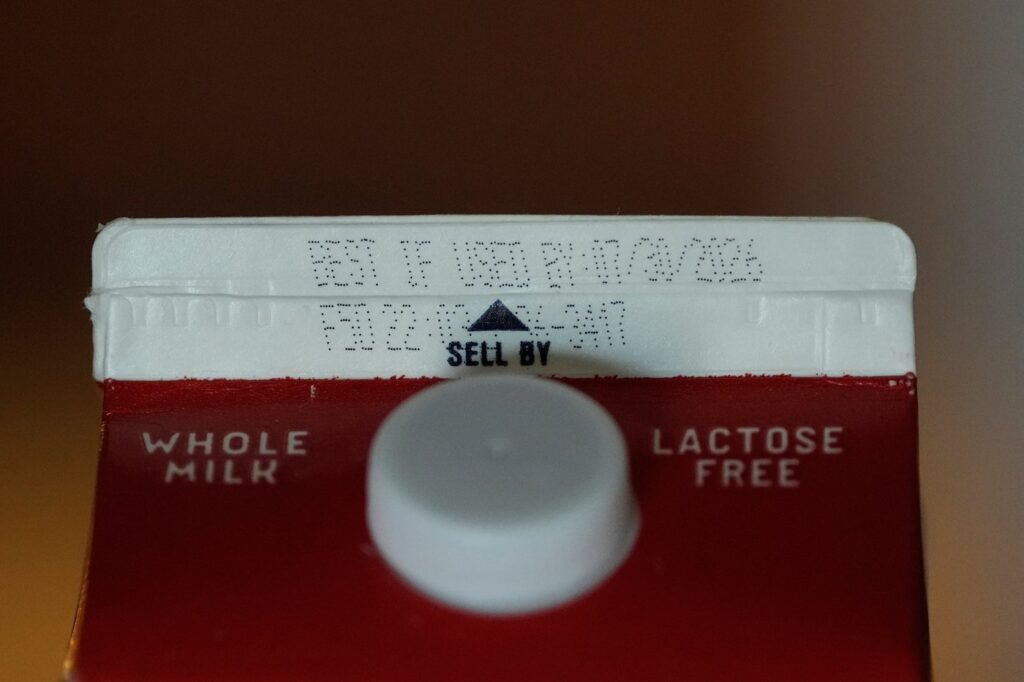
SAN FRANCISCO (AP) – In Kimberley Kausen's home in Irvine, California, the meaning of a "sell by" date on milk varies among family members. For her daughter, it signifies that the jug is destined for the trash, while her husband believes the milk remains good for a few additional days. Kausen, a chef and cooking teacher, uses her sense of smell to determine the milk's usability, especially when it involves meat and poultry, where she is more cautious.
The uncertainty surrounding food labeling is a concern shared by households throughout California and the larger U.S., where ambiguous phrases on food packaging often leave consumers unsure whether items are still safe to eat or merely past their peak quality. In an effort to reduce this confusion—and the food waste it generates—a new food labeling law in California commenced on Wednesday.
This legislation prohibits the use of "sell by" labels, which experts indicate primarily serve as an inventory guideline for retailers rather than a safety indicator for consumers. Instead, food manufacturers in California are now required to adopt two standardized labels: "Best if Used By," which denotes peak quality, and "Use By," indicating product safety. Food manufacturers have the option to use either label or both on their products.
With the approval of this law in 2024, California became the first state in the U.S. to establish standardized food labels aimed at reducing food waste and mitigating climate change impacts. New York has recently passed a similar law awaiting Governor Kathy Hochul's signature, while other states, including Illinois, Maryland, Massachusetts, New Jersey, and South Carolina, have proposed similar legislation that has not yet been enacted.
Nick Lapis, director of advocacy at Californians Against Waste, co-sponsored the bill and noted that food labeling confusion is the leading cause of household food waste. "Sell by" dates pose significant issues for food banks as many mistakenly interpret those dates as indicators of food expiration. Lapis emphasized that resolving this issue does not require extensive infrastructure or financial investments; rather, it simply necessitates uniform terminology across brands.
A 2022 report from the University of Maryland found that there are over 50 different date labels used on packaged food in stores. The information provided by these labels is largely unregulated and often unrelated to food safety. Kumar Chandran, policy director at ReFED, highlighted this consumer confusion, suggesting that individuals tend to reflexively interpret any date on a package as a cue to discard the item.
The recent advances in food labeling laws in California and New York are fueling the push for a national standard. A bipartisan bill is currently pending in Congress that seeks to establish uniform food labeling across the U.S. The U.S. Department of Agriculture has recommended the adoption of "Best if Used By" labels over a decade ago, yet as of now, the only federally regulated date labels concern infant formula.
Without federal regulations dictating what must be included on food labels, these stamps have led to significant consumer confusion, contributing to almost 20% of the nation's food waste, according to the Food and Drug Administration. In California alone, about 6 million tons of food that is still safe to eat is discarded each year.
Nate Rose, a spokesperson for the California Grocers Association, acknowledged that some grocery stores have had to revamp their labeling systems, though the association as a whole has been supportive of the new regulations. He stated that the new labels represent a "win-win" situation, aiming to reduce food waste while simplifying consumer decision-making. However, shoppers can expect to encounter old labels in stores for some time as grocers work through their existing inventory.








