

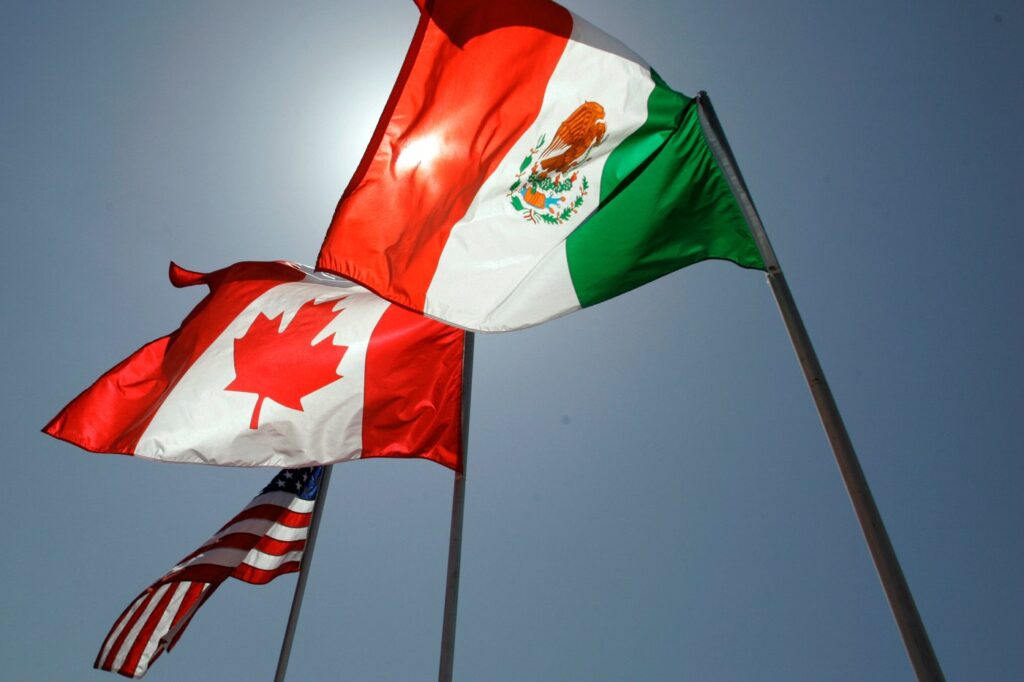
Tourists from Chattanooga are checking into beach resorts in Cancun, while Canadian auto parts feed factories in the American Midwest and vice versa. Revelers in Seattle raise glasses of Mexican tequila and mezcal at bars. This daily interaction between the United States, Canada, and Mexico adds up to an impressive $1.9 trillion annually in trade, equivalent to $5 billion per day. As a result, these countries have replaced China as America’s top two trading partners.
The stakes are high when considering changes to the rules governing trade between these nations. After a year of President Donald Trump's chaotic tariff policies, businesses in the U.S., Canada, and Mexico are eager for stability. However, renewal of the U.S.-Mexico-Canada Agreement (USMCA) is fraught with challenges as it comes up for renewal on July 1, a process expected to last months, if not longer.
The renewal process is rife with potential pitfalls. The U.S. is demanding changes that could compel Canada and Mexico to shift some auto manufacturing to the U.S., creating more jobs domestically but disrupting existing supply chains and driving up new car prices, which currently average nearly $50,000. Trump has heightened tensions by threatening to withdraw from the agreement altogether.
In 2020, the USMCA succeeded the 1994 North American Free Trade Agreement (NAFTA), which eliminated many trade barriers between the three countries. Critics, including Trump, had decried NAFTA as a job killer, as it encouraged U.S. companies to shift production to low-wage Mexico. The USMCA retained elements of NAFTA while increasing wage requirements and ensuring more products originated in North America to prevent duty-free imports from China.
A unique aspect of the USMCA mandates that the agreement must be renewed every six years. Although July 1 is the deadline, nothing definitive is expected on that day. Negotiators might opt to extend the agreement as is for another 16 years, but this is considered unlikely. Instead, they are anticipated to continue discussions on potential improvements with an ultimate deadline of 2036 for a new agreement.
Any country involved in the USMCA can withdraw from the pact with six months’ notice, an option that Canada and Mexico feel Trump could seriously contemplate. In June, Trump expressed disinterest in renewing the trade agreement, stating, "We don’t need anything that they have." Observers note that he may not genuinely wish to abandon the treaty but instead use the uncertainty to exert pressure on Mexico regarding security and immigration matters.
As U.S.-Mexico discussions on the renewal continue, Canada is finding itself sidelined. Concerns have arisen that Mexico and the U.S. might reach an agreement on modifications to core treaty provisions without involving Canada, ultimately presenting Canada with a take-it-or-leave-it offer. Canadian Prime Minister Mark Carney emphasized the necessity of Congress's approval for any new agreements.
One significant U.S. demand is to bolster the regional production requirements further, particularly in the automotive sector. Currently, 75% of automotive products must be made in North America to qualify for duty-free treatment, a benchmark raised from 62.5% under NAFTA. The U.S. seeks to increase this threshold, along with introducing a requirement that 50% of cars sold in the U.S. be manufactured domestically, a stipulation strongly opposed by both Mexico and Canada.
Currently, only 20% of car imports from Mexico and Canada would meet the proposed 50% standard. Affected models, including the Ford Maverick compact pickup and Chevrolet's mid-size Equinox SUV, could see prices rise by 5% to 7% due to these changes.
Amid this uncertainty, many businesses are hoping for relief from Trump’s inconsistent tariff regime. Shawn Miller, co-founder of PKGD Group, which imports Mexican spirits, expressed the need for stability: “If the rules change, the rules change. But we’d really like to know what they’re going to be and we’d like them to stay that way for a while.” In contrast, small businesses like EazyHold face difficulties complying with USMCA standards due to their complex nature.
Kerry Mellin, founder of EazyHold, noted her challenges in meeting North American content qualifications due to the silicone she imports from Asia. She proposed that the rules could be relaxed to support small businesses, which often cannot shoulder the financial burden of ensuring all production meets stringent local sourcing standards.








