

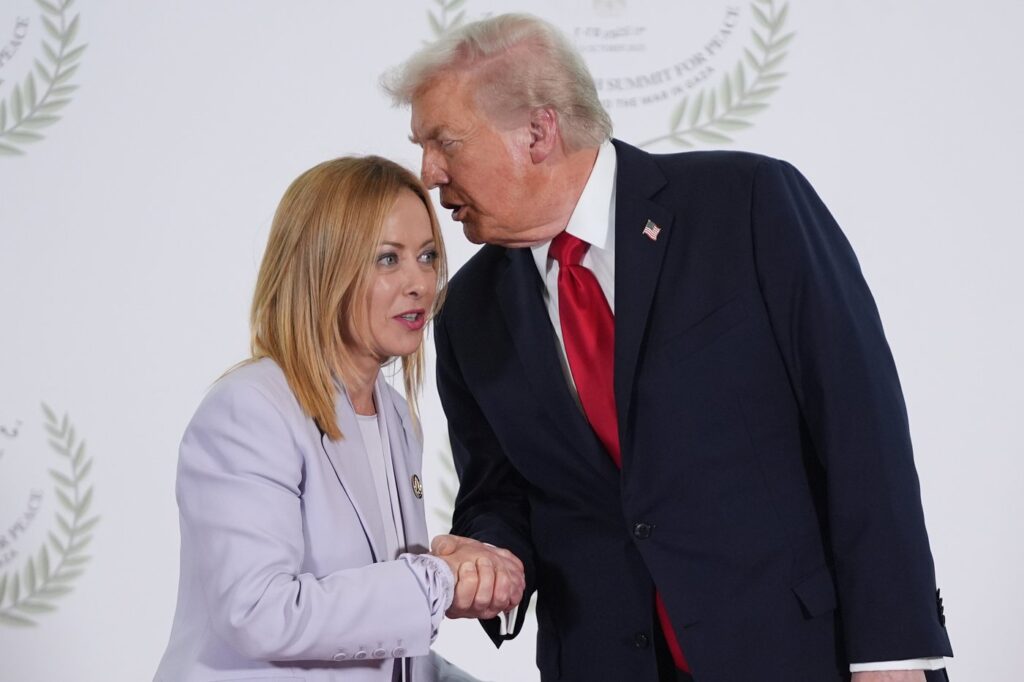
ROME (AP) — U.S. President Donald Trump's recent attacks on Italy's Prime Minister Giorgia Meloni have had an unexpected effect, leading to stronger support for her among European leaders. After questioning Italy's reliability as a wartime ally and alleging that Meloni had "groveled" for his attention, European officials, who had previously viewed the leader with skepticism due to her hard-right political background, united behind her. This dynamic illustrates how Trump's divisive style is inadvertently fostering greater cohesion among European nations.
As Europe faces ongoing challenges, including wars in Ukraine and Iran, a rising trade deficit with China, and threats from Russia, leaders are increasingly finding common ground on defense, tariffs, and foreign policy. Analysts suggest that Trump's strategy of negotiating with individual European countries has become less viable, as European leaders recognize they must act collectively to maintain their global standing. Sudha David-Wilp, vice president at the German Marshall Fund, notes, "Most of the mainstream leaders realize that Europe is getting squeezed between China and America, and so, if not now, then when?"
This emerging unity among European leaders was evident at a NATO summit scheduled for the following week in Turkey. Meloni's disputes with Trump have significantly bolstered her relationships with previously cautious European counterparts. A pivotal moment occurred in March when she refused to grant permission for U.S. bombers en route to the Middle East to utilize a base in Sicily without parliamentary approval. Historically, nations like France and Germany had excluded her from critical discussions regarding major foreign policy crises, particularly related to the ongoing Russian war on Ukraine, where she previously rejected proposals for European troop deployments.
However, escalating criticisms from Trump—who Meloni deemed "unacceptable" in his criticisms of Pope Leo—prompted a shift in this perception. As leaders across Europe have similarly borne the brunt of Trump's criticisms, they have coalesced around Meloni. For instance, she participated in a late June meeting in Berlin with the heads of Germany, France, Britain, and Poland, followed by a bilateral summit with French President Emmanuel Macron, marking significant diplomatic outreach.
Meanwhile, nationalist parties across the continent that once aligned with Trump are reevaluating their positions. Far-right leader Jordan Bardella from France criticized U.S. actions as "foreign interference" and described Trump as "erratic." Similarly, the far-right Alternative for Germany party has expressed disappointment in Trump’s military campaign against Iran, highlighting a trend among European nationalists distancing themselves from his foreign policy.
As elections approach across Europe, many political figures are beginning to prioritize domestic issues over international alignments, which could alter the political landscape. Lorenzo Castellani, a political analyst, observes that this shift is prompting leaders to focus more on European consolidation rather than external desires. This sentiment is also evident beyond the European Union, with issues like Trump’s comments about Greenland prompting protests in Denmark and resulting political ramifications in places like Hungary, where Prime Minister Viktor Orbán lost power despite Trump’s backing.
Although Meloni fundamentally aligns with Trump on matters such as immigration and security, her support for Ukraine has positioned her more firmly with European allies, thus strengthening a united front towards the U.S. In a recent response to Trump's suggestion that she had "begged" for a photo together at a G7 summit, Meloni remarked on social media that her association with Trump hadn't improved her political standing, with feelings toward Trump trending negative in Italy. A Pew Research Center survey revealed that 83% of Italians lack confidence in Trump’s foreign policy.
As looming national elections approach, possibly by 2027 and certainly by next spring, Meloni faces mounting political pressures from the Iranian war and her past ties with Trump. Voters across Europe might scrutinize their leaders for the unfavorable consequences of an American president's decisions, underscoring the complex interdependence of global politics.








