

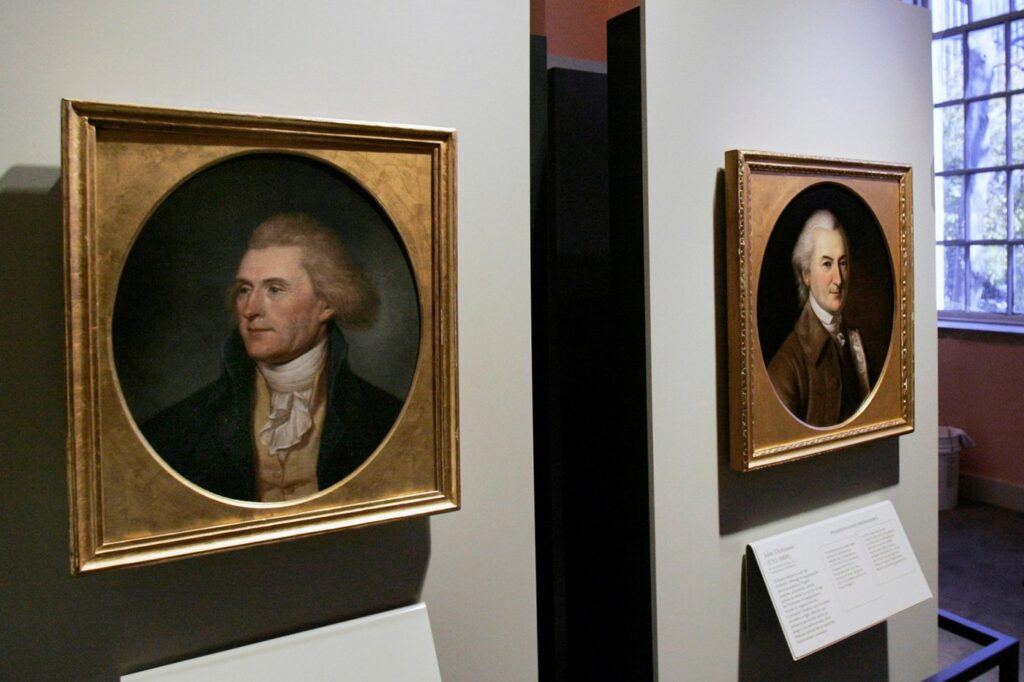
For 25 years, Jane Calvert has dedicated her academic career to reviving the legacy of John Dickinson, a Revolutionary War figure commonly remembered as the man who refused to sign the Declaration of Independence. A former associate professor at the University of Kentucky, Calvert has made it her mission to shed light on Dickinson's significant contributions and to challenge the misconceptions surrounding his character.
As the United States approaches the 250th anniversary of its independence, Calvert emphasizes that this milestone should not only celebrate the nation’s birth but also confront the misconceptions about a man who has often been overlooked or disparaged. Once hailed as a crucial founding figure, Dickinson was known for his articulate writings and advocacy against British taxation in the 1760s through his influential “Letters from a Farmer in Pennsylvania.” He also penned one of America’s first patriotic songs, “The Liberty Song,” earning him the moniker “the Penman of the Revolution.”
Despite his early contributions, Dickinson’s perspective on independence set him apart from many of his contemporaries. He advocated for peace with Britain, evident in his association with the Olive Branch Petition in July 1775, which sought reconciliation but was ultimately ignored by King George III. When the Continental Congress voted for independence in July 1776, Dickinson chose to abstain, believing that America was not yet prepared for the tumult and challenges that declaring independence would entail. According to Calvert, Dickinson’s chief concern was the legal protections for vulnerable groups, particularly religious dissenters like the Quakers in Pennsylvania.
Dickinson’s legacy has suffered from historical misrepresentation. At the National Constitution Center in Philadelphia, his statue is isolated, and popular cultural narratives often overlook his contributions. Figures like documentary filmmaker Ken Burns and “Hamilton” creator Lin-Manuel Miranda include him infrequently, sometimes portraying him negatively. For instance, the musical “1776” depicts him as a dismissive Anglophile, while HBO’s miniseries on John Adams frames him as a compromising antagonist to Adams’ passionate fervor.
Calvert argues this representation is misleading. Dickinson was a charismatic leader and a devoted patriot who continued to serve after independence as a member of the Pennsylvania and Delaware militias. He contributed to drafting the Articles of Confederation and supported the U.S. Constitution, serving as a delegate from Delaware and later as president of both Delaware and Pennsylvania. When he died in 1808, President Thomas Jefferson referred to him as “one of the great worthies of the revolution,” underscoring his importance in the founding of the nation.
While some historians, like Joseph Ellis and Jack Rakove, credit Dickinson for his early leadership, they suggest he hesitated to take decisive action, relegating him to a secondary status among the founding fathers. Despite this, Calvert believes Dickinson deserves recognition alongside eminent figures such as John Adams and Thomas Jefferson. Others in the historical community, like Thomas Donnelly, acknowledge Calvert's efforts to broaden understanding of Dickinson's role.
Calvert cites historical narratives used by historians like George Bancroft that have contributed to Dickinson’s diminished stature, criticizing him for allegedly softening public resistance against British rule. Yet, Calvert remains steadfast in her defense of Dickinson, finding support among varied advocates, including the late conservative commentator William Murchison and Dickinson Project editors like Ian Iverson and Nathan R. Kozuskanich.
Interestingly, Calvert points to a 2003 episode of “South Park” as one of the few pop culture representations of Dickinson that casts him as a principled character. In that episode, Cartman time travels to 1776 and observes the debate around independence, drawing parallels to contemporary issues. Calvert interprets this portrayal as highlighting Dickinson's anti-war sentiment, suggesting he might have questioned the justification for the Revolution, thus resonating with modern anti-war perspectives.
This ongoing reevaluation of John Dickinson’s contributions and character reveals the complexity of historical narratives and the need for a more inclusive understanding of the founding fathers of the United States.








