

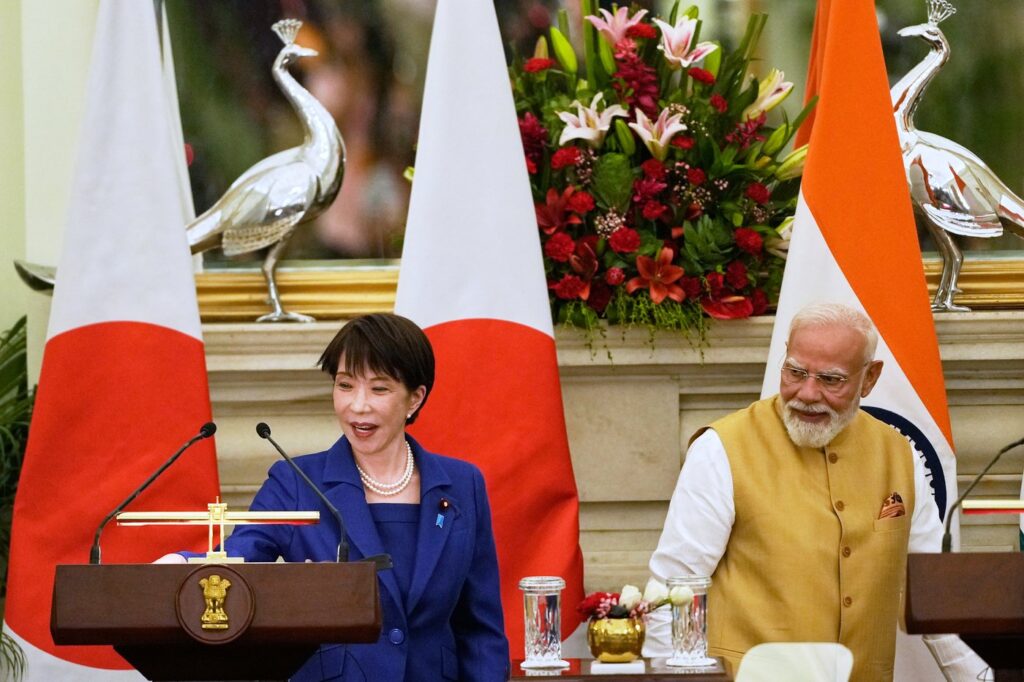
NEW DELHI (AP) — In a significant diplomatic move, Japan and India have initiated a series of agreements geared towards enhancing cooperation in defense, economic vitality, and maritime security. This announcement came following bilateral talks on Thursday between Indian Prime Minister Narendra Modi and Japanese Prime Minister Sanae Takaichi in New Delhi.
During the post-meeting address, Modi emphasized the commitment both nations share towards collaboration in various sectors, including naval radio antenna systems, artificial intelligence, shipbuilding, biogas, semiconductors, and critical technology. He highlighted that India and Japan perceive economic security as a mutual security interest, signifying a deeper partnership between the two nations.
Japan stands as one of India's largest foreign investors and has heavily invested in major infrastructure schemes, such as the Mumbai-Ahmedabad high-speed rail project. The collaboration is further underscored by the presence of around 1,400 Japanese companies operating in India, with nearly half engaged in manufacturing.
According to recent data from the Indian government, two-way trade between India and Japan soared to $27.5 billion in India's fiscal year 2025-26. Furthermore, Japanese investment in India amounted to $3.2 billion from April to December 2025, showcasing the growing economic ties between the two nations.
Prime Minister Takaichi is in New Delhi for a three-day visit, marking the 16th annual India-Japan summit. The summit signifies both countries' commitment to strengthen their partnership in the Indo-Pacific region, which has gained momentum following Modi's trip to Tokyo last year. During that visit, Japan pledged to more than double its investment in India to over $61 billion in the next decade.
Both India and Japan are also part of the Quad, a strategic alliance that includes the United States and Australia, aimed at promoting cooperation on regional security, maritime issues, and defense, particularly in countering China's increasing influence across the Indo-Pacific.
Takaichi reiterated New Delhi and Tokyo's shared dedication to Japan's initiative for a free and open Indo-Pacific, which emphasizes freedom of navigation and adherence to international law. She remarked that the enhancement of maritime security cooperation is crucial for achieving regional peace and stability.
In response to the initiatives discussed in the summit, China reacted through its Foreign Ministry spokesperson Guo Jiakun, who criticized the notion of "freedom and openness" proposed by some nations while accusing them of pursuing "confrontation and division." Guo asserted that this dual approach is contrary to the region's aspiration for peace, prosperity, and collaboration.
Guo emphasized the necessity of stability in the Asia-Pacific region, stressing the importance of cooperation over division. The ongoing dialogue and agreements between India and Japan reflect a pivotal step in fostering an environment conducive to mutual growth and security amidst the current geopolitical landscape.
Associated Press writer Ken Moritsugu contributed to this report.
By Sheikh Saaliq, The Associated Press








