

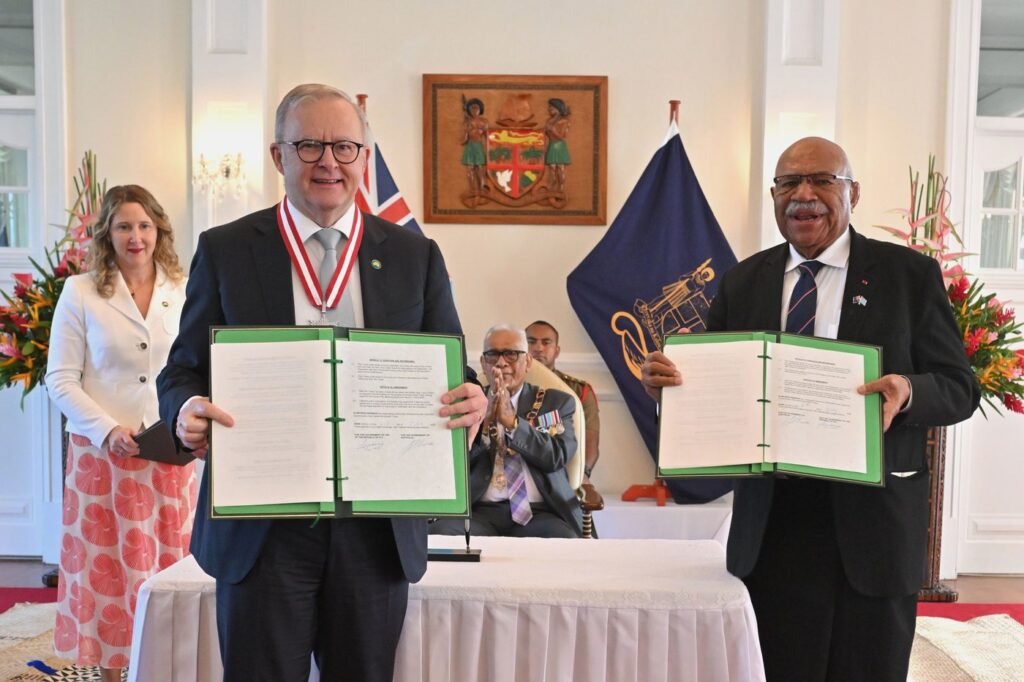
MELBOURNE, Australia (AP) — Australia and Fiji have entered into a new bilateral defense alliance as of Monday, marking a significant diplomatic achievement for Australian Prime Minister Anthony Albanese and countering Chinese influence in the South Pacific. The agreement, known as the Ocean of Peace Alliance, was signed in Fiji’s capital, Suva, by Albanese and his Fijian counterpart, Sitiveni Rabuka. Along with the defense pact, both nations also finalized an economic treaty named the Vuvale Union, under which Australia plans to invest over 1 billion Australian dollars (approximately $693 million) in Fiji over the next decade.
This move represents Fiji's first mutual defense treaty, while it is Australia's fourth, following a treaty with the United States and New Zealand established in 1951, and a bilateral treaty signed with Papua New Guinea last year. Albanese emphasized the significance of the alliance by stating, "The Ocean of Peace Alliance introduces a mutual defense obligation and there’s no higher obligation than to come to each other’s aid at a time of need." He affirmed Australia's commitment to regional security, emphasizing the importance of collaboration during periods of global uncertainty.
Fijian Prime Minister Rabuka expressed his expectation that China would not react negatively to the newly established treaties. He stated, "I do not expect China to have any severe pushback on either government. And I believe that they will welcome the understanding that is between Australia and Fiji. It does not threaten Fiji’s relationship with China nor Australia’s relationship with China." According to Rabuka, the bilateral agreements are focused on three key pillars: deeper security cooperation, enhanced economic integration, and strengthened connections between people.
Australia has been actively working to solidify its role as the preferred security partner in the region, particularly since the secretive security treaty that China signed with the Solomon Islands in 2022, which raised fears regarding the establishment of a Chinese naval base in the South Pacific. Albanese will be visiting the Solomon Islands on Tuesday to discuss a potential security pact with his counterpart, Matthew Wale, following Wale's recent visit to Australia where he mentioned a review of the existing deal with Beijing.
On Wednesday, Albanese is set to host Papua New Guinea Prime Minister James Marape and Tongan Prime Minister Fatafehi Fakafunu'a in Brisbane. The defense treaty with Papua New Guinea, which is Australia's nearest neighbor, will become effective on the same day. Additionally, Australia and Vanuatu signed a long-awaited bilateral security and economic treaty last week aimed at preventing China from establishing a military base in Vanuatu. This agreement, known as the Nakamal Agreement, was finally signed after the Vanuatuan government rejected an earlier draft due to concerns about limiting its ability to attract infrastructure investment.
China expressed apprehension last week regarding the Nakamal Agreement, suggesting that it may be directed against Beijing. As these developments unfold, the geopolitical dynamics in the South Pacific continue to evolve, with regional nations navigating their relations with both Australia and China amidst increasing global tensions.








