

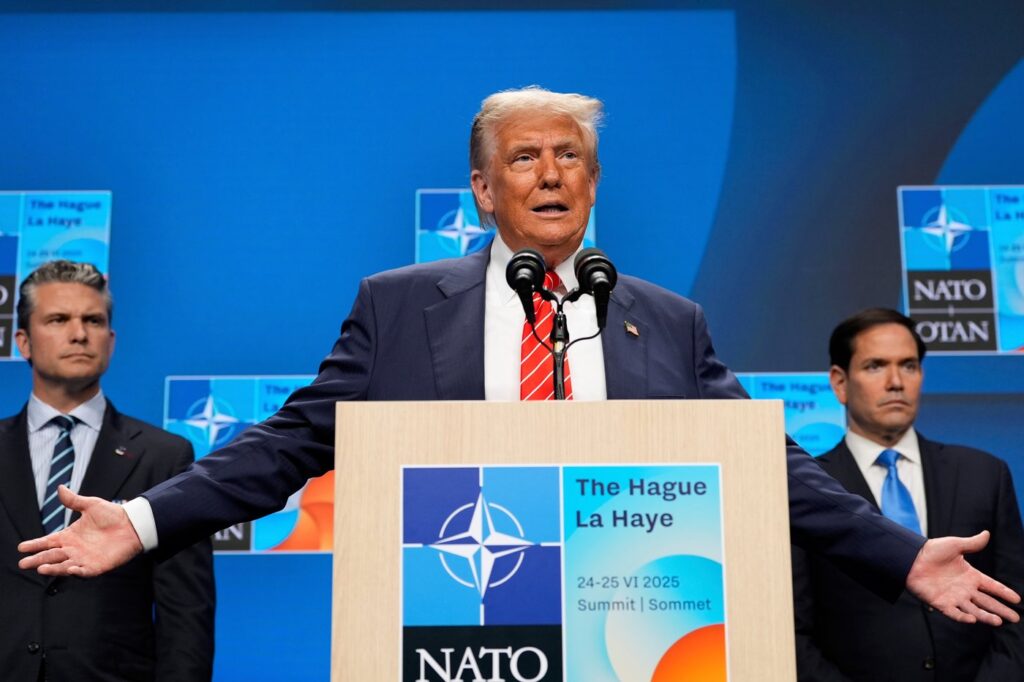
At last year’s NATO summit, President Donald Trump achieved a key objective: convincing NATO members to increase their defense spending. This week, he is set to meet with leaders in Turkey to reinforce those commitments, aiming to ensure that alliance members adhere to the pledge to spend 5% of their annual Gross Domestic Product (GDP) on defense over the next decade.
The quick response from NATO countries to Trump's request highlights his significant influence over the alliance. U.S. Ambassador to NATO, Matt Whitaker, emphasized that Trump expects all allies to immediately align with the 5% spending target with urgency. Despite ongoing tensions between the U.S. and NATO members over various issues—including the situation in Iran and Trump's controversial suggestions regarding Greenland—the president’s administration views this week’s gathering as an opportunity for accountability following previous commitments.
Luke Coffey, a senior fellow at the Hudson Institute, referred to the Ankara meeting as the "first report card" on NATO countries' progress since the last summit in The Hague. He noted that a demonstration of commitment and a reasonable plan from NATO leaders could allow Trump to claim a victory. Additionally, Trump is expected to focus on the ongoing Ukraine-Russia conflict, with a meeting scheduled on Wednesday with Ukrainian President Volodymyr Zelenskyy.
Trump’s diplomatic engagements will also include a meeting with Turkish President Recep Tayyip Erdogan. However, he has no planned bilateral meetings with other leaders, raising concerns about his relationships with allies. Recently, he revived feuds with leaders such as British Prime Minister Keir Starmer and Italian Prime Minister Giorgia Meloni, making comments that have sparked controversy and denials from the respective leaders.
A bipartisan group of U.S. senators is heading to the summit to underscore the importance of NATO and counterbalance Trump's often skeptical stance toward the alliance. Senator Jeanne Shaheen highlighted the necessity of nurturing relationships with allies, emphasizing that they are crucial to U.S. national security and economic success.
Trump's administration is advocating for an initiative dubbed "NATO 3.0," which envisions a shift toward Europe assuming greater responsibility for its own security. This strategy was outlined by U.S. Undersecretary of Defense Elbridge Colby. In a recent speech, Defense Secretary Pete Hegseth announced a review of U.S. military forces in Europe, causing surprise among allies who anticipated coordination with the Trump administration during the transition period.
The commitment by NATO members to increase their defense spending is visible, but many experts assert that significant portions of Europe remain reliant on U.S. support for defense against potential aggressors. The foundational principle of NATO—that an attack on one member is an attack on all—means that many European nations are still far from being able to defend themselves independently.
In response to Trump's demands, NATO has also made adjustments to accommodate his leadership style. Earlier in the year, the alliance launched "Arctic Sentry," a military exercise aimed at countering Russian and Chinese maneuvers in the Arctic, further addressing Trump's desire for strategic security in the region.








