

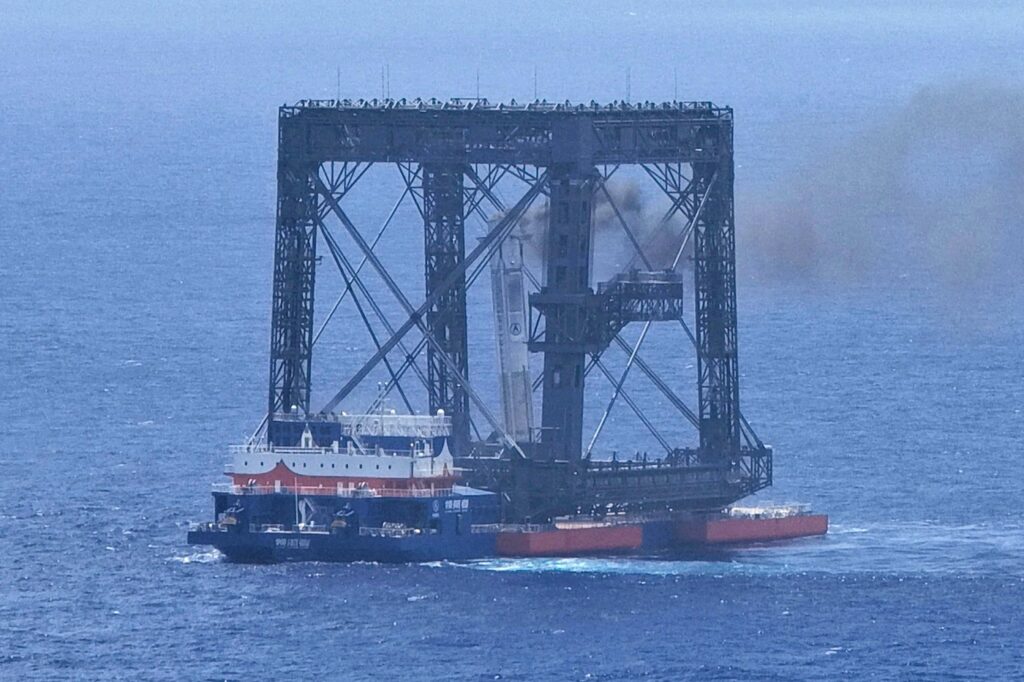
BEIJING (AP) — On Friday, China celebrated a significant achievement in its space program by successfully recapturing the first stage of the Long March-10B rocket after its launch. This milestone was reported by state media, highlighting China’s growing capabilities in space exploration.
The Long March-10B rocket, launched from Hainan Island, one of China’s well-known beach destinations located on the southern coast, has marked a new chapter in the country's endeavors in space technology. The rocket's first stage successfully separated from its second stage and made a controlled return to a designated platform in the sea, as detailed by the official Xinhua News Agency.
This event marks the first time that China has achieved the recovery of a rocket's first stage, mimicking a practice that has been successfully implemented by America’s SpaceX for several years. SpaceX’s reusability approach has significantly lowered launch costs by allowing the booster to be used multiple times. This technological advance underscores the competitive nature of the global space industry and showcases the strides that China is making in this domain.
The Long March-10B is designed for reusability and can carry a payload of up to 16,000 kilograms (approximately 35,275 pounds) into low Earth orbit, according to Xinhua News. By comparison, the SpaceX Falcon 9 rocket has a maximum payload capacity of 22,800 kilograms (around 50,265 pounds). Falcon 9 rockets play a vital role in transporting astronauts and supplies to the International Space Station, demonstrating the diverse applications of these advanced space vehicles.
The success of the Long March-10B not only represents a technological advancement but also propels China further into the global space race. By innovating on rocket reusability, China aims to enhance its capabilities in satellite deployment and manned space missions, presenting a more competitive stance against established players like SpaceX.
As the world watches closely, China's continued progress in rocket technology could have far-reaching implications for international cooperation and competition in space exploration. The nation’s ambition to establish itself as a leader in space endeavors is evident, with plans for future missions and technological developments that could reshape the landscape of space travel and exploration.








