

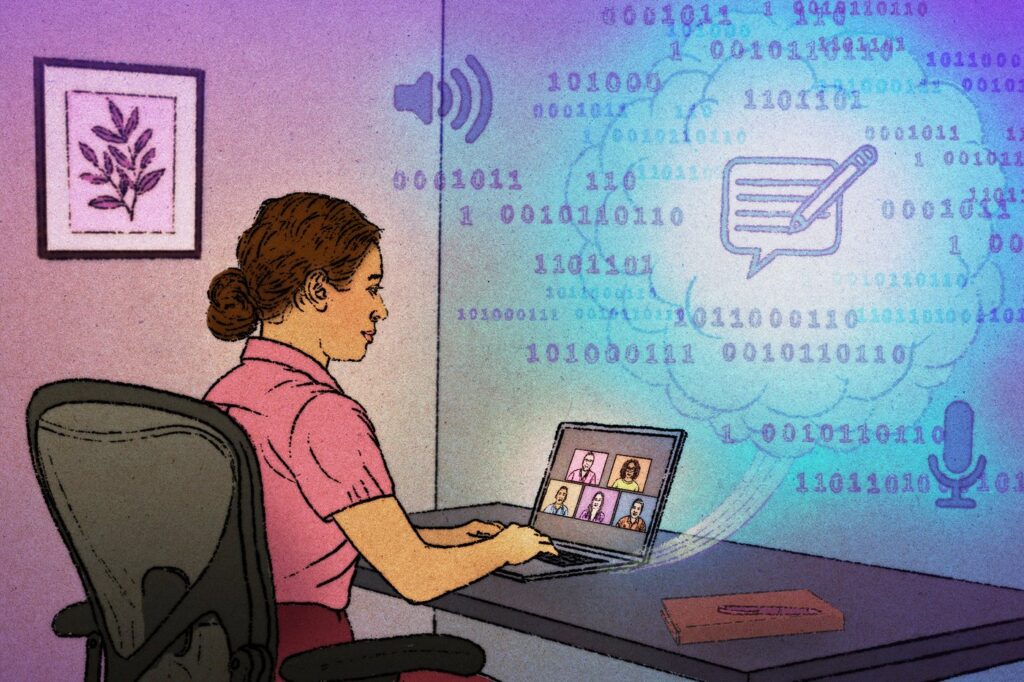
NEW YORK (AP) – The allure of launching an artificial intelligence (AI) tool for noting and summarizing critical information from virtual meetings is undeniable. Within moments of attending an hour-long video conference, these AI notetakers can provide a recap of key points and a to-do list for participants. However, the methodology employed by these popular AI notetakers compels some individuals to refrain from their use due to significant privacy concerns.
Amy Dufrane, the CEO of human resources training and certification provider HRCI, emphasizes that "there are huge risks to the organization on AI notetakers," stating that she believes companies should avoid using them altogether. AI notetakers are software applications or devices employing artificial intelligence, speech recognition, and large language models to record, transcribe, and summarize conversations. While the intent is to save time and enhance participation, apprehensions loom large among professionals across various fields.
A major concern is the uncertainty surrounding data storage and retention duration. Privacy advocates worry that the companies behind these AI notetakers may create voiceprints without obtaining consent. Voiceprints, akin to biometric profiles such as fingerprints, can be exploited to access confidential information, including bank account details. Moreover, certain tech companies may resell data collected through these notetaking tools or utilize confidential meeting transcripts for training their AI models.
Legal risks also emerge, as conversations between an attorney and a client might be improperly exposed during legal proceedings. A recent ruling by a New York federal judge highlighted this issue when a criminal defendant was instructed to provide materials shared with a third party, which included communications recorded by Anthropic’s AI model, Claude. Justin Daniels, a corporate attorney with Baker Donelson, adds that users of AI notetakers may often be unaware of where their data might go, leaving legal protections of sensitive discussions potentially compromised.
As professionals navigate the use of AI notetakers, it’s vital to develop etiquette for addressing their presence during meetings and to understand the associated risks. A key first step is to check for AI notetakers when joining a meeting. They might appear as participants or through a pop-up message indicating that the meeting is being recorded. While platforms like Zoom and Google Meet inform users when a meeting is being recorded, not all software does, which could lead to individuals unknowingly participating in recorded conversations.
Thorin Klosowski, a senior security and privacy analyst at the Electronic Frontier Foundation, advises participants to inquire about the presence of AI notetakers and to emphasize that a meeting is not authorized for recording, stating, "Our company policy is that this meeting cannot be recorded," can be a polite approach. Additionally, conducting part of the meeting with the notetaker active while turning it off for sensitive discussions can mitigate risks.
Protection of privacy rights regarding voiceprints is crucial. Chris Pluymers, an associate attorney at The Dillon Law Group, points out that voiceprints can distinguish individual speakers, which poses identity theft risks if they fall into the wrong hands. Some states have laws regarding the creation and storage of voiceprints. In Illinois, they are classified as biometric identifiers, governed by the Biometric Information Privacy Act, which necessitates written consent before an AI notetaker collects voiceprints.
Employees in Illinois can therefore refuse to participate in meetings with AI notetakers until they receive assurances about data storage, usage, and deletion protocols. In the event that an AI notetaker unexpectedly appears in a meeting, participants can express a preference for maintaining privacy by stating, "I prefer we keep this meeting without AI recording or transcript tools." Klosowski highlights the importance of being warm and genuine while asserting privacy wishes.
Furthermore, when utilizing AI notetaking applications, it’s essential to know the data policies of the companies behind them. Transparency regarding the retention of recordings, transcripts, or metadata is crucial. Danielle Kays, a partner at Fisher Phillips, suggests users familiarize themselves with the nature of speaker IDs and voice recognition technologies employed by these applications. Even if content is erased, metadata may remain stored, potentially exposing sensitive business information to unintended scrutiny or usage.
In conclusion, as AI notetakers gain prominence in virtual meetings, awareness and proactive measures regarding data privacy and voiceprint security must be prioritized to safeguard sensitive information and maintain the integrity of professional communications.








