

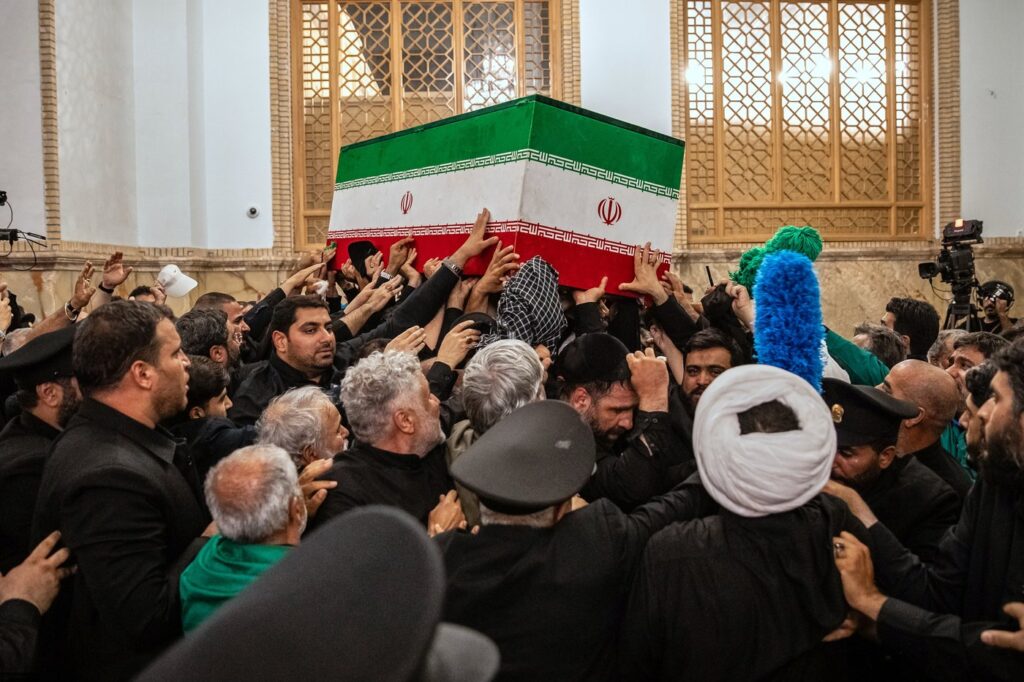
DUBAI, United Arab Emirates (AP) – Tensions in the Middle East escalated following the funeral of Supreme Leader Ayatollah Ali Khamenei, where open calls for the assassination of U.S. President Donald Trump emerged. This incident highlighted the instability in the region as an interim deal aimed at resolving the ongoing war appeared to be unraveling amidst repeated hostilities.
In a post shared on his Truth Social platform, President Trump issued a stern warning to Iran, stating that "1000 Missiles are Locked and Loaded and aimed at the Islamic Republic of Iran, with thousands of more to immediately follow, should the Iranian Government act on its threat." This threat came in response to concerns over Khamenei’s funeral, during which attendees openly displayed banners calling for Trump's assassination alongside that of Israeli Prime Minister Benjamin Netanyahu.
U.S. officials have demanded that Iran publicly declare the Strait of Hormuz, a crucial maritime passage, as open and safe for ships, asserting that Iranian attacks on vessels traversing the strait must cease. However, Iranian authorities have maintained their claim over the strait, declaring it under their control and insisting on their right to charge fees for passage, defining a stark departure from its longstanding status as an international waterway.
Recent days have seen multiple U.S. airstrikes targeting Iranian assets, which were met with Iranian retaliatory fire across the region. These hostilities escalated following attacks by Iran on three ships in the Strait of Hormuz, prompting a renewed cycle of military action. The conflict, which has reverberated beyond regional borders, threatens to destabilize global oil markets, especially with about a fifth of the world's oil and natural gas passing through this strategic route prior to the outbreak of hostilities.
Trump's remarks have been described by some as inflammatory, as he expressed intentions to "completely decimate and destroy all areas of Iran – PRAISE BE TO ALLAH!" His interjections have drawn criticism from various advocacy groups, highlighting concerns regarding his incendiary rhetoric surrounding Islam.
U.S. officials revealed that they believe a renegade faction within Iran's military is attempting to sabotage peace efforts with Washington, while Iranian leaders claim their government is unified under the new Supreme Leader, Ayatollah Mojtaba Khamenei. Amidst this backdrop, Trump is reportedly giving U.S. negotiators a tight timeline to secure a deal with Iran, but has also signaled that a spectrum of military options remains on the table should those talks fail.
Iranian officials have resisted U.S. pressures, with Tehran's diplomat at the United Nations asserting that operations within the Strait of Hormuz rest solely with Iran. This assertion comes at a time when tensions in the region have sparked fears of a broader conflict, with recent unidentified attacks hitting Iranian targets, speculated to be executed either by Gulf Arab states or other actors seeking to weaken Iran's position.
Meanwhile, Iranian Foreign Minister Abbas Araghchi has voiced concerns regarding U.S. violations of the interim deal, particularly regarding the cessation of waivers that allowed Iran to sell crude oil on the international market in U.S. dollars, a decision prompted by maritime attacks carried out by Iranian forces. Araghchi emphasized the necessity for "mutual compliance" in negotiations moving forward.
As diplomatic talks continue, U.S. officials have also confirmed that any agreement related to Iran's nuclear program will hinge on Tehran's commitment to relinquish its stockpile of highly enriched uranium, which remains a contentious issue. The U.S. is adamant that there can be no nuclear pact unless Iran halts its assaults on vessels in the Strait of Hormuz, a stipulation underscoring the deep distrust that currently characterizes U.S.-Iran relations.








