

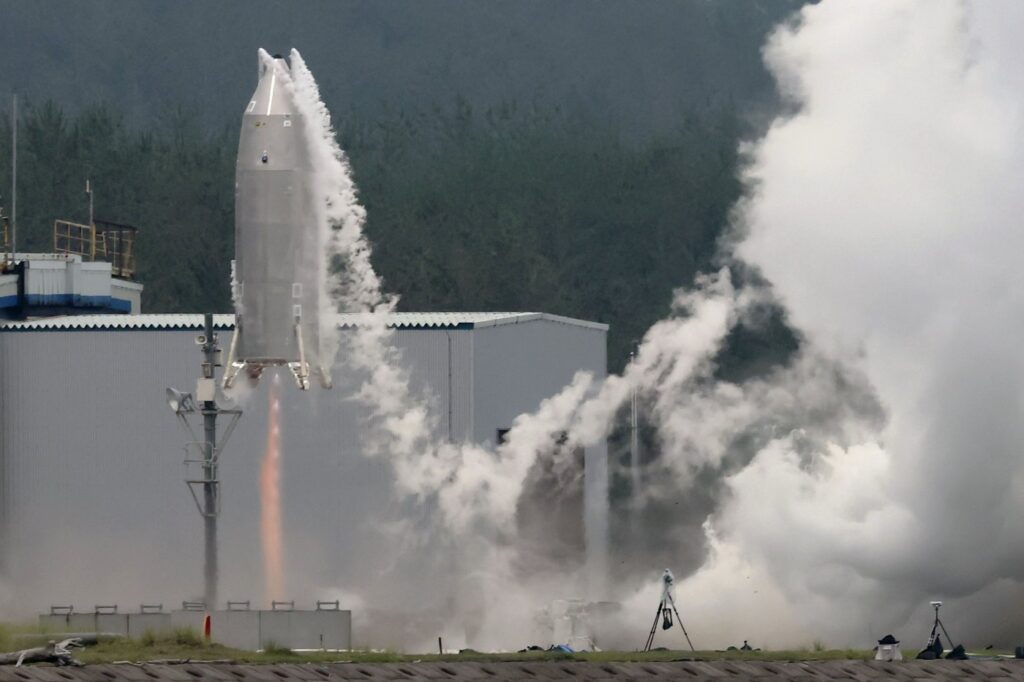
TOKYO (AP) — Japan's experimental reusable rocket, known as the RV-X, successfully executed its first test flight on Saturday, marking a significant milestone as the nation aims to enhance its technological capabilities to reduce launch costs. This initiative is crucial for Japan to compete in a global space market increasingly dominated by companies like SpaceX.
The RV-X was launched from the Japan Aerospace Exploration Agency's (JAXA) Noshiro Testing Center, located in northeastern Japan. During the under-one-minute flight, the rocket lifted to an altitude of 11 meters (36 feet), hovered for a moment, and then moved horizontally for 16 meters (52 feet) before landing safely. Takashi Ito, JAXA’s reusable rocket project manager, provided insights during an online briefing regarding the flight’s successful execution, highlighting its controlled movements and stable landing.
Japan's pursuit of reusable rocket technology is a strategic response to the advancements made by Elon Musk's SpaceX, which has successfully utilized this technology for several years. The successful test flight of the RV-X represents a step towards developing a more cost-effective alternative to Japan's existing H3 series rockets, which currently rely on single-use designs.
This innovative flight coincides with reports from China, where state media announced the country's first successful recovery of a rocket's first stage post-liftoff, further intensifying competition in the space sector. The H3 rocket, Japan’s key launch vehicle, is designed to improve cost efficiency compared to its predecessor, the H-2A series, which boasts a high success rate but requires further technological advancements to remain competitive globally.
The Japanese government emphasizes that having a reliable and commercially viable transport capability is vital for the nation's space program and overall national security. To this end, JAXA is collaborating with Mitsubishi Heavy Industries to develop the RV-X, which measures 1.8 meters (5.9 feet) in diameter and 7.3 meters (23.9 feet) in length. It features a robust engine designed for durability and four shock-absorption landing gears to facilitate successful landings.
Remarkably, the engine has undergone 165 combustion tests, demonstrating its operational integrity as outlined by Ito. Looking ahead, JAXA plans to conduct additional test flights, intending to elevate the RV-X to a target altitude of around 100 meters (218 feet), which would serve to further investigate the rocket’s capabilities and fine-tune its design.
Hello from JAXA seems exciting as they continue to push the boundaries of reusable rocket technology, collaborating also with international partners from France and Germany in a bid to strengthen their position in the evolving space exploration landscape.








