

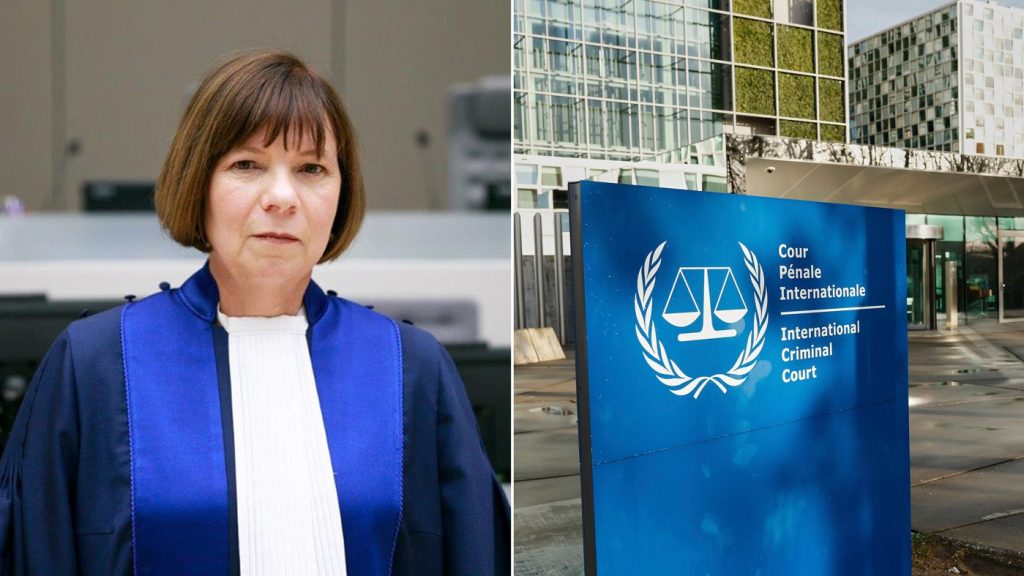
OTTAWA – The Canadian government has not confirmed whether it will intervene on behalf of Kimberly Prost, a Winnipeg-born judge of the International Criminal Court (ICC), who is seeking to reverse sanctions imposed by U.S. President Donald Trump. These sanctions have severely limited her financial and online activities, preventing her from using a credit card or accessing major vendors like Amazon.
Prost was sanctioned by Washington nearly a year ago due to her involvement in a case related to American troops in Afghanistan. This decision has not elicited a public criticism from Canada, in contrast to the stance taken by France. Sabine Nolke, a former senior Canadian diplomat with expertise in international law, noted, "We haven’t said anything about that." She emphasized that although Canada possesses strong human rights credentials, there is a need for the country to be more vocal in such matters.
In previous statements to The Canadian Press, Prost expressed that the sanctions have profoundly impacted her ability to travel and perform everyday tasks, such as purchasing tickets for theatre shows. She maintains that the sanctions are an attack on judicial independence, asserting that they will not deter efforts to deliver justice to victims of serious crimes.
Prost, alongside two fellow judges, has initiated a lawsuit against Trump and his administration, claiming that he exceeded his legal authority and failed to ensure due process in imposing the sanctions. The suit was filed in their personal capacity and is not affiliated with the ICC. James Goldston, the executive director of the Open Society Justice Initiative, which represents Prost, remarked that "Congress did not vest the president with authority to violate international law." He condemned the sanctions as arbitrary and an abuse of discretion.
Prost’s legal team argues that Trump has exceeded the emergency powers granted to him by Congress, and they point out that the U.S. has historically raised concerns about the ICC, suggesting that such concerns do not constitute an emergency justifying the application of the International Emergency Economic Powers Act. Goldston further argued that the judges are being penalized for improper reasons, aiming to coerce them into more favorable rulings for the administration in the future.
As of now, the U.S. government has not yet responded to the complaint submitted on June 24 to a district court in New York. Goldston indicated that his legal team applied for a preliminary injunction on July 2, which could temporarily suspend the sanctions while the lawsuit is in progress. They set deadlines for responses, with Washington required to reply by July 30 and Prost's team to respond again by August 20.
Nolke, who has previously acted as Canada’s ambassador at The Hague, described Prost as a friend and suggested that Canada should submit an amicus brief in support of Prost’s case. Canada has a history of similar interventions in past U.S. cases, including a 1992 dispute concerning an extradition treaty involving Mexico and an incident in 2005 that dealt with the abolition of the death penalty for young offenders, influenced partly by concerns for Omar Khadr, a Canadian citizen detained at Guantanamo Bay.
Global Affairs Canada has not disclosed whether it is contemplating support for Prost's legal fight. A spokeswoman, Thida Ith, reiterated that Canada remains a strong backer of the ICC and underscored the importance of protecting the independence of its judges, although added that further comments could not be provided while the matter is ongoing in court. Nolke voiced that at a minimum, Canada should express its support, as doing so would reinforce the rule of law and affirm its commitment to the ICC.
Goldston acknowledged that it is up to Canada to decide on filing an amicus brief and stressed that any participant providing relevant information or arguments regarding the case would be welcomed. The ongoing situation exemplifies the complexities surrounding international judicial independence and diplomatic interventions in the face of unilateral sanctions.








