

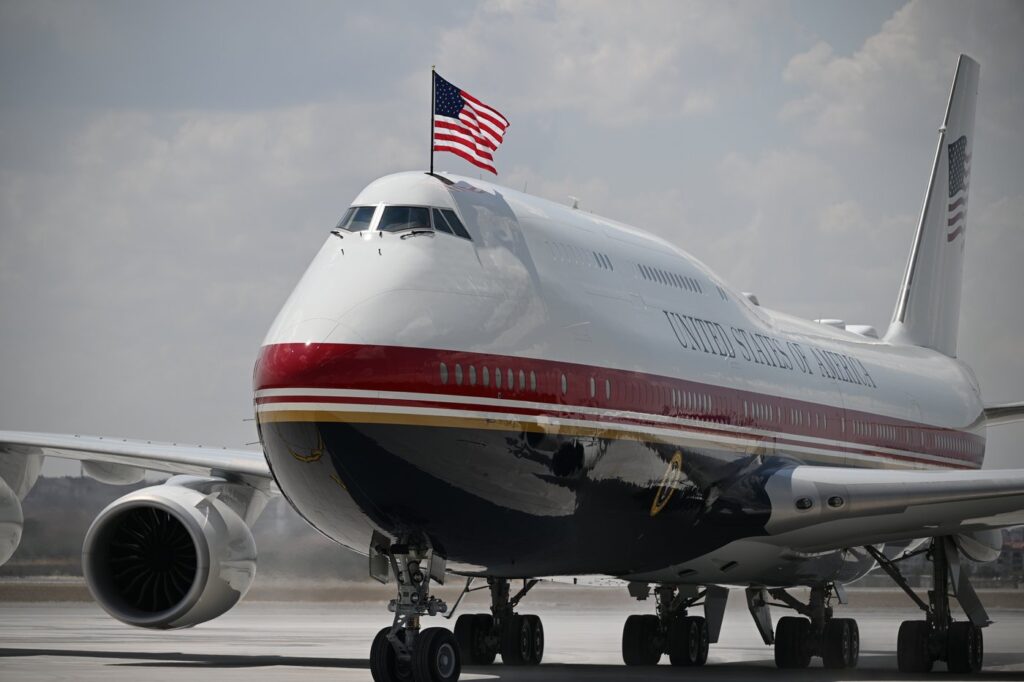
On Friday, the Trump administration issued subpoenas to several journalists from The New York Times in response to a report concerning security issues related to the new Air Force One. This report, which was published earlier that week, raised questions about the aircraft's safety features, particularly in light of heightened tensions with Iran.
The newly introduced jet, reportedly a gift from Qatar, commenced service just a week prior to the controversy. The subpoenas aim to compel the involved journalists to testify before a federal grand jury in Manhattan, with reports indicating that federal agents delivered some of these subpoenas to the reporters' homes directly.
The Times' report on the aircraft could not be independently verified, and there was no immediate comment from either the White House or the Department of Justice regarding the subpoenas. David McCraw, the newspaper's lawyer, articulated concerns over the implications of federal agents confronting journalists at their homes, emphasizing the need for press freedom as protected by the Constitution.
These developments occurred shortly after President Trump utilized the new Air Force One for a NATO summit in Turkey. However, he opted to fly an older model of the airplane for a separate trip to Mildenhall, a Royal Air Force base located in Suffolk, England. Both the new and the older jets flew to Mildenhall, with Trump switching to the newer model for his return trip to Joint Base Andrews.
This sudden change in aircraft took place amid an unstable cease-fire with Iran that had recently collapsed, leading to U.S. airstrikes on Iranian targets as well as Iranian attacks on three Gulf Arab states. The fact that the Qatari-gifted aircraft recently underwent a $400 million retrofit sparked speculation that it might lack critical security and countermeasure systems when compared to older models.
The New York Times reported that the aircraft switch was prompted by concerns raised by the Secret Service. According to subsequent reports, the newer plane did not possess some advanced security features found in older Air Force One models, such as anti-missile capabilities. Both reports relied on anonymous sources, highlighting potential vulnerabilities in the new aircraft.
In response to these security concerns, President Trump publicly dismissed any potential threats to the new aircraft during a flight, asserting that the visit to Mildenhall was intended to allow service members there to see the new jet. He also brushed aside questions about credible threats posed by Iran, asserting, "I have a threat all the time. I’m No. 1 on their list."
The White House later contested claims regarding security shortcomings, asserting that the new Air Force One is equipped with sophisticated security protocols designed to ensure the President's safety. Spokesman Steven Cheung emphasized that the administration employs various strategies to address threats, including "distraction and misdirection."
Journalists who received the subpoenas from The New York Times include Julian E. Barnes, Eric Lipton, Tyler Pager, and Eric Schmitt. Earlier in the year, the Justice Department had also issued subpoenas to reporters from The Washington Post and The Wall Street Journal, but those subpoenas were subsequently withdrawn.
The situation reflects the ongoing tensions between the media and the Trump administration, especially concerning the dissemination of information related to national security. As this story unfolds, it sheds light on the broader implications for press freedom and government accountability in an increasingly polarized political climate.








