

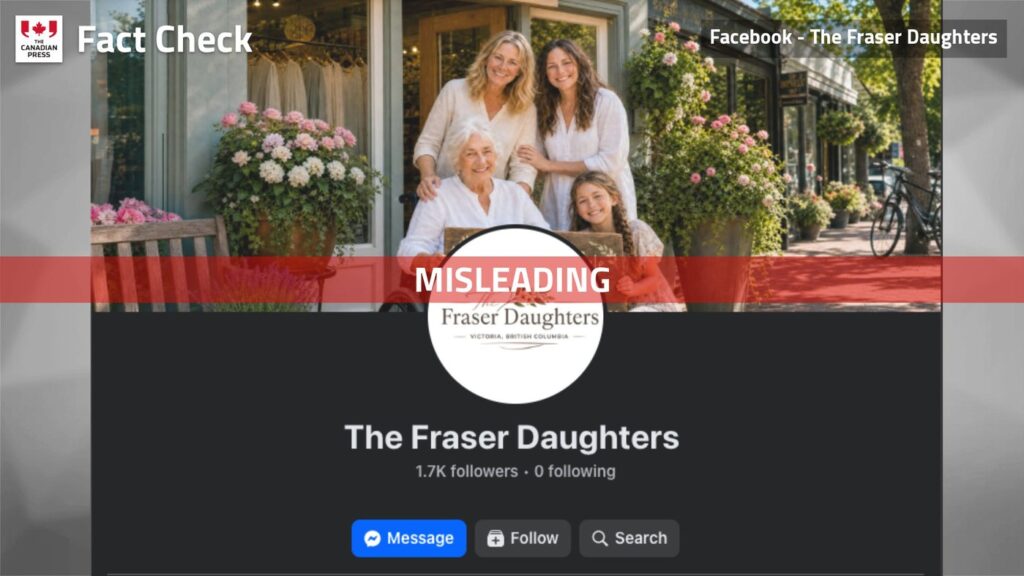
Multiple online retail businesses are presenting themselves as Canadian boutiques on platforms such as Facebook. However, many of these pages are not based in Canada, and the businesses claim locations that appear to be fictional. Reports from customers and local authorities indicate that these sites are deceiving shoppers into purchasing misleading products.
THE CLAIM
For Canadian consumers eager to shop locally, small boutiques present an attractive choice. On Facebook, numerous shops promote themselves as Canadian, complete with photos and videos to draw customers to their websites. Nevertheless, investigations reveal that many of these supposed Canadian boutiques have no genuine connection to the country.
The Canadian Press identified at least 21 Facebook pages that claimed to operate as Canadian boutiques in cities such as Vancouver, Ottawa, Toronto, and Calgary. Of these, Meta’s ad library indicated that seven were currently running advertisements. The pages’ follower counts varied, from a few dozen to approximately 17,000, and they were established between March 2025 and June 2026, with the majority created in the last few months.
Only two of these pages had administrators located in Canada; 18 were managed from the Netherlands, accompanied by one from both Germany and the Philippines. The shops also host websites, almost all of which concealed their domain registration details. Only one site revealed an administrator based in the Netherlands, who did not respond to inquiries. Most domain registrations occurred between March and June of this year.
Linking to websites that claimed to possess physical locations, these pages stated their operating hours but frequently omitted actual addresses or phone numbers. A simple Google search failed to uncover any physical presence in the claimed cities. Instances of listed addresses revealed inconsistencies. For example, the “Ivy Charlotte Boutique” purported to be located at 118 Queen St. W in Toronto, an address that does not exist. A call to the associated phone number, which had a B.C. area code, resulted in an error message, stating the call could not be completed.
The “Ottawa Grace” shop indicated it was located within the CF Rideau Centre shopping mall, yet it does not appear in the mall's official directory. Many of the websites showcased images that seem AI-generated, exhibiting an overly polished and unnatural aesthetic. The product descriptions are vague and frequently employ language indicative of artificial intelligence, such as the use of negative parallelisms.
For instance, a typical description from “Sophia & Claire Vancouver” reads: “Not because we were difficult. Because the options just weren’t there… Not because something went wrong. Because something went very right.” The logo for The Fraser Daughters closely resembles that of a similar shop, The Rowan Daughters, based in North Carolina, suggesting no genuine connection to the supposed Victoria establishment.
As of Tuesday, The Fraser Daughters website redirected to another boutique, “Rosie and Pearl,” based in Queensland, Australia. However, its terms of service still mentioned Canada Post, the Canadian dollar, and the laws of British Columbia. Other shops, like “The Harrington Sisters Ottawa” and “The Bennett Sisters Vancouver,” now redirect to “Luvora Wellington.”
Most of these stores utilize the Shopify platform, which offers some protection against chargeback issues for scam purchases. While many appear to offer legitimate products, some customers have reported receiving items that were not as advertised. One shopper recounted an experience with “Lara & Kate Boutique,” stating: “I just purchased a ‘quilted’ bag from a site called Lara & Kate boutique. It sounded really lovely and legit. It came, shipped from China, cheaply made with no labels inside. I tried a return and only got 30 percent of my purchase price back.”
None of the purportedly Canadian-based boutiques replied to inquiries made last week. The Canadian Federation of Independent Business, representing 103,000 small businesses across the nation, stated it was unaware of the sites impersonating Canadian retailers.
In August, police in Victoria issued a warning about local boutiques operating fake websites, noting that many promised products were never delivered. They advised shoppers to watch out for red flags, including newly created domains, a lack of physical addresses, and offers that appear too good to be true. Acting Sgt. Vlad Filatov emphasized that these scams are increasingly sophisticated and persuasive, preying on consumers' desire to support local businesses while creating a sense of urgency that pressures victims into hasty decisions.








