

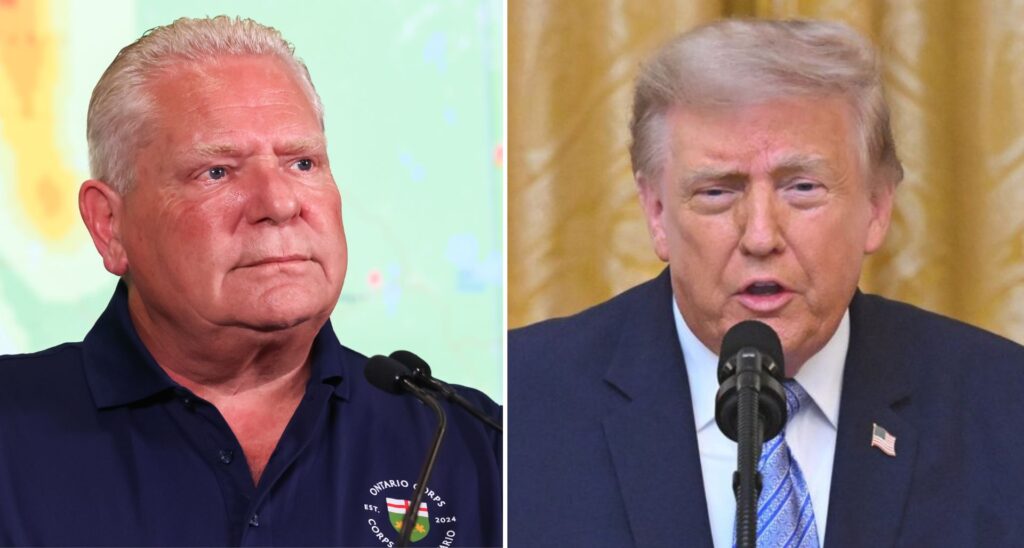
U.S. President Donald Trump recently threatened to impose additional tariffs on Canada, citing what he described as "willful negligence" in managing forests, which he believes is contributing to the wildfires that have enveloped Ontario and some northern U.S. states in smoke. In a social media post shared on Friday, Trump stated, "We are holding Canada responsible for the fact that they are not properly maintaining their Forests, and Brush therein, and the United States is being unnecessarily invaded by filthy, polluted, and unhealthy air, the quality of which is dangerous, and totally unacceptable!"
Trump indicated his intention to call Canadian Prime Minister Mark Carney to discuss Canada's response to the situation. He emphasized that the pollution caused by these fires was not only a health hazard but also incurred substantial financial costs to the United States. Trump exclaimed, "The cost is incalculable! Canada has refused to engage in basic Forest Management and Debris Removal, knowing that such refusal will lead to exactly this result." He characterized this neglect as "Willful Negligence" that had become a recurring issue, costing the U.S. billions of dollars annually.
The President suggested that the costs associated with the air pollution should be added to the tariffs Canada is currently paying. When asked about the criticism from the U.S. regarding Canada's wildfire management, Prime Minister Carney downplayed the comments during a Thursday news conference held in London, Ontario. He highlighted Canada's commitment to investing in clean energy, contrasting it with what he described as the U.S. engaging in actions that undermine clean energy initiatives. Carney stated, "Fighting climate change is the responsibility of all countries, including the United States," reinforcing Canada's view that addressing environmental challenges is a shared global responsibility.
It remains uncertain under what legal authority President Trump could impose new tariffs on Canada. Earlier this year, the U.S. Supreme Court ruled against Trump's ability to utilize the International Emergency Economic Powers Act (IEEPA) for sweeping tariff measures against Canada and other countries. The existing 10 percent tariffs on Canadian goods were enacted under Section 122 of the 1974 Trade Act and are set to expire after 150 days by the end of July unless Congress votes for an extension. These tariffs do not apply to goods compliant under the Canada-U.S.-Mexico Agreement.
The Trump administration is reportedly looking into utilizing Section 301 of the Trade Act of 1974 to reestablish tariffs, focusing on investigations into forced labor in supply chains. Trump's comments follow recent statements from four Republican lawmakers who have called for sanctions against Canada regarding its wildfire management. Republican Congressman John James, representing a district north of Detroit, issued a "final warning" to Canada via social media, stating that "American lungs are paying the price for Canadian inaction, year after year." He added, "Sovereignty comes with responsibility," highlighting the expectation for Canada to manage its forests effectively to prevent disasters that affect its neighbor.
Additionally, Senator Bernie Moreno from Ohio announced plans to introduce a bill that would impose sanctions on Canada over the smoke issues caused by wildfires. The proposed legislation would require the president to determine the extent to which Canadian wildfires affect U.S. air quality and could result in sanctions against Canadian officials held responsible. Measures could include revoking visas, blocking assets, and declaring the Canadian ambassador "persona non grata" until the situation improves. Moreno stated, "My bill will declare an emergency, sanction all Canadian officials responsible, and study a victims compensation fund driven by imposing additional tariffs."
In response to the U.S. criticism, Ontario Premier Doug Ford urged American politicians to focus on providing support rather than complaining. He emphasized Canada's efforts to assist the U.S. during similar crises and highlighted that crews in Ontario are battling nearly 200 active fires, with half categorized as "out of control." Ford remarked, "There’s some politicians out there chirping away, well maybe what you should do rather than complain, is send support, send help, because we have done the exact same thing for our American friends." This underscores the ongoing challenges both countries face in managing wildfire hazards and addressing cross-border environmental concerns.








