

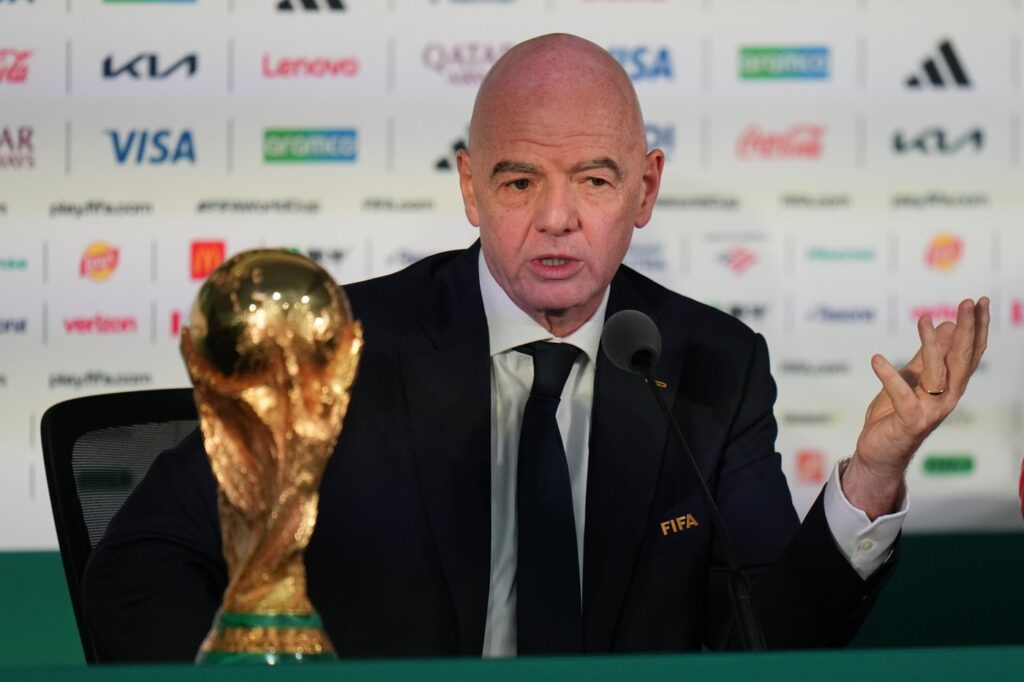
On Thursday, UEFA member federations reached a significant decision to boycott all FIFA competitions in response to Gianni Infantino's controversial plan to sell stakes in the World Cup to private equity investors. The European soccer governing body announced this collective stance following an urgent online meeting attended by the 55 member associations.
In their official statement, UEFA declared, “UEFA and its national associations will not participate in FIFA competitions.” They emphasized the sanctity of the FIFA World Cup, asserting, “Some things are simply too important to sell. The FIFA World Cup belongs to football. It always will. And so long as Europe has a voice, it will never be for sale.” This declaration illustrates the strong commitment of UEFA members to prioritize the integrity of football over potential financial gains.
The urgent strategy meeting was convened to address Infantino's recent offer of $20 million to each of FIFA's 211 global members, which must be accepted by mid-September. This proposal has raised significant concerns among UEFA members about the influence of private equity investors in football, leading to the decision for a boycott.
Infantino's secret proposal, which was disclosed earlier, involves spinning off FIFA's commercial operations into a new subsidiary valued at $20 billion, with 20% ownership allocated to private investors. Notably, the core investor for this venture is a New York investment firm founded by Joshua Kushner, who is the brother of Jared Kushner, son-in-law to former U.S. President Donald Trump.
UEFA further criticized Infantino, stating, “This is not merely a profound failure of leadership, but an abdication of FIFA's duty as the custodian of world football.” Infantino, who previously served as UEFA's general secretary before being elected as FIFA’s president in 2016, now faces backlash from associations who believe in the need for FIFA to uphold its responsibilities to the sport, rather than prioritize potential profit-sharing with external investors.
The organization's statement elaborated on the broader implications that external investments could have on the future of football: “The moment external investors acquire ownership interests in FIFA competitions, football changes forever. Commercial return becomes a permanent obligation. Investor expectations become a daily pressure.” This highlights UEFA's fears about the potential commercialization of the sport, which they believe could disrupt its fundamental values.
Despite Infantino’s justification for the private equity offer as a means to “turbocharge” funding for soccer development worldwide, this approach was met with skepticism. Approximately 40 UEFA member officials expressed frustration during the meeting, suggesting that FIFA should allocate its substantial multi-billion-dollar reserves toward boosting development programs instead of seeking outside investment.
The urgency surrounding this issue is compounded by the proximity of the next scheduled FIFA tournament, which is the Women’s Under-20 World Cup, hosted in Poland starting from September 5. As UEFA members gear up to implement their boycott, the implications for future competitions and the landscape of international football remain uncertain.








