

Hamas announced on Friday that it will initiate disarmament as part of a deal brokered by U.S. President Donald Trump, which also requires Israel to cease its airstrikes and withdraw from Gaza. This development may signify a breakthrough in efforts to end ongoing hostilities, although significant challenges lie ahead for implementation.
Hamas stated that the process of laying down its heavy weapons would depend on the establishment of a Palestinian state, a condition that is firmly rejected by the current Israeli government. While Israel has not formally commented on this latest agreement, it is part of a broader U.S.-mediated ceasefire arrangement announced in October 2023, where Hamas was expected to disarm and transfer authority to an independent Palestinian administration, and Israel was to pull back its forces.
Progress towards this agreement has stalled, as Israel emphasizes that any movement hinges on Hamas disarming, while Hamas accuses Israel of breaching the accord through continued strikes on Gaza. Disarmament would represent a notable shift for Hamas, which views armed resistance against Israel as fundamental to its identity and has historically maintained an arsenal that includes rockets, anti-tank missiles, and explosives.
Currently, Israel appears unlikely to make significant concessions, particularly ahead of its October elections. Prime Minister Benjamin Netanyahu is facing a challenging reelection campaign, with opposition figures accusing him of failing to prevent the October 7, 2023, attack by Hamas that led to the outbreak of war.
Phased Implementation of the Deal
In his announcement on social media, Trump outlined that the deal would be executed in "carefully structured phases." As disarmament progresses, Israeli forces are set to withdraw, while an International Stabilization Force will collaborate with a new Palestinian police force to ensure safety and security in Gaza.
According to a copy of the agreement verified by The Associated Press, all weapons held by the Hamas-controlled police will be transferred to the U.S.-backed National Committee for the Administration of Gaza upon its arrival in the enclave, although the timeline for this remains uncertain as it relies on the fulfillment of other agreements.
A procedure to decommission and securely store heavy weaponry, military production sites, and tunnels will commence only after the Palestinian committee's arrival and the deployment of international forces. This process directly correlates with a gradual Israeli withdrawal from areas of Gaza under its control, as specified in the agreement.
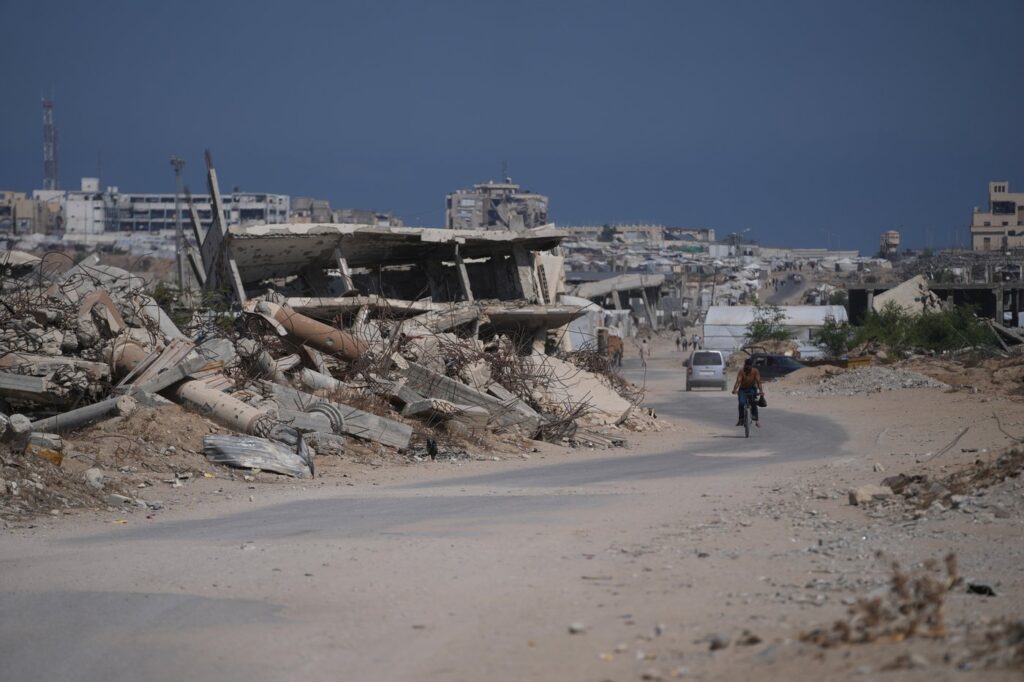
Israel presently controls approximately 60% of Gaza, where the infrastructure has been largely devastated. The majority of Gaza's population of 2 million resides in the remaining areas, many of which are characterized by overcrowded tent camps and destroyed neighborhoods. An anonymous Israeli official stated that there would be no withdrawal before Hamas is disarmed and Gaza is demilitarized, adhering to government protocol regarding confidentiality.
A source with knowledge of the negotiations indicated that although Israel is actively involved in the discussions, it is not a signatory to the deal, which consolidates arrangements between Hamas and various countries tasked with mediating and securing the ceasefire. The agreement's guarantors include the U.S., Turkey, Egypt, and Qatar.
Timeline and Challenges Ahead
U.S. and Board of Peace officials, tasked with overseeing the ceasefire, have provided an optimistic view of the deal's execution. While Gaza's police force is expected to relinquish its arms, this initial disarmament phase will not encompass the bulk of Hamas militants or their heavy weaponry. Instead, the surrender of significant arms and the decommissioning of tunnels and military infrastructure is projected to unfold between 200 and 350 days later, according to a Board of Peace official, although this timeline was not included in the AP-obtained agreement.
Hamas officials and others involved in the negotiation process revealed that there is a consensus among Hamas and other factions to "collect and store" arms within Gaza under the oversight of the Palestinian technocratic committee, emphasizing that these weapons will not be turned over to Israel or any external non-Palestinian entities. This disarmament is set to happen gradually alongside an Israeli withdrawal.
Skepticism and Concerns
A U.S. official noted Israel's skepticism about Hamas's genuine commitment to disarmament and relinquishing control over Gaza, assuring that Israel was consulted throughout the negotiation process. Nevertheless, Israel has not been asked to undertake anything beyond what it initially agreed upon when it endorsed Trump's 20-point plan, which primarily entails withdrawing its forces from Gaza and ceasing airstrikes.
A member of the Palestinian technocratic committee expressed eagerness to enter Gaza but raised concerns about potential challenges posed by Israel. This individual indicated that the committee does not anticipate entering Gaza for at least two months. While the committee acknowledged positive developments from the agreement, it simultaneously acknowledged the daunting task ahead of restoring public institutions and services and rebuilding the devastated territory.
The current conflict in Gaza began following a Hamas-led assault on southern Israel on October 7, 2023, which resulted in approximately 1,200 fatalities and saw 251 individuals taken hostage. Israel's retaliatory military campaign in Gaza has reportedly led to the deaths of over 73,000 Palestinians, including casualties since the ceasefire began, as reported by Gaza's Health Ministry. The ministry, associated with the Hamas-led government, does not differentiate between militants and civilians but claims that women and children constitute nearly half of all reported deaths.








