

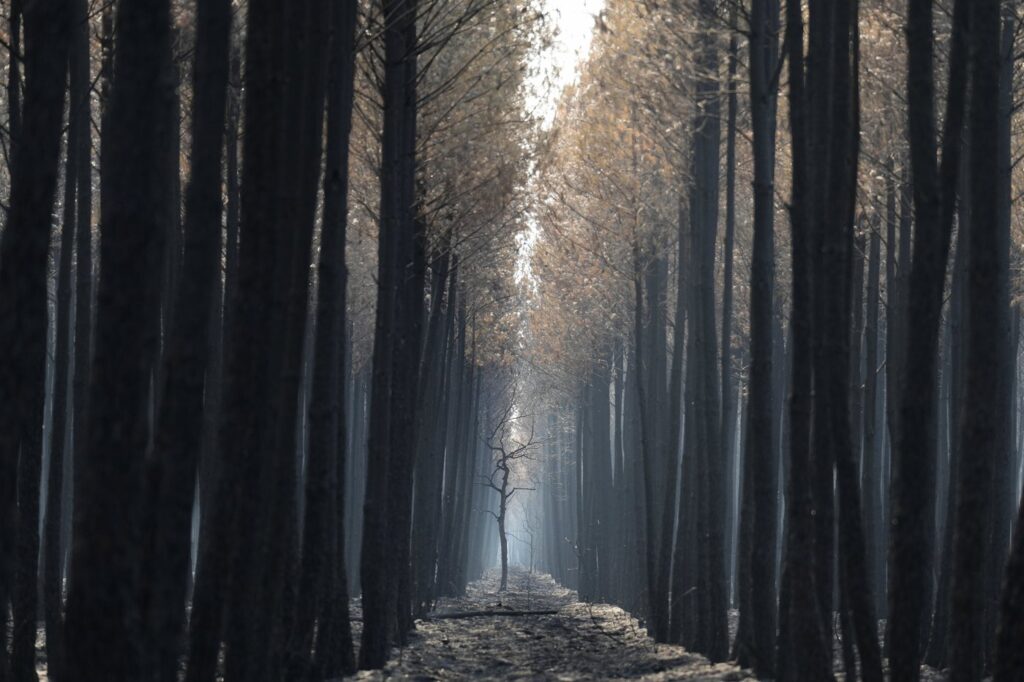
LE PORGE, France (AP) – Firefighters successfully contained a large wildfire within its perimeter in southwestern France on Saturday, enabling approximately 198,000 people to return to their homes. This follows what could be considered the largest peacetime evacuation in the country’s history. However, renewed fires in other parts of France and Greece led to further evacuations, demonstrating how quickly progress in firefighting can be undermined.
In the Mediterranean Var region, a fire that was believed to have been contained flared back to life, expanding across 10 square kilometers (4 square miles) in just six hours on Friday. The prefecture described this rapid spread as “faster than a horse at full gallop.” The contrasting situations—mass returns in the Gironde region of France and renewed evacuations in Var, alongside boat rescues from Greek resorts—highlight the volatility of wildfire conditions across Europe.
At the height of the crisis, wildfires in France and Spain forced around 330,000 people to flee their homes and vacation spots. This situation stretched firefighting resources, aircraft, and emergency services thin as they responded to simultaneous emergencies. The European Union’s Copernicus climate service states that Europe is the fastest-warming continent, with temperatures rising at more than twice the global average since the 1980s. This increase in temperatures and prolonged drought conditions lead to drier vegetation, which allows wildfires to spread more rapidly and burn more fiercely.
The wildfire in Gironde has burned through 420 square kilometers (162 square miles) of pine forest west of Bordeaux, an area that is four times larger than Paris. Firefighters confirmed on Saturday that the fire remained contained but had not yet been declared “fixed,” which would indicate it was no longer advancing. Significant challenges remain, as active fire sectors and buried hot spots could reignite. While many communities in Gironde are starting to see residents return, the affluent Cap Ferret peninsula remains largely evacuated due to nearby hot spots that could threaten safety and accessibility.
In terms of wildlife impact, Allain Bougrain-Dubourg, president of France’s League for the Protection of Birds, reported that millions of animals have already been affected by the fires. In Var, a fire that had previously been declared fixed reignited, consuming an additional 1,250 hectares rapidly on Friday. The resurgence has stunned officials, with Var Prefect Simon Babre noting that this fire, considered under control earlier, suddenly flared back to life.
Despite the containment of fire edges that protected nearby communities, around 2,500 people were still unable to return to their homes, and approximately 1,300 firefighters were deployed in the area. On the same day, twenty French departments issued orange heat warnings, particularly in the eastern and southeastern regions, with forecasts predicting temperatures between 35 to 39 degrees Celsius (95 to 102 degrees Fahrenheit), while eight departments were under a high forest-fire risk.
In Greece, the fire situation escalated as well, with hundreds of firefighters deployed to protect the Porto Germeno resort on the Gulf of Corinth. Strong winds exacerbated the situation, forcing the evacuation of approximately 300 individuals by sea as the flames surged between Athens and Thebes. Theodore Giannaros, a wildfire meteorologist at the National Observatory of Athens, described the damage in the region as “inconceivable,” with early estimates suggesting that 40 to 50 square kilometers (15 to 19 square miles) had been affected, although official burn areas had yet to be confirmed.
Firefighting efforts included 420 deployed firefighters, with reinforcements consisting of 20 specialized forest-fire teams, supported by 19 aircraft and 11 helicopters. Despite these resources, ongoing strong winds hampered aerial operations, and Greece’s fire service reported tackling 73 active blazes on Friday. The Athens region, along with parts of Evia, has been placed at the highest wildfire alert level, with wind speeds anticipated to reach up to 88 kilometers per hour (55 miles per hour), complicating fire control efforts.








