

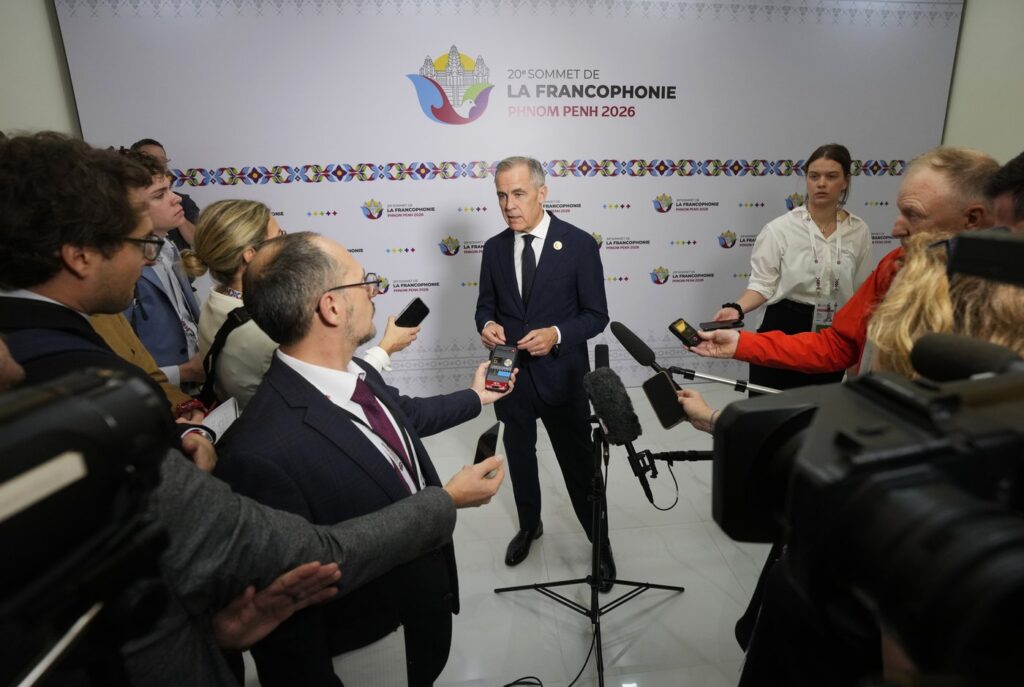
PHNOM PENH – Prime Minister Mark Carney is embarking on a diplomatic visit to China, aiming to engage with Chinese President Xi Jinping and leaders from various Pacific Rim nations. He is departing from the Francophonie summit in Cambodia to attend the Asia-Pacific Economic Co-operation (APEC) summit in Shenzhen, a prominent tech hub in China.
Carney's meeting with Xi is scheduled for Tuesday morning in China, which corresponds to late Monday evening in Ottawa. The Prime Minister emphasized that Canada has the potential to enhance cooperation with China in sectors such as agriculture, clean and conventional energy, and financial services. He noted, “We’ve established pretty clear guardrails on the areas that we’re going to focus on… I’m using our words, not theirs,” while talking to reporters in Phnom Penh.
During the discussions, Carney intends to address the transformation of the international landscape, focusing on China’s role in it and Canada’s strategic priorities. A significant topic of conversation will be the influx of Chinese investments into Canada's automotive industry, particularly following an agreement earlier this year that permits a limited number of Chinese electric vehicles to enter the Canadian market. Carney expressed his desire for Chinese automakers to establish operations in Canada, provided they offer good jobs, indicating his skepticism about facilities that primarily assemble vehicles using components sourced from China.
Trade negotiations with the United States are expected to influence how Canada navigates its approach to Chinese investments. Carney stated, “It’s part of the trade negotiations. Depending (on) where that settles, there’ll be other options – European options, Asian options.” He elaborated that while this was not leverage, the dynamics would be contingent on actions and reactions.
Additionally, Carney will engage with various leaders from the APEC forum, which includes 21 economies across the Pacific working collaboratively to reduce trade barriers. The spectrum of members ranges from Taiwan to Australia and Peru. His office indicated a continued commitment to securring increased investments and diversifying Canada's trade practices.
Vina Nadjibulla, co-founder of the Centre for Strategic Statecraft, expressed her anticipation regarding whether Carney will permit increased Chinese investments in vital sectors like energy and technology, specifically concerning renewables and batteries, alongside the automotive sector. “We have to constantly triangulate our relationship with China with our discussions with the U.S. – and also watch then what happens between the U.S. and China bilaterally,” she remarked.
Nadjibulla believes the summit could significantly influence the foreign policy review that Carney intends to present in the House of Commons shortly, as well as the upcoming renewal of the 2022 Indo-Pacific strategy initiated by former Prime Minister Justin Trudeau. She highlighted the growing significance of Canada in the eyes of Asian leaders, noting visits from countries like Vietnam and India.
Additionally, Nadjibulla pointed out that an updated strategy must address Taiwan's relations, given its contentious status with China. She noted that the federal cabinet has delayed signing a trade arrangement with Taiwan for over a year, despite encouragement from the foreign-affairs committee to strengthen economic relations.
Notably, the APEC summit is expected to see a meeting between U.S. President Donald Trump, President Xi, and Russian President Vladimir Putin, an event that has sparked concerns among European officials about potential proposals that might undermine both Ukraine and Europe's security.
Carney remarked on conversations with Brazilian President Luiz Inacio Lula da Silva, who stressed the importance of pursuing peace talks towards resolving the war in Ukraine. Carney reiterated Canada’s desire for a just resolution and a needed ceasefire. Nadjibulla characterized the trilateral meeting as a striking development, reaffirming Carney’s warnings about growing challenges in global power dynamics.
In light of Carney's visit, the Chinese state-controlled English-language newspaper, Global Times, projected a positive outlook, framing the trip as an opportunity for a mutually beneficial partnership amidst global tensions. A representative from the Chinese Academy of Social Sciences emphasized the importance of dialogue in alleviating trade tensions and fostering mutual trust. He indicated that rebuilding understanding would require time, particularly after years of limited high-level exchanges.
Despite the diplomatic engagement, Canada has expressed concerns regarding Hong Kong’s increasing repression as it shifts from semi-autonomy to total Chinese control. Earlier, Canada joined Western allies in criticizing long sentences handed down to political figures and activists, urging for an end to unjust prosecutions linked to the national security law.
Carney has reiterated his approach of discussing human rights issues with China privately rather than publicly condemning actions, showcasing a diplomatic balance between securing economic interests and advocating for human rights.








