

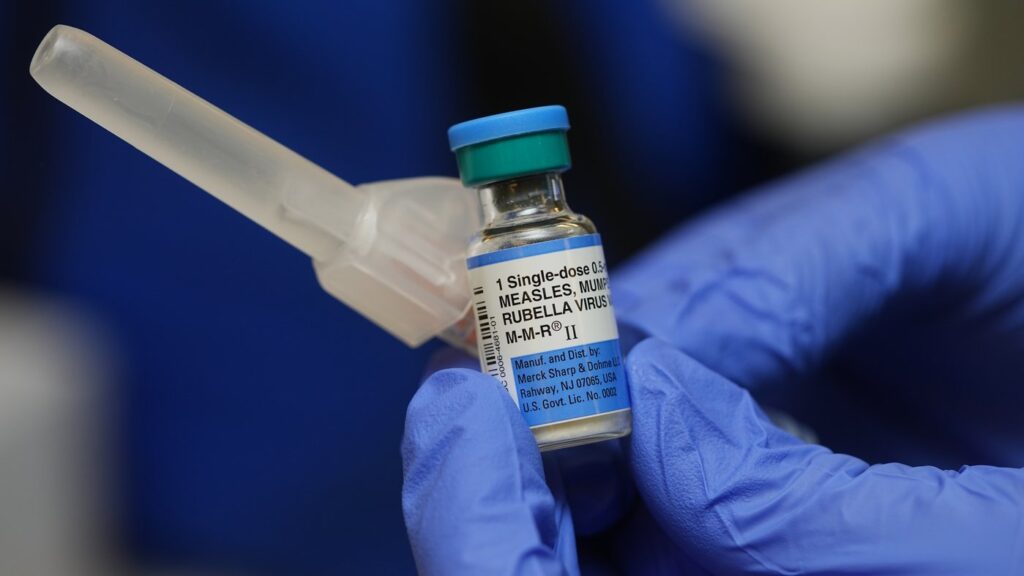
The United States has officially lost its measles-free status, as reported by international health officials this Tuesday. The resurgence of this highly contagious virus, once thought to be largely eradicated, has occurred primarily among unvaccinated populations and is at its highest transmission rate in over three decades.
Similarly, Mexico has also lost its measles-elimination status, particularly following a massive outbreak in Chihuahua state. Bolivia has experienced a comparable loss as well. While the declaration from the Pan American Health Organization (PAHO) primarily serves as a symbolic warning, it signifies a significant regression in public health achievements that had successfully controlled measles through extensive vaccination efforts.
Dr. Jarbas Barbosa, the director of PAHO, emphasized at a news conference that “measles elimination is not a trophy that is won once and placed on a shelf.” He highlighted the need for continuous efforts to close immunity gaps and reach every community to maintain public health standards.
In response to the resurgence, PAHO has indicated that the affected countries— the U.S., Bolivia, and Mexico—are expected to submit plans in the coming weeks to prevent further transmission and work towards regaining their measles-free status. Dr. Daniel Salas, PAHO's executive manager for immunizations, noted that outbreaks have been accelerating across the Americas since 2024, with initial cases traced back to close-knit Mennonite communities. Last year, Canada also lost its measles-free designation for the first time since 1998.
International health experts designate measles as eliminated when there is no local transmission for at least 12 months. With the U.S. losing this classification, experts regard it as an indicator of declining public health preparedness. Vaccination rates have been dropping for various diseases both domestically and internationally, and measles, one of the most contagious diseases known, is often the first to resurface when vaccination rates fall.
Measles vaccination has been effective in halting virus transmission in the U.S. for three decades, requiring a community coverage rate of 95% to prevent outbreaks. However, with many parents opting out of vaccinating their children and federal leaders expressing skepticism about vaccination, the virus has reestablished itself in vulnerable communities across the country. Nearly every state has reported confirmed measles cases this year.
Senator Ron Wyden from Oregon criticized this development, attributing it to ongoing campaigns by individuals promoting misinformation regarding vaccines, which jeopardizes public health, particularly for children.
The last two years have marked the highest incidence of measles in recent history for the U.S., with over 7,000 reported cases and 11 deaths. Most of these individuals were either unvaccinated or their vaccination status was unknown, with over 10% requiring hospitalization. Vulnerable populations, including infants too young to be vaccinated, are particularly at risk in this resurgence of the disease.
This year's measles death count has already surpassed totals recorded in over three decades, making it the worst year for the disease in the U.S. since 1991. Major outbreaks have been reported in Texas, Utah, South Carolina, and Pennsylvania, with thousands of cases surfacing since measles was eliminated in the U.S. in 2000, where typically fewer than 200 cases were logged annually, mostly linked to international travel.
In the past two years, significant outbreaks began with rural communities in the Southwest. Texas reported over 760 infections, while New Mexico saw about 100 cases. In 2025, measles infections ballooned in rural border towns in Arizona and Utah. However, the current year, with over 5,400 confirmed cases, is already double that of 2025, largely driven by a massive outbreak in Pennsylvania.
Critics argue that the U.S. government’s response has been inadequate. U.S. Health Secretary Robert F. Kennedy Jr., who influenced the anti-vaccine movement, has asserted that vaccination rates had been declining prior to the Trump administration and that the U.S. was managing measles outbreaks more effectively than other countries. Nonetheless, experts believe the U.S. outcome was not inevitable, pointing out that more decisive actions could have been taken.
In recent months, the CDC allocated $100 million to support state and local measles initiatives, while health officials say this amount is insufficient. Experts advocate for a louder federal campaign to promote vaccinations, suggesting that the current federal messaging is not robust enough to sufficiently address the situation.
With previous vaccination campaigns, the Americas were among the first regions globally to be declared free of measles in 2016. The measles vaccine is credited with preventing an estimated 6.2 million deaths in the Americas between 2000 and 2023. However, as the region now tackles the challenge of regaining measles-elimination status, the urgent demand for robust vaccination coverage has become clear.








