

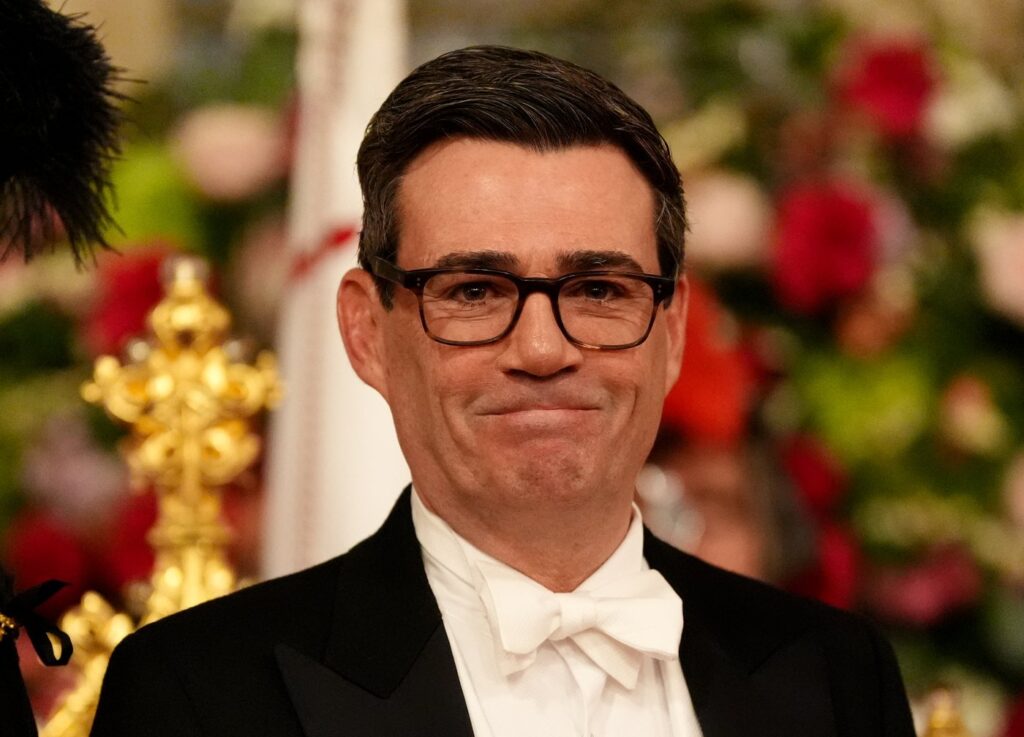
LONDON (AP) – British Prime Minister Andy Burnham addressed the ongoing repercussions of Brexit during a speech at the Lord Mayor’s Banquet in London, articulating the need for the U.K. to reevaluate its relationship with the European Union (EU). He expressed that Brexit has not yielded the expected benefits for the country, emphasizing that the U.K. now requires a much closer alliance with the EU to combat rising isolationism globally.
In his remarks, Burnham likened the situation to Hans Christian Andersen’s fairy tale “The Emperor’s New Clothes,” where no one dares to tell the emperor that he is naked. He asserted, “The Brexit we were given has not worked. We have lost more than we gained.” This statement marks a significant point in the political discourse surrounding the U.K.'s exit from the EU, which was initiated following a referendum in 2016.
As the seventh prime minister since the Brexit vote, Burnham is keen to move past nearly a decade of political upheaval. He claimed that the U.K. is now positioned to play a leading role in a world leaning toward international cooperation, owing to the experiences it has accumulated since the decision to leave the EU in 2020. He mentioned that Brexit set off a global trend towards isolationism and protectionism, catering to the interests of adversarial nations such as Russia.
Burnham’s comments come ahead of a crucial U.K.-EU summit scheduled in Brussels, where negotiations are set to forge a trade agreement focusing on food and drink, along with initiatives surrounding energy and emissions trading. Additionally, provisions will allow young people to work across the U.K. and EU for limited periods. The summit is seen as a pivotal step in resetting U.K.-EU relations a decade after the referendum.
During his speech, Burnham challenged the narrative presented by pro-Brexit supporters, asserting that the promises of regaining control over borders, laws, and the economy have not materialized. He highlighted the significant drop in trade with EU countries and estimated that the economic impact of Brexit could diminish the U.K.’s gross domestic product by 4% to 8%. While most economists support the view that Brexit has adversely affected the British economy, political leaders have historically shied away from reigniting this contentious debate.
However, Burnham has expressed his intent to initiate a national dialogue about the future of the U.K.'s relationship with the EU following the upcoming summit. His spokesman, Tom Wells, stated that “no assumptions are being made” and that the British public will ultimately influence the outcome of any discussions.
It's important to note that, until the next national election, Burnham is constrained by a commitment from Keir Starmer, his predecessor as Labour Party leader and prime minister, not to pursue rejoining the EU’s tariff-free customs union or the frictionless single market for goods, services, and workers. Revisiting this pledge could reignite divisive sentiments within the country, which experienced a narrow split in the referendum vote: 52% favored leaving the EU, while 48% supported remaining.
Former Conservative Prime Minister Boris Johnson, a key figure in the Brexit campaign, warned Burnham that attempting to reestablish ties with the EU could result in public backlash. He claimed, “If Burnham tried to take Britain back into the EU, people will wake up to what is going on. They won’t want it, and he won’t succeed.”








