

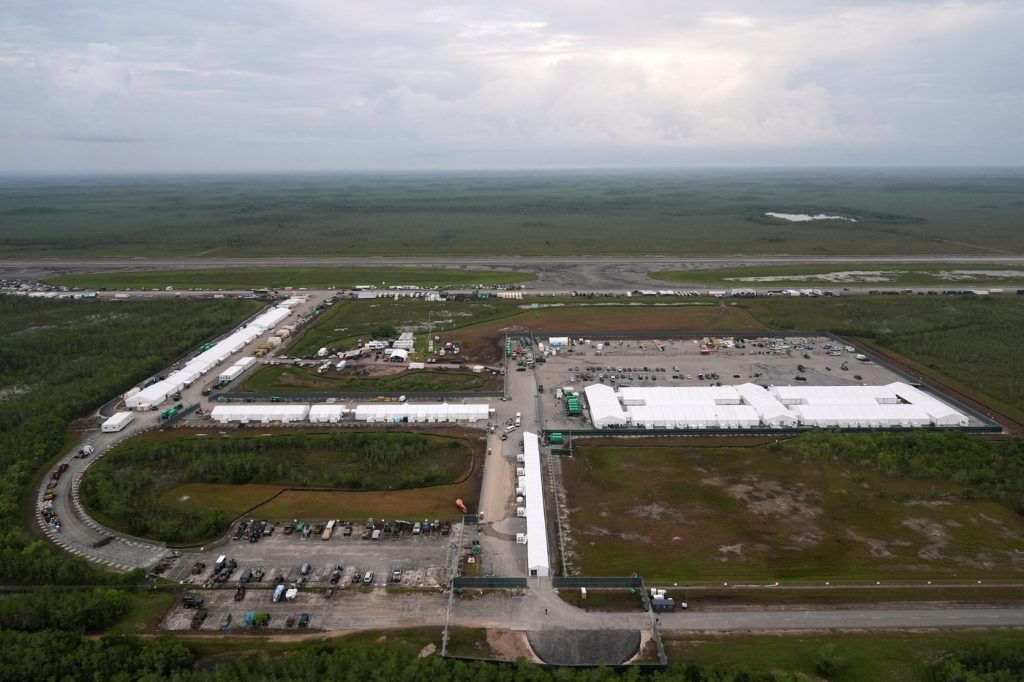
TALLAHASSEE, Fla. - A senior official from Florida has indicated that the controversial state-operated immigration detention facility located in the Everglades, referred to as “Alligator Alcatraz,” is expected to be empty within a few days. This development comes amid ongoing legal battles between Governor Ron DeSantis’ administration and the federal government as they seek to contest a ruling from a federal judge to close the facility by late October.
In an email correspondence shared with the media, Kevin Guthrie, the Executive Director of the Florida Division of Emergency Management, expressed that the facility would likely have “0 individuals” in the coming days. Rabbi Mario Rojzman from South Florida and the executive assistant who contacted Guthrie confirmed the authenticity of these messages. However, a spokesperson for Guthrie did not respond to media inquiries regarding this matter.
This news arrives shortly after U.S. District Judge Kathleen Williams issued an order mandating the detainment center to cease operations, allowing up to 60 days for the final detainee to be released. The state of Florida has appealed this order, with federal authorities requesting that the judge suspend her ruling while the appeal is processed. They argue that the thousands of beds at the Everglades facility are essential due to overcrowding in other detention centers across Florida.
Environmental organizations and the Miccosukee Tribe, who initiated the lawsuit leading to the judge's decision, have contested the federal government’s request. They argue that the Everglades detention facility is unnecessary, particularly as Florida is set to open a second facility in northern Florida, which DeSantis has dubbed “Deportation Depot.” Reports suggest that during a recent visit by U.S. Representative Maxwell Frost, it was revealed that only a small fraction of the detention center’s capacity, between 300 to 350 detainees, was currently occupied.
As of Wednesday, Judge Williams had not made a decision regarding the request for a stay. In her order, she noted the expectation that the facility's population would decrease over the next 60 days, with plans for transferring detainees to other facilities, followed by the removal of fencing, lighting, and generators. The judge stipulated that no new detainees could be brought onto the premises other than those already at the facility.
The environmental groups and the Miccosukee Tribe have argued their lawsuit against the detention center on the grounds that its construction and operations must be halted until compliance with federal environmental laws is fulfilled. They contend that the facility poses a threat to sensitive wetlands in the area, which house protected species and would undermine decades of investment in environmental restoration efforts.
Constructed rapidly two months ago at a scarcely used training airport within the Everglades, the detention center has reportedly cost state officials over $245 million in contracts for its construction and operations since its official opening on July 1.
The situation continues to evolve, with the legal implications of the federal judge’s order and the state’s response still pending, illustrating the complex interplay between immigration enforcement, environmental concerns, and state governance in Florida.








