

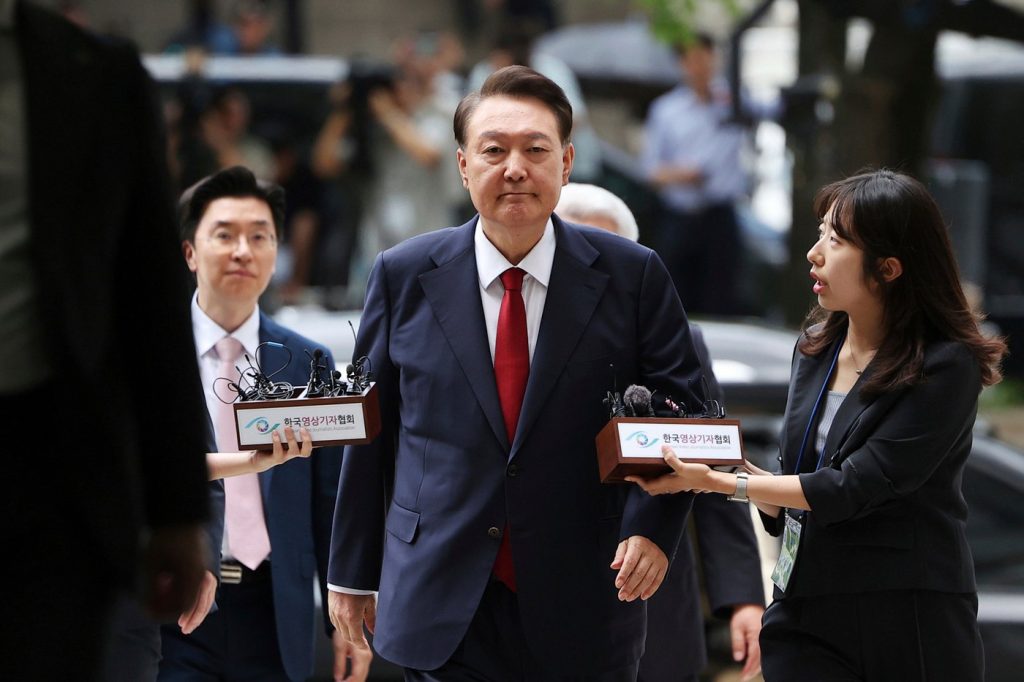
SEOUL, South Korea (AP) – Former South Korean President Yoon Suk Yeol, who is currently imprisoned, has appealed his life sentence for rebellion related to his brief imposition of martial law in December 2024. This announcement was made by his legal team on Tuesday.
The conservative leader, facing several trials concerning his actions during his presidency, has expressed defiance following his conviction by the Seoul Central District Court last week. Yoon labeled the court's decision as illogical and asserted that his actions were taken “solely for the sake of the nation and our people.” He accused the presiding judge of bias against him.
In a text message issued by Yoon's lawyers, they indicated their intention to contest the ruling by addressing apparent “errors in fact-finding and misinterpretations of the law” present in the court’s decision. The appeal will be forwarded to a specialized panel at the Seoul High Court, which was established to handle cases involving rebellion, treason, and foreign subversion under a law passed in December.
Yoon's legal team stated, “We will never be silent about what we view as an excessive indictment by a special prosecutor, the contradictory judgment rendered by the lower court based on that premise, and its political circumstances.”
The martial law decree issued by Yoon on the night of December 3, 2024, was in effect for approximately six hours until lawmakers managed to breach a blockade of armed soldiers and police at the National Assembly. They subsequently voted to overturn the decree, which forced Yoon’s Cabinet to lift the martial law.
On December 14, 2024, Yoon was suspended from office after being impeached by a legislature dominated by liberals. He was formally removed from office by the Constitutional Court in April 2025. Following renewed legal challenges, he was re-arrested in July and is now facing a total of eight different criminal trials linked to the martial law incident and other accusations, including the serious charge of rebellion, which could lead to severe penalties.
Although Yoon's martial law was brief, it incited the gravest political crisis in South Korea for several decades, leading to a paralysis of political functions and high-level diplomatic engagements, as well as upsetting financial markets. Stability returned only after Yoon’s liberal rival, Lee Jae Myung, won a presidential election held early in June.
Yoon insists that the martial law decree was both legal and necessary to counteract what he has described as the liberal forces controlling the legislature, which he claims obstructed state governance by impeaching senior officials, cutting budgets, and hampering his presidential agenda.
However, the Seoul Central District Court ruled that Yoon's actions constituted orchestrating a rebellion. The court found that he unlawfully mobilized military and police forces in a bid to seize control of the legislature, arrest political adversaries, and establish unchecked rule.
A special prosecutor who led the investigation into Yoon's rebellion charges had previously sought the death penalty for the former president, emphasizing the considerable threat his actions posed to the nation’s democratic fabric. After the court's ruling last week, a member of the special prosecutor’s team, Jang Woo-sung, hinted at the intent to appeal, citing unspecified “reservations” concerning some factual findings and the severity of the imposed sentence.
It is noteworthy that South Korea has not carried out an execution of a death-row inmate since 1997, leading to a prevailing perception of a de facto moratorium on capital punishment amid rising public sentiment for its abolition.
Yoon's life sentence marks him as the first former South Korean president to receive such a sentence since Chun Doo-hwan, the late military dictator. Chun was sentenced to death in 1996 for his role in a 1979 coup and a violent crackdown on pro-democracy protests in Gwangju in 1980, which resulted in the deaths or disappearances of over 200 individuals. His sentence was later commuted to life imprisonment, and he was released in late 1997 via a special presidential pardon.








