

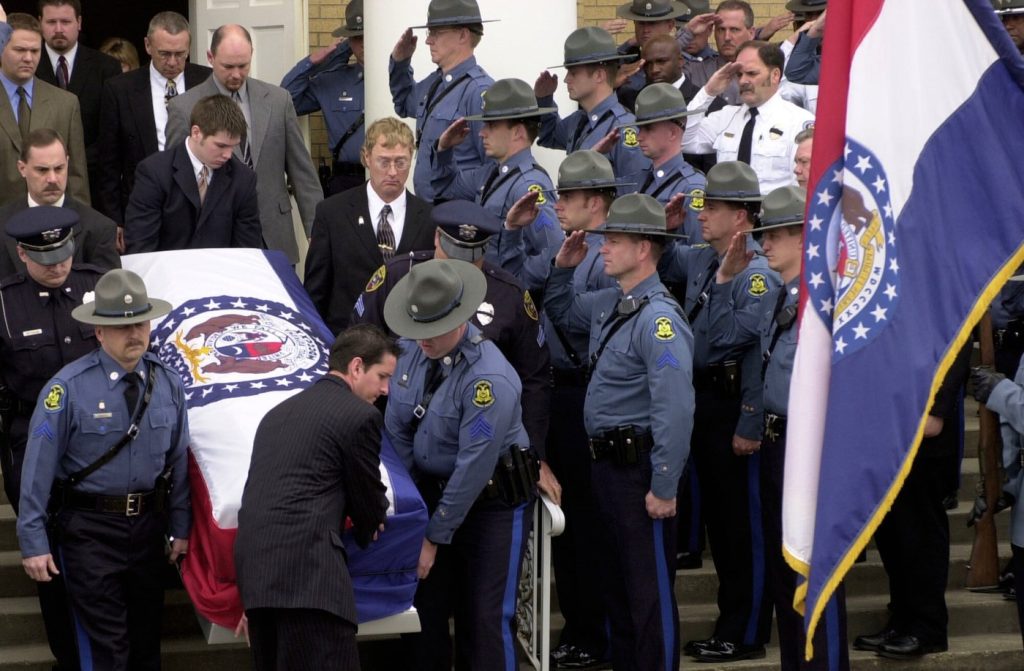
A Missouri man, Lance Shockley, is scheduled to be executed on Tuesday evening for the 2005 murder of Missouri State Highway Patrol Sgt. Carl Dewayne Graham Jr. Shockley, 48, was convicted of fatally shooting the trooper outside his home in Van Buren, Missouri. Prosecutors claimed that Shockley waited for hours before ambushing Graham, using both a rifle and a shotgun. The incident occurred as Graham exited his patrol vehicle, leading to a brutal attack.
Shockley’s execution is set to take place after 6 p.m. local time at the state prison in Bonne Terre, Missouri. His case stands as one of two executions planned for the same evening in the United States; the other belongs to Samuel Lee Smithers, 72, in Florida, who is facing execution for the murders of two women discovered in a rural pond in 1996.
On Monday, Missouri's Republican Governor Mike Kehoe denied Shockley's clemency request, emphasizing the state's commitment to protecting law enforcement personnel. "Violence against those who risk their lives every day to protect our communities will never be tolerated," Kehoe stated. He reaffirmed Missouri's stand with law enforcement, reinforcing the state's seriousness regarding violence against its officers.
Last week, the Missouri Supreme Court denied a request to delay Shockley’s execution. His legal team is seeking DNA testing on evidence found at the crime scene that they argue has never been analyzed. Jeremy Weis, one of Shockley’s attorneys, expressed doubt that a ruling on this request would materialize before the scheduled execution. The attorneys claim that scientific testing could potentially exonerate Shockley.
Moreover, Shockley’s legal representatives have raised concerns about a violation of his First Amendment rights, stemming from the Missouri Department of Corrections' decision to bar his daughter from acting as his spiritual adviser during the execution. They referenced a U.S. Supreme Court ruling from March 2022, which mandated that states must allow spiritual advisers access to condemned inmates in the death chamber. However, Missouri officials argue that their prison policy restricts family contact during executions due to security issues.
The motive behind Graham's murder is linked to ongoing investigations into Shockley for involuntary manslaughter from a fatal accident involving his best friend. Prosecutors allege that on the day of the killing, Shockley had borrowed his grandmother's red Pontiac Grand Am, which was spotted near Graham's residence.
Evidence presented during Shockley’s trial indicated that he initially shot Graham with a rifle, which injured the trooper severely, causing him to fall and fracture his skull. Shockley then allegedly approached and fired a shotgun at Graham. While .243-caliber rounds were found at the scene, the murder weapons themselves were never recovered. Despite this, prosecutors maintain that they have sufficient circumstantial evidence linking Shockley to the crime.
Defense attorney Jeremy Weis contested this characterization, asserting that the prosecution's case hinged on circumstantial elements without direct evidence proving that Shockley committed the murder. Additionally, some witnesses have reportedly placed Shockley approximately 14 miles away from Graham's residence at the time of the shooting, further complicating the prosecution's narrative.
If Shockley’s execution proceeds as planned, he will become Missouri’s first executed inmate in 2023. The state's most recent execution prior to this was on December 3, 2022, when Christopher Collings was executed for the sexual assault and murder of a nine-year-old girl. If both executions scheduled for Tuesday are carried out, the total number of executions in the U.S. this year would reach 37.








