

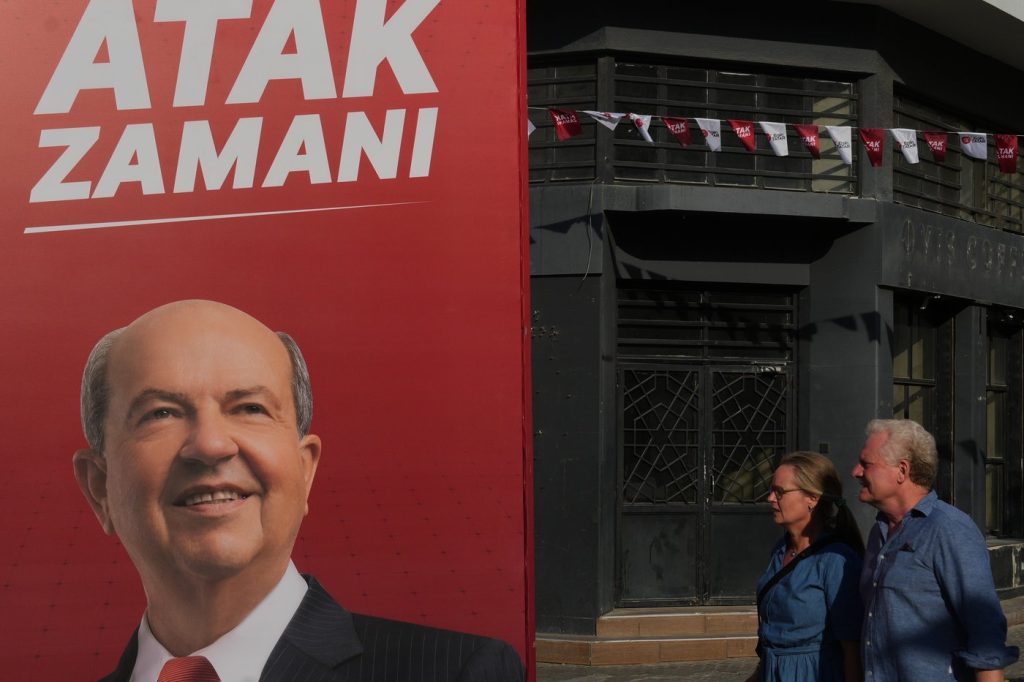
On Sunday, Turkish Cypriots residing in the ethnically divided island of Cyprus participated in a pivotal election that is widely perceived as a critical decision point regarding their political alignment. The choice before them is between aligning more closely with Turkey or shifting toward deeper ties with the European Union.
The election saw approximately 218,000 registered voters, with polling closing at 1500 GMT. Among the seven candidates contesting for the leadership position, the main contenders emerged as the hard-right incumbent, Ersin Tatar, and the center-left candidate, Tufan Erhurman.
Ersin Tatar, aged 65, is a staunch proponent of the permanent division of Cyprus. He aims to achieve international recognition for a Turkish Cypriot state that would align tightly with Turkey’s political, economic, and social policies. His views reflect the stance of Turkish President Recep Tayyip Erdogan, who has reiterated the stance of “two separate states” during recent speeches, including one at the U.N. General Assembly, emphasizing the need for international recognition of the Turkish Cypriot entity.
In contrast, Tufan Erhurman, aged 55, advocates for a return to negotiations with Greek Cypriots to establish a two-zone federation. He has criticized Tatar’s unwillingness to engage in formal peace talks throughout his five-year tenure, labeling this avoidance as a significant setback that has left Turkish Cypriots increasingly isolated on the international stage.
The historical backdrop of this election is significant; Cyprus has been divided since 1974, following Turkey's military intervention in response to a coup aimed at uniting the island with Greece. Turkish Cypriots declared independence in 1983, a move that only Turkey recognizes, maintaining a military presence of over 35,000 troops in the northern part of the island. Although Cyprus became a member of the European Union in 2004, only the Greek Cypriot south, where the internationally recognized government operates, enjoys the full benefits of EU membership.
Many Turkish Cypriots possess EU-recognized passports but reside in the north. The prevailing sentiment among Greek Cypriots towards the idea of a two-state solution is one of rejection; they view it as contrary to both the U.N.-endorsed and EU-endorsed frameworks for a federated solution. Greek Cypriots are concerned that a formal partition would enable Turkey to exert control over the entire island. Cypriot President Nikos Christodoulides has consistently stated that no negotiations premised on a two-state framework will take place.
As the Turkish Cypriots cast their ballots, the outcome of this election is crucial in determining the future direction of the island’s fractured political landscape, which has been marred by decades of division and conflict.








