

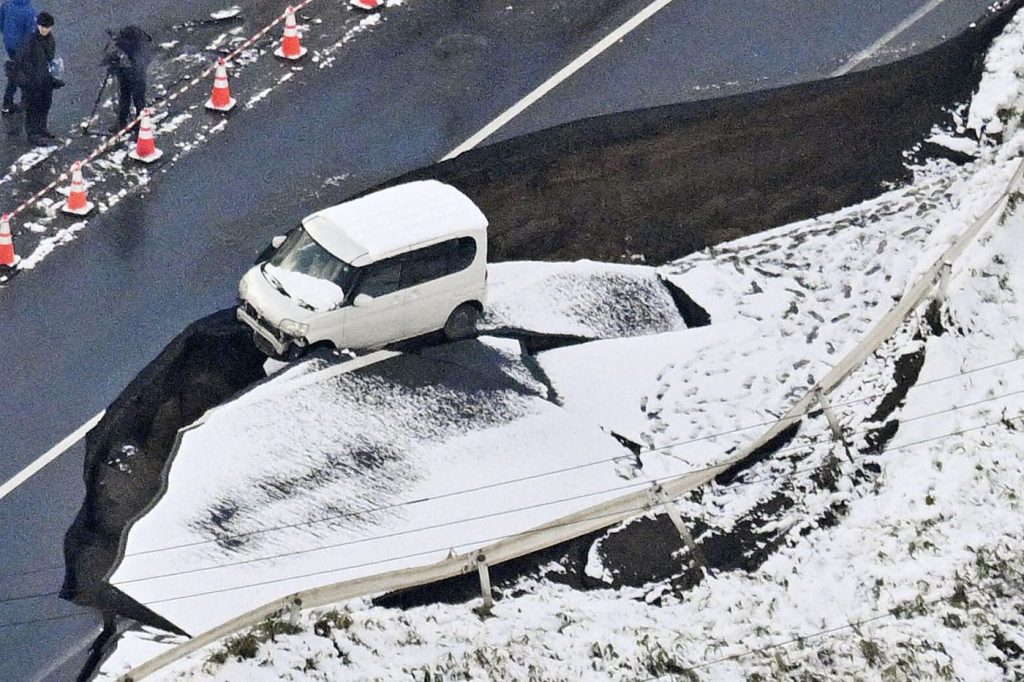
TOKYO (AP) – Japan is currently assessing the damage and warning residents about potential aftershocks following a powerful late-night earthquake measuring 7.5 in magnitude. The quake, which caused injuries, minor damage, and a tsunami warning, affected several communities along the Pacific coast.
According to the Fire and Disaster Management Agency, at least 33 individuals suffered injuries, with one person reported to be in serious condition. Most injuries stemmed from falling objects, as reported by the state broadcaster NHK.
Prime Minister Sanae Takaichi announced the formation of an emergency task force dedicated to urgently evaluating the extent of the damage. "We are prioritizing the safety of people's lives and will do everything we can," she stated during a press briefing. In a parliamentary session, Takaichi reiterated the government’s commitment to assist while also reminding citizens to take precautions to protect themselves.
The earthquake struck at approximately 11:15 p.m. local time, occurring around 80 kilometers (50 miles) off the coast of Aomori, which is Japan’s northernmost prefecture on the main island of Honshu. The U.S. Geological Survey recorded the quake at a slightly higher magnitude of 7.6, noting that it took place 44 kilometers (27 miles) beneath the surface.
A tsunami, measuring up to 70 centimeters (2 feet, 4 inches), was recorded at Kuji port in Iwate prefecture, situated just south of Aomori. Additionally, waves reaching 50 centimeters were reported in various communities in the surrounding area. NHK indicated that the waves caused damage to some oyster rafts in the region. By 6:30 a.m. Tuesday, the Japan Meteorological Agency had lifted all tsunami advisories.
Chief Cabinet Secretary Minoru Kihara reported that approximately 800 homes were left without electricity, and numerous Shinkansen bullet trains along with certain local railway lines were temporarily suspended early Tuesday. East Japan Railway announced its intention to restore bullet train services later that day. By Tuesday morning, most power had been restored, as confirmed by Tohoku Electric Power Co.
Amid the ongoing assessments, about 480 residents sought refuge at Hachinohe Air Base, and 18 defense helicopters were deployed to evaluate the impact of the earthquake, as stated by Defense Minister Shinjiro Koizumi. NHK reported that around 200 passengers found themselves stranded for the night at New Chitose Airport in Hokkaido due to damage at part of a domestic terminal, where sections of the ceiling had cracked and fallen.
The Nuclear Regulation Authority reported that around 450 liters (118 gallons) of water had leaked from a spent fuel cooling area at the Rokkasho fuel reprocessing plant in Aomori. However, the water level remained within normal parameters, posing no safety concern. Additionally, no irregularities were detected at other nuclear power plants and spent fuel storage facilities.
The Japan Meteorological Agency has issued a caution regarding possible aftershocks in the coming days, warning of a slight increase in the risk of a magnitude 8-level earthquake and potential tsunamis affecting Japan’s northeastern coast, stretching from Chiba, located just east of Tokyo, to Hokkaido. Residents in 182 municipalities in the area have been urged to reevaluate their emergency preparedness, clarifying that this warning does not predict a significant earthquake will occur.
This earthquake followed closely after the ninth anniversary of the catastrophic magnitude 9.0 earthquake and tsunami in 2011 that resulted in nearly 20,000 fatalities and caused extensive damage to the Fukushima Daiichi nuclear power plant. JMA official Satoshi Harada stressed the importance of being prepared for the possibility of similar future disasters.
On Tuesday, smaller aftershocks continued to occur, with the U.S. Geological Survey reporting a magnitude 6.6 aftershock followed by a magnitude 5.1 aftershock within hours of the initial quake.








