

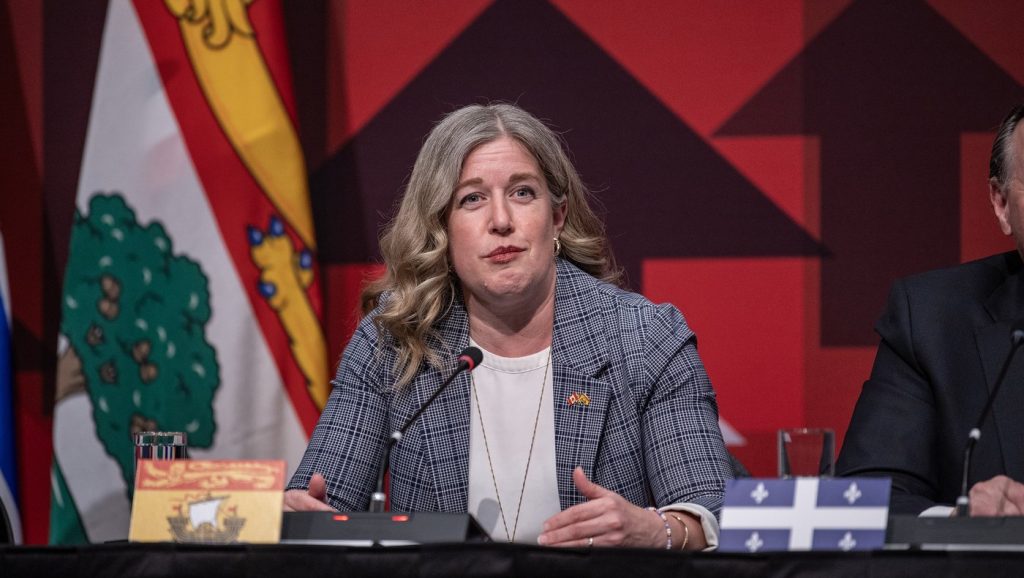
FREDERICTON — New Brunswick Premier Susan Holt has marked a year of significant developments in healthcare, economic challenges, and environmental adversity as her government lays the groundwork for change. With increased salaries for healthcare workers, a $270-million agreement for physicians, and the establishment of 11 new collaborative care clinics, Holt emphasized that patients could expect improvements starting in 2026.
In her recent interview, Holt reflected on 2025, the first full year following her election in October 2024. Following her campaign promises, the Liberal government delivered $10,000 retention payments to full-time and part-time permanent nurses by the year's end. By October 2025, Holt's administration successfully negotiated a new contract with nurses that includes a 12.5 percent wage increase over four years, along with elevated premiums for weekend and night shifts.
Moreover, Holt fulfilled her commitment to open ten collaborative care clinics during the year; the eleventh clinic was announced just last week. "We knew it was an ambitious promise," she said, recalling that the previous government had failed to deliver on a promise to open four clinics.
In a significant milestone for the medical community, the New Brunswick Medical Society voted in November to approve a new $270-million contract that incentivizes physicians to work in team-based settings. "These are some of the shifts that are gonna change the foundation of healthcare for New Brunswick that we can then build on," she explained.
Despite positive advancements, Holt acknowledged the hurdles faced throughout the year. A major issue was U.S. President Donald Trump’s tariffs on Canadian goods, particularly impacting New Brunswick’s forestry sector, which has historically depended on American markets. A CIBC provincial forecast from October indicated that New Brunswick and Quebec are experiencing significant declines in trade due to these tariffs. Holt described the economic challenges as "one of the biggest challenges we’ve faced" and noted that they were unexpected, as they had anticipated economic and GDP growth trends similar to prior years.
In response to the economic challenges, New Brunswick has signed memorandums of understanding on free trade and labor mobility with four provinces and has created a new loan program that offers up to $5 million to assist businesses in sustaining operations. The government unveiled a $14.3-billion budget that reflects the increased healthcare funding as well as a contingency fund to mitigate the impacts of U.S. tariffs.
Holt also pointed to a challenging wildfire season in 2025, with 448 fires that consumed over 34 square kilometers of forest. This was a stark increase from 2024, which recorded 281 wildfires and burned only 2.3 square kilometers. The premier remarked on the unprecedented scale of the fires: "The magnitude and extent of the fires really challenged everyone in our system." She commended the performance of emergency responders in facing such a rare event.
The dry conditions that fostered the wildfires also had repercussions for the agricultural sector, with smaller yields reported for apples, blueberries, and cranberries. Holt stated, “That’s challenging for the economy as well,” highlighting the interconnections between agricultural productivity and economic health. To address these challenges, she remains dedicated to supporting the sector and is continuously looking for solutions to high living costs.
One effort made by her administration involved addressing gas prices. Holt had promised during the 2024 election campaign to eliminate the segment of the carbon adjuster tax on diesel and gasoline, but this decision was recently blocked by the province's energy regulator. Nonetheless, Holt insisted on pursuing the issue. A member of her team uncovered that the regulator was basing its price-setting formula on conventional gas despite E10 being the standard fuel sold throughout the province. Following this revelation, Holt's cabinet approved an order on December 12 to amend the pricing formula, resulting in a significant reduction of 7.9 cents per liter for regular gas the subsequent morning.
Holt emphasized that her government will continue to seek ways to ensure that New Brunswickers are not overpaying for gas and are receiving fair, competitive rates for essential services. "We weren't going to stop, and we still won't stop," she affirmed, underscoring her commitment to the financial well-being of the citizens in this predominantly rural province.








