

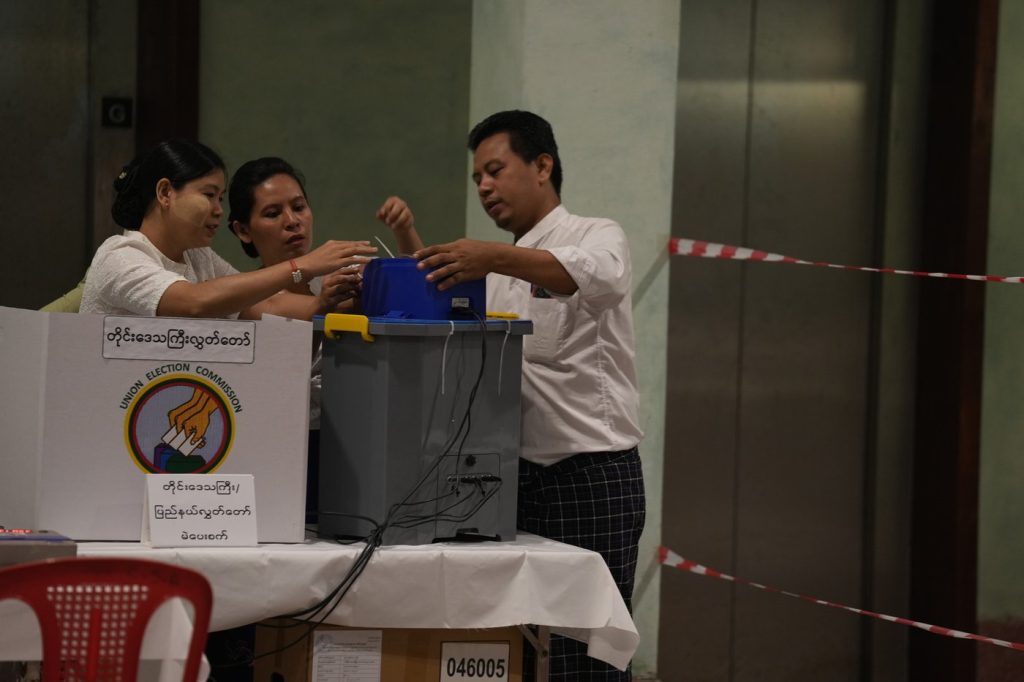
YANGON, Myanmar (AP) — On Sunday, voters in Myanmar participated in the first phase of the country's general election in five years, overseen by the military government amid ongoing civil conflict. This election follows the military coup in February 2021, which ousted the democratically elected government of Aung San Suu Kyi. Her party, the National League for Democracy (NLD), had achieved a landslide victory in the 2020 elections but was prevented from taking office for a second term.
Many critics argue that the election's primary purpose is to lend a veneer of legitimacy to the military's rule. In Yangon, the largest city, as well as in Naypyitaw, the capital, voters cast their ballots at various locations, including high schools and government buildings. Observers express concerns about the election's validity due to the exclusion of key political parties, limitations on free speech, and a pervasive atmosphere of repression. The expected success of the military-aligned Union Solidarity and Development Party (USDP) suggests that any transition to civilian governance may be illusory.
Maintaining this electoral process could, however, provide an opportunity for Myanmar's neighboring countries—like China, India, and Thailand—to justify continued support under the guise of promoting stability. In contrast, Western nations have levied sanctions against the military leaders for their anti-democratic actions and the violent suppression of dissent.
Security measures were visibly heightened in Yangon, with armed guards protecting polling stations and military vehicles patrolling the streets. Election officials implemented electronic voting machines for the first time, and despite threats from opposition groups to disrupt the voting process, significant unrest did not occur. Aung San Suu Kyi, now 80 years old, is unable to participate as she serves a 27-year prison sentence on charges widely regarded as politically motivated. The NLD was dissolved in 2023 after refusing to register under the military's new regulations.
Other political parties also opted not to register or declined to participate under what they deem unfair conditions, while opposition groups have called for a voter boycott. Analyst Amael Vier noted that the lack of genuine choices is evident, as 73% of voters in the 2020 election cast ballots for parties that no longer exist. Given the military's repressive climate, mobilizing opposition remains a significant challenge. The Assistance Association for Political Prisoners reports that over 22,000 individuals are currently detained for political offenses, and security forces have killed over 7,600 civilians since the military coup.
The situation has deteriorated since armed resistance began following the military's violent crackdown on peaceful protests. This civil war has displaced more than 3.6 million people, according to United Nations estimates. Furthermore, the new Election Protection Law imposes harsh penalties and restrictions, effectively silencing public critique of the elections. U.N. Human Rights Chief Volker Türk has condemned the intensified violence and intimidation in Myanmar, stating that there are no conditions enabling freedom of expression or peaceful assembly.
Both the military and its opponents appear to expect that power will remain with Senior General Min Aung Hlaing, who orchestrated the 2021 coup. Voting is being conducted in three phases, with the first phase occurring on Sunday in 102 of Myanmar's 330 townships. The second phase is scheduled for January 11, and the third for January 25, with final results projected to be announced by the end of January. Although over 4,800 candidates from 57 parties are competing for seats in the national and regional legislatures, only six are competing on a national level with a realistic chance of gaining influence in Parliament.








