

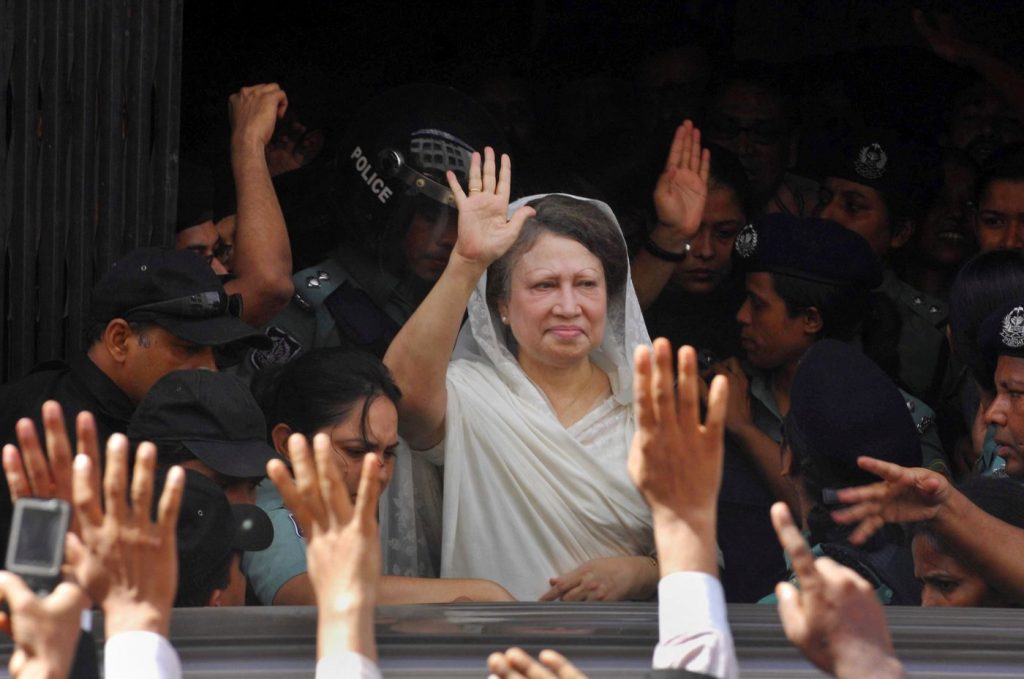
DHAKA, Bangladesh (AP) — Khaleda Zia, the former Prime Minister of Bangladesh and a key figure in the nation’s political landscape, has passed away at the age of 80, as confirmed by her party, the Bangladesh Nationalist Party (BNP), in a statement released on Tuesday. Zia was notable for being the first woman elected to the office of Prime Minister in the history of Bangladesh.
Throughout her political career, Zia was embroiled in corruption allegations that she asserted were politically motivated. However, in January 2025, the Supreme Court acquitted her of the last corruption charges, which would have allowed her to participate in the upcoming general elections in February.
In 2020, following her release from prison due to health issues, Zia’s family made multiple requests to the administration of her adversary, former Prime Minister Sheikh Hasina, for her to receive medical treatment abroad, all of which were denied. Later, after Hasina's removal from power in 2024 during a widespread uprising, an interim government led by Nobel Peace Prize laureate Muhammad Yunus permitted her to travel for treatment. Zia traveled to London in January and returned to Bangladesh in May.
The early years of Bangladesh’s independence, stemming from the 1971 war against Pakistan, were fraught with political turmoil characterized by assassinations and military coups. Zia was married to Ziaur Rahman, a former military chief who became president in 1977 and established the BNP. After his assassination in a military coup in 1981, Zia became a prominent political figure, advocating strongly against military rule, which contributed to the downfall of dictator H.M. Ershad in 1990.
Khaleda Zia faced significant political rivalry with Sheikh Hasina, who was her opponent in several elections, including Zia’s first win in 1991. Her tenure in the 1996 election was marked by controversy after the BNP won a vast majority amid a boycott from other parties, which led to her government lasting only 12 days before a caretaker government was installed.
In 2001, Zia returned to power in a coalition with Jamaat-e-Islami, an Islamist party with a controversial history. Her policies during this time were generally pro-investment and pro-business, but her leadership also faced allegations of allowing insurgents to operate against India from Bangladeshi territory. Additionally, she was linked to accusations of corruption involving her elder son, Tarique Rahman.
The rivalry between Zia and Hasina became increasingly contentious, especially in 2004 when a grenade attack during a rally killed several members of Hasina's party and was blamed on Zia’s administration. Following the 2014 elections, which saw a boycott by Zia's party, Hasina's regime gained an unchallenged victory, further intensifying the political strife.
In a dramatic twist in 2020, Zia was sentenced to 17 years in prison for corruption related to funds meant for a charity, a ruling that her party and supporters described as a politically motivated attempt to undermine opposition. Amid public outcry and criticism, Hasina’s government eventually released Zia due to her deteriorating health.
After being allowed to travel for medical treatment, Zia remained inactive in politics for years but held her position as the BNP chairperson until her death. Her son, Tarique Rahman, has acted as the party's chair since 2018. Khaleda Zia was last seen in a public appearance during a military function in Dhaka Cantonment on November 21, where she appeared frail and wheelchair-bound.
She leaves behind her elder son, Tarique Rahman, who is seen as her political heir, while her younger son, Arafat, passed away in 2015. The political legacy of Khaleda Zia is intertwined with the complex and often contentious history of Bangladesh’s governance and the dynamics between the BNP and Awami League, the two principal political parties in the country.








