

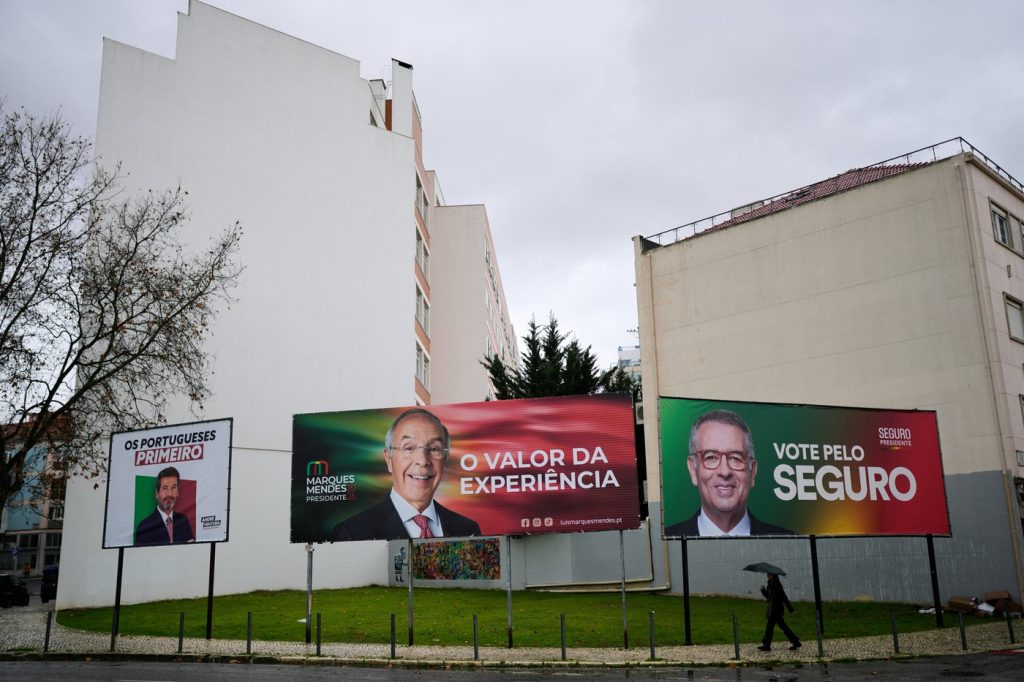
LISBON, Portugal (AP) — Portugal is gearing up for its presidential election on January 18, with a record 11 candidates officially launching their campaigns on Sunday. The two-week campaign period leading up to the election is expected to be highly competitive, as the diverse field of candidates makes it unlikely for any single contender to secure more than 50% of the vote. Should no candidate achieve this threshold, a runoff between the two leading candidates will take place on February 8.
Recent opinion polls highlight the frontrunners: Luís Marques Mendes, representing the center-right Social Democratic Party that is currently in power, and António José Seguro from the center-left Socialist Party. Both parties have alternated in governing Portugal for the past 50 years, and their candidates are anticipated to face strong competition from André Ventura, the leader of the populist anti-immigration Chega party. Chega's rising popularity recently propelled it to become the second-largest party in Portugal’s Parliament. Additionally, Henrique Gouveia e Melo, a retired rear admiral running as an independent, has gained public admiration for efficiently overseeing the rapid distribution of COVID-19 vaccines during the pandemic.
In Portugal, the presidency is primarily a symbolic position lacking executive power. The president is expected to remain neutral, overseeing political disputes to help mitigate tensions. Despite this, the president possesses significant authority, including the ability to veto parliamentary legislation—though this veto can be overridden—and the power to dissolve Parliament and call for snap elections.
Following Portugal's tumultuous political landscape marked by three general elections within a single year, the incoming head of state will likely need to foster consensus. Hot-button issues await the next president, particularly a controversial bill concerning limitations on citizenship acquisition and grounds for revocation, which was recently rejected by the Constitutional Court and sent back to Parliament. Moreover, a proposed government package of labor reforms has already sparked street protests and significant strikes, which will also require presidential consideration.
Additionally, the president may soon have to address legislation regarding euthanasia and physician-assisted suicide, a law approved by Parliament in 2022 that has encountered constitutional challenges and is currently stalled. Approximately 11 million people are eligible to cast their votes in this pivotal election, marking a critical moment in Portuguese politics.
As the campaign period progresses, candidates are expected to intensify efforts to engage voters on crucial electoral issues, with the outcome potentially reshaping the political landscape in Portugal.








