

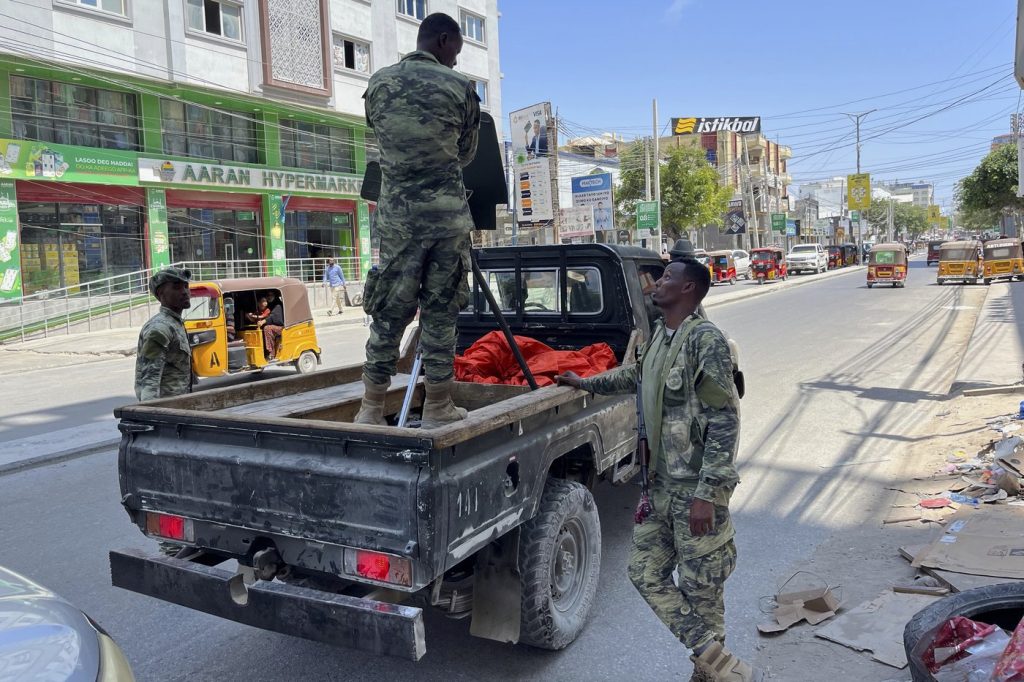
MOGADISHU, Somalia (AP) — In a bid to fortify its defenses against future militant attacks, Mogadishu has deployed a front line of operatives that ranges from machine gunners stationed in pick-up trucks to young men in plain clothes managing checkpoints across the city. Abdikani Ali Mohamed, a young colonel, leads this initiative as the Somali government intensifies efforts to dismantle the al-Shabab network, which has plagued the capital for years.
Mohamed’s team is alarmingly vigilant, with armored vehicles sparking suspicion if they go unchecked at a checkpoint for several days. “What we have clearly understood is these people (al-Shabab) are always evolving," Mohamed noted, emphasizing the militants' adaptive strategies in their attack mechanisms.
Following his election in 2022, President Hassan Sheikh Mohamud announced a "total war" against al-Shabab, a group notorious for its violent opposition to his government, which has resulted in the deaths and injuries of thousands over the years. His strategy focuses not only on frontline military engagements but also on undermining al-Shabab's financial operations and support among the general populace.
Somalia has struggled with political instability since the downfall of dictator Siad Barre in 1991, leaving the nation without a functioning central government. To combat the resurgence of al-Shabab, military operations backed by African Union peacekeepers and foreign military advisors, including forces from Egypt and Turkey, are essential. Intelligence gathering plays a central role in these operations, positioning the National Intelligence and Security Agency (NISA) as a vital component of the country’s security framework.
The last major attack by al-Shabab occurred in August 2024, resulting in numerous fatalities at Mogadishu's Lido beach. The group has also been involved in audacious plots, such as the attempted assassination of President Mohamud in March and a significant prison break in October. Security forces tout recent successes, citing the decreased frequency of major attacks within Mogadishu, where al-Shabab continues to impose its interpretation of Islamic law, leveraging connections with al-Qaida.
The "ring of steel" surrounding Mogadishu has reportedly made it more challenging for al-Shabab to infiltrate the city. According to independent analyst Abdi Guled, improvements in high-tech surveillance and intelligence sharing have resulted in the disruption of numerous militant cells. However, these gains remain tactical rather than strategic.
Al-Shabab's modus operandi typically employs improvised explosive devices hidden in vehicles, detonated at carefully chosen locations, particularly near hotels and government buildings where significant casualties can occur. These attacks have frequently resulted in the deaths of hundreds of civilians.
In response, hotels and restaurants frequented by government officials now utilize concrete barriers for protection, while fortified zones near the airport encase the presidency and most embassies, under Mohamed's security oversight. "For us, we are at war," Mohamed affirmed, emphasizing the need for enhanced security measures, including mandatory security camera installations for shop owners. He believes that this ongoing battle is one that they are currently winning.
Faced with military pressure, al-Shabab has retreated into southern and central Somalia, where guerrilla tactics prevail. Outside of Mogadishu, the conflict has shifted focus from rapid offensives to a slow war of attrition, as militants rearm and stage ambushes against government forces in remote areas. In the Lower Shabelle region, which has become a critical battleground, confrontations between government troops and al-Shabab have increased in frequency.
Mixed outcomes characterize the struggles of government forces in contested towns like Bariire, which has changed hands multiple times in the past year. As the holy month of Ramadan concluded, al-Shabab overtook Bariire, setting homes ablaze and displacing residents. Daynab Mukhtar Aden, a tea vendor, recounted her arduous 40-kilometer trek to safety before returning with hope after government troops reclaimed the city again.
However, the aftermath of the fighting is fraught with destruction, as al-Shabab has targeted infrastructure critical to transportation and access in the area. Lt. Col. Abdirahim Mohammed Munye from the Somali military remarked on the adeptness and evolving tactics of al-Shabab fighters, recognizing recent victories but acknowledging the challenges that remain. He asserted the importance of weakening al-Shabab in Lower Shabelle to secure Mogadishu, where a heavy security presence reassures citizens.
As development projects flourish across Mogadishu, the city is slowly but steadily returning to life. The hope for a more secure future is reflected in the activities of residents like Hajji Abuker Osman, who notes that the security situation has markedly improved and is critical to the city’s recovery.








