

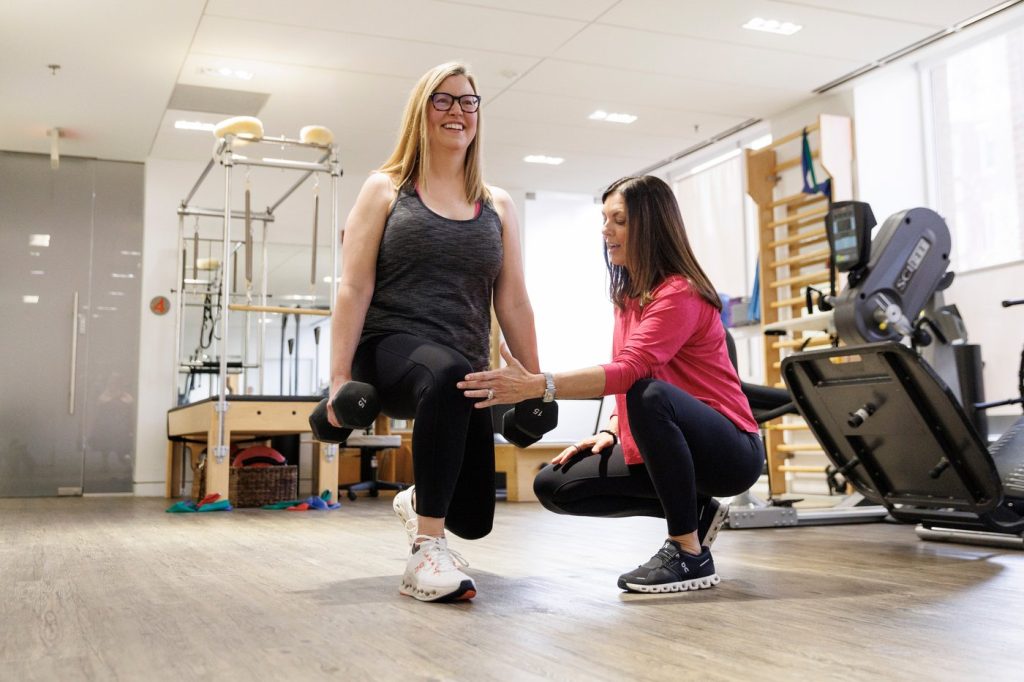
When Sarah Baldassaro reached the milestone of 50 years, she decided to evaluate her health and started collaborating with a fitness coach to focus on strength training. This form of exercise is deemed essential for women in midlife, particularly as they navigate the changes that come with aging.
Baldassaro, now 52 and residing in Alexandria, Virginia, reported feeling stronger than ever. She remarked, "My fitness level is much more like when I was in my early 30s." This transformation highlights how strength training can significantly impact one’s overall fitness and health.
Medical professionals emphasize that strength training is vital for maintaining bone and muscle health post-menopause. The loss of estrogen during this life stage accelerates the decline in bone density and contributes to the gradual loss of muscle mass. Engaging in resistance exercises not only aids in protecting these crucial bodily components but also assists women in maintaining a healthy weight and sticking to fitness resolutions.
Dr. Christina DeAngelis, an OB-GYN at Penn State Health, stated, "People underestimate how powerful it is." Hence, the question arises: What should a proper strength training regimen consist of, and how can one get started?
Physical therapist Hilary Granat explains that the health of bones and muscles is closely related. Resistance training, whether through dumbbells, free weights, or machines, allows muscles to pull on bones, stimulating bone-building cells. An example of a strength training exercise is the chest press, where an individual lies back on a bench or the ground, pressing weights upward from chest level.
Granat suggests working "close to muscle failure," meaning choosing weights that are sufficiently challenging and performing between six and 30 repetitions. A sign that one is pushing hard enough is a decreased tempo or the inability to complete another repetition with proper form. For instance, in exercises like bicep curls, beginners might start with weights ranging from 5 pounds (2.3 kilograms) to 20 pounds (9.1 kilograms).
Over time, Baldassaro has increased her weights up to 20 pounds for certain exercises, integrating techniques advised by her coach, Granat. While she continues with aerobic exercises, she emphasizes that "the strength training has really been the difference maker for me."
For those without access to weights, there are still numerous ways to build strength. Bodyweight exercises such as pushups, squats, lunges, situps, and planks can be performed without any equipment. Simple movements like transitioning from sitting to standing in a chair can also be beneficial, as noted by DeAngelis, who emphasizes engaging the core during such transitions. This helps in enhancing coordination and balance.
Granat discusses "impact training," emphasizing exercises like walking, hiking, running, jumping, skipping, and climbing stairs, with activities like rebound jumps involving 10 to 30 repetitions being particularly effective. However, she cautions that "we’re not talking about jumping hard and fast and a lot," suggesting that three days a week of such activities is adequate.
Additionally, balance exercises are crucial for middle-aged women as they help prevent falls and potential fractures. Activities such as tai chi, yoga, or even standing on one leg for about 30 seconds while performing daily tasks like brushing teeth can enhance balance.
Experts agree that these exercises are beneficial for individuals of all ages, especially as bone mass typically peaks between ages 25 and 30 and starts to decline around 40. After experiencing significant improvements in her health and fitness level, Baldassaro encourages others by stating, "Don’t wait. Get started.”








