

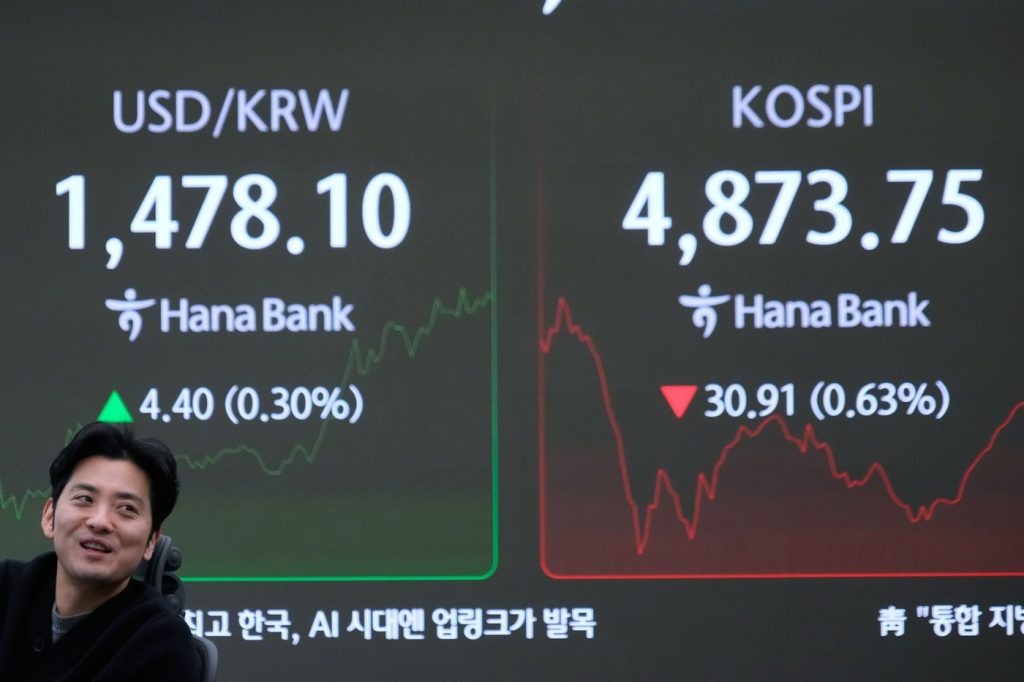
Asian shares experienced a mostly downward trend on Tuesday, following the closure of U.S. markets for Martin Luther King Jr. Day, a national holiday. U.S. futures indicated sharp declines after most European market benchmarks fell on Monday, while oil prices remained relatively flat.
Global stock markets were impacted by U.S. President Donald Trump's announcement to impose a 10% extra tariff on imports from eight European nations. This news incited a significant backlash from crucial trading partners who invest substantially in the U.S.
In Tokyo, the Nikkei 225 index dropped by 1.1% to close at 52,988.24. This decline came after Prime Minister Sanae Takaichi announced a snap election scheduled for February 8. The yields on Japanese government bonds surged in anticipation of the elections, with Takaichi's plans to dissolve parliament and proceed with an election aimed at leveraging her favorable public approval ratings. Furthermore, she proposed temporarily suspending the food tax, raising concerns about Japan's national finances.
Market anxieties escalated in response to the expectation that Takaichi will seek a renewed electoral mandate to increase government spending. Consequently, the yield on the 40-year Japanese government bond hit a record high of 4% on Tuesday, with other long-term bonds also experiencing significant increases to their yields, marking decades-high levels.
Chinese markets similarly faced declines. Hong Kong's Hang Seng index fell by less than 0.1%, finishing at 26,552.57, while the Shanghai Composite index slipped 0.3% to 4,101.62. Conversely, South Korea's Kospi gained 0.3%, ending at 4,921.42, while the S&P/ASX 200 in Australia dropped 0.6% to close at 8,818.10. Taiwan's Taiex experienced a modest increase of 0.1%, whereas India's Sensex remained unchanged.
This week is expected to yield additional corporate earnings reports in the U.S. and an update on the inflation metrics preferred by the Federal Reserve for policy decision-making. The next Federal Reserve policy meeting is slated for two weeks from now, where it is anticipated that the benchmark interest rate will be maintained at its current level, as the Fed aims to navigate a cooling job market alongside persistent inflation, which continues to exceed the Fed's 2% target. Meanwhile, the Bank of Japan is poised to hold a policy board meeting later this week.
On European markets, Germany's DAX index closed down by 1.3%, reaching 24,960.33, and the CAC 40 in Paris fell by 1.9% to 8,101.96. The FTSE 100 in the UK also faced a decline, dropping by 0.4% to 10,190.26.
In U.S. stock futures, early Tuesday saw the S&P 500 index decline by 1%, while futures contracts for the Dow Jones Industrial Average showed a decrease of 0.9%.
On Saturday, Trump confirmed his intention to impose a 10% import tax starting in February on goods from countries including Denmark, Norway, Sweden, France, Germany, the United Kingdom, the Netherlands, and Finland. This move was sparked by these nations' opposition to American control of Greenland. The affected European countries responded critically to Trump's tariff threats, asserting that such actions threaten transatlantic relations and could lead to a detrimental economic spiral.
In the commodities market, U.S. benchmark crude oil saw a minor increase of 4 cents, reaching $59.38 per barrel, while the international benchmark, Brent crude, added 12 cents to settle at $64.06 per barrel.
The U.S. dollar experienced a slight decline against the Japanese yen, falling to 157.98 yen from the previous rate of 158.14 yen. In contrast, the euro rose to $1.1658, an increase from $1.1645.








