

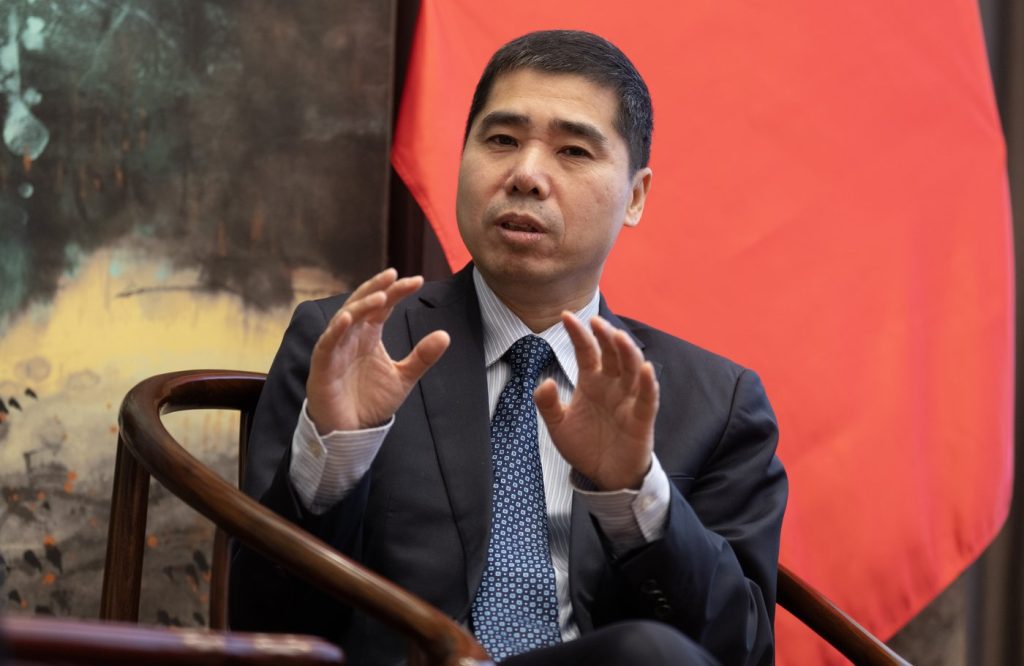
OTTAWA – China's ambassador to Canada, Wang Di, has called on the Canadian government to expedite progress in areas of collaboration that emerged during Prime Minister Mark Carney's recent trip to Beijing. In his first interview following Carney's visit, Wang emphasized that both nations should demonstrate sincerity in order to turn the agreements into tangible outcomes.
Wang stated, “The most important task for both sides is to respond as soon as possible to the expectation of the two peoples and to move along the direction that has been pointed out by the leaders of our two countries.” During Carney's visit, Chinese President Xi Jinping and Carney reached an agreement to tackle a tariff dispute, in which both countries had imposed tariffs on each other’s agricultural goods and electric vehicles.
Additionally, both leaders signed memorandums aimed at revamping working groups and institutional mechanisms. The agreements focus on crucial sectors such as finance, lumber, oil, green technology, and tourism, which Wang noted will lead to improved communication and expedited actions between government departments in both countries.
Carney is scheduled to return to China in November 2026 for the Asia-Pacific Economic Cooperation (APEC) summit in Shenzhen, giving both nations a ten-month window to deepen their collaboration. Wang remarked, “That requires us to lose no time and work faster to achieve more outcomes,” suggesting that this proactive approach will enable leaders to discuss the future of China-Canada relations at a higher level.
However, it is crucial to note that the areas of collaboration do not extend to sensitive issues related to Canada's national security, such as artificial intelligence, critical minerals, and defense. These sectors have raised alarms among analysts, particularly given the risks posed to ongoing trade discussions with the United States if Canada becomes too intertwined with China.
Wang acknowledged these concerns from Canada, stating that Beijing is committed to pursuing deeper collaboration in the sectors that are open for discussion. He reiterated the importance of “seeking common ground while reserving the differences,” a phrase that has been a staple in China's dialogue with Canada for years.
He expressed confidence in the potential for mutual benefits, asserting, “The character of the China-Canada relationship is win-win and mutual benefit. There is great potential and promising prospects for China and Canada to leverage our complementary advantages.” Nonetheless, he admitted that differences still exist between the two nations.
Carney has characterized his diplomatic approach as a “recalibration” of Canada's relations with China rather than a complete reset. This strategy allows Ottawa to maintain focus on ongoing concerns regarding foreign interference, human rights, and the South China Sea while emphasizing opportunities for collaboration.
Uncertainty remains regarding Ottawa's Indo-Pacific strategy released in late 2022, which framed China as a “disruptive global power” and identified a need for increased collaboration with other Asian nations to mitigate dependency on Beijing. In October 2026, Foreign Affairs Minister Anita Anand instructed her department to revise this strategy, aligning it with the evolving dynamics of relations with both China and India.
Wang indicated that it is ultimately up to Canada to redefine its regional strategy. However, he pointed out that the Indo-Pacific strategy has been a source of “serious concern” for China since its release, suggesting that current discussions framing a new “strategic partnership” do not align with this previous strategy.
Analysts have advised Canada to exercise caution in its engagement with China. Some advocate for the need to pragmatically address human rights issues, potentially through joint statements with allied nations. Others have accused Beijing of leveraging economic influence to silence criticism on contentious issues.
Wang underlined the expectations from both Chinese and Canadian populations for leadership that fosters opportunities and stability in a tumultuous global landscape. He articulated that industry leaders on both sides have high hopes for the outcomes of Carney's visit and urged officials to promptly translate these outcomes into practical results.
Furthermore, Wang expressed optimism for future relations, especially as Canada prepares to welcome its Chinese counterpart, Wang Yi, later this year. He concluded by noting that historical evidence supports the notion that cooperation leads to significant achievements when both nations align their goals.








