

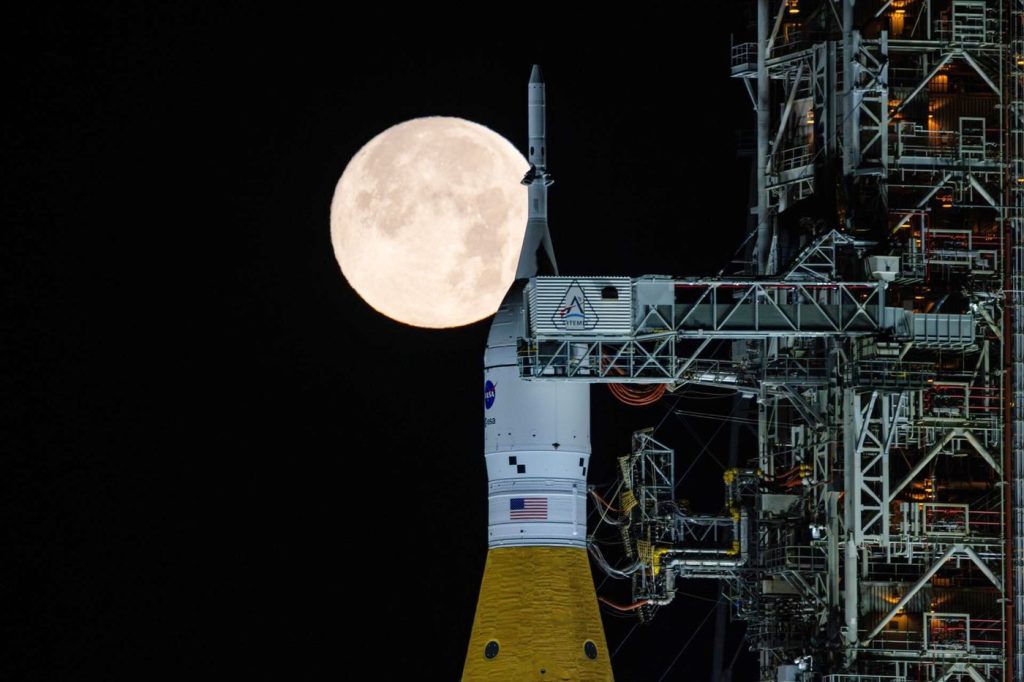
CAPE CANAVERAL, Fla. (AP) – NASA has announced that it will now aim for a launch in March for its new moon rocket, following persistent fuel leaks encountered during a critical test that took place just a day prior. The fuel leaks were reminiscent of issues that delayed the rocket’s debut three years ago and raised questions about the potential timeline for sending astronauts into space.
In a statement, NASA explained that the delay will provide teams with the necessary time to review the data collected during the test and conduct a second wet dress rehearsal before the upcoming flight test. The wet dress rehearsal simulates a real countdown and includes the fueling of the rocket.
The problematic leaks emerged only a few hours into the daylong fueling operation at Kennedy Space Center, which involved loading over 700,000 gallons of super-cold hydrogen and oxygen into the 322-foot (98-meter) rocket. This process is crucial as it mimics the final stages of an actual launch countdown, but the build-up of excessive hydrogen halted the loading process multiple times. Launch controllers had to employ techniques developed during previous Space Launch System countdowns to work around the issues.
NASA acknowledged that the testing phase also faced delays due to problems encountered during close-out operations and recurring audio dropout issues impacting ground crew communications. As a result of these complications, the four astronauts assigned to the mission, comprising three Americans and one Canadian, were removed from their nearly two-week quarantine, with plans to implement a new quarantine period approximately two weeks before the next projected launch window.
While the space agency did not specify an official launch target for March, it stated that teams need to thoroughly review the test data, address each identified issue, and return to testing before confirming any specific launch date. Prior to the postponement, the earliest possible launch date was set for no sooner than Sunday.
The mission aims to send the astronauts on a nearly 10-day journey past the moon, around its far side, and then back to Earth, focusing on testing key systems such as life support. Unlike the Apollo missions, which included lunar landings, this mission will not attempt to land on the moon but is intended to lay the groundwork for future manned moon landings.
NASA last sent astronauts to the moon during its Apollo program in the 1960s and 1970s. The current Artemis program seeks to establish a sustained human presence on the lunar surface, using the upcoming missions as a stepping stone for future exploration endeavors.
The space agency has limited opportunities for launches each month, and the extreme cold has further constrained the launch window for February, shortening it by two days. Working under tight schedules, countdown clocks were engaged Saturday night, allowing controllers to navigate through all necessary procedures before an eventual launch.
As anticipation builds for the next lunar missions, NASA is focused on resolving existing technical challenges while ensuring the readiness of its crew and systems for the next phase of human space exploration. The upcoming Artemis mission is viewed not only as a critical test of technological capabilities but also as a significant step toward humanity’s continued exploration of the moon and beyond.








