

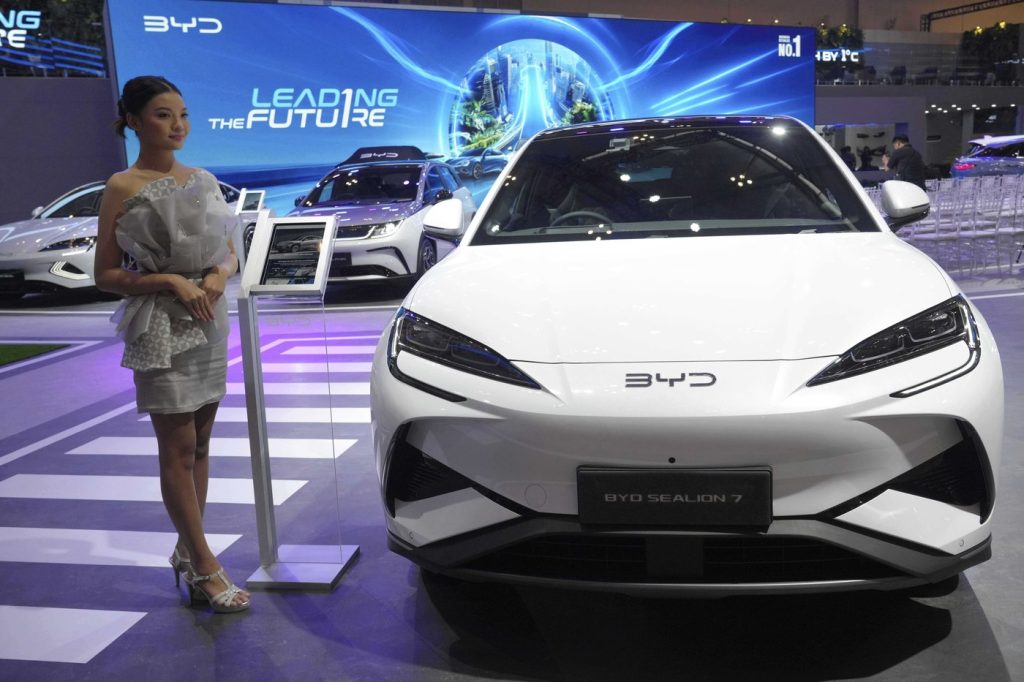
OTTAWA The recent agreement between Ottawa and Beijing allowing a limited number of Chinese electric vehicles (EVs) to enter Canada has sparked criticism, with concerns raised about potential impacts on local industries. Beijing's envoy, Chinese Ambassador to Canada Wang Di, emphasized that this partnership aims to create good jobs for Canadian autoworkers and make cars more affordable. He expressed this sentiment during a statement to The Canadian Press, asserting that cooperation between the two nations will drive job growth and enhance the Canadian EV industry.
Prime Minister Mark Carney and Chinese President Xi Jinping signed the deal which introduces a 6.1 percent tariff on Chinese EVs. The agreement permits an annual import quota of up to 49,000 Chinese EVs, stipulating that half of these must be priced below $35,000 by 2030. Before this agreement, Canada, alongside the U.S., had imposed a 100 percent tariff on Chinese EVs since 2024, citing unfair subsidies in China's EV sector and dumping practices in North America.
The tariff imposed by Canada resulted in reciprocal tariffs on Canadian agricultural exports from China. However, in a bid to alleviate tensions regarding agricultural trade, China consented to ease tariffs on Canadian agricultural products in exchange for allowing Chinese EVs into its market.
Despite the potential benefits highlighted by Wang, some local leaders, including Ontario Premier Doug Ford, have expressed skepticism. Ford labeled the agreement a "lopsided deal," raising worries about an influx of inexpensive Chinese EVs potentially undermining domestic automakers and limiting their access to the critical U.S. market. Union leaders, like Unifor’s Lana Payne, described the arrangement as a "self-inflicted wound," cautioning that Chinese EVs could rapidly capture market share as seen in other regions.
Wang countered these fears, asserting a shared interest between Ottawa and Beijing in bolstering Canada's manufacturing sector. He stressed the importance of providing a fair and predictable business environment for Chinese investors. "The character of China-Canada practical cooperation is complementarity and mutual benefit," he stated, emphasizing the potential for joint ventures that could yield benefits on both sides.
A senior government official involved in Carney's discussions claimed that the deal is not viewed as a threat but rather a strategic move toward the eventual production of Chinese EVs in Canada. Wang stressed that if Chinese companies take advantage of this opportunity for collaboration, it could foster a "win-win" situation.
While some analysts remain critical, pointing out that China's industrial policies and subsidies could lead to a surplus of low-cost vehicles that may harm local industries, others advocate for collaboration and investment in Canada. Margaret McCuaig-Johnston of the China Strategic Risks Institute raised concerns about deindustrialization and the implications of surveillance capabilities associated with Chinese EV software. However, some experts believe that successful partnerships could be established, citing examples like Magna International’s collaboration with a Chinese manufacturer to produce vehicles in Austria.
The dialogue around this agreement unfolds amidst broader discussions about the implications of international trade and partnerships in the evolving automotive landscape. Engaging in strategic negotiations could potentially allow Canada to leverage its strengths and align with regional advantages through cooperation with China.
This report showcases the complexities of cross-border agreements in an industry rapidly transforming due to technological innovation and global economic changes, reflecting the broader context of Canada-China relations.








