

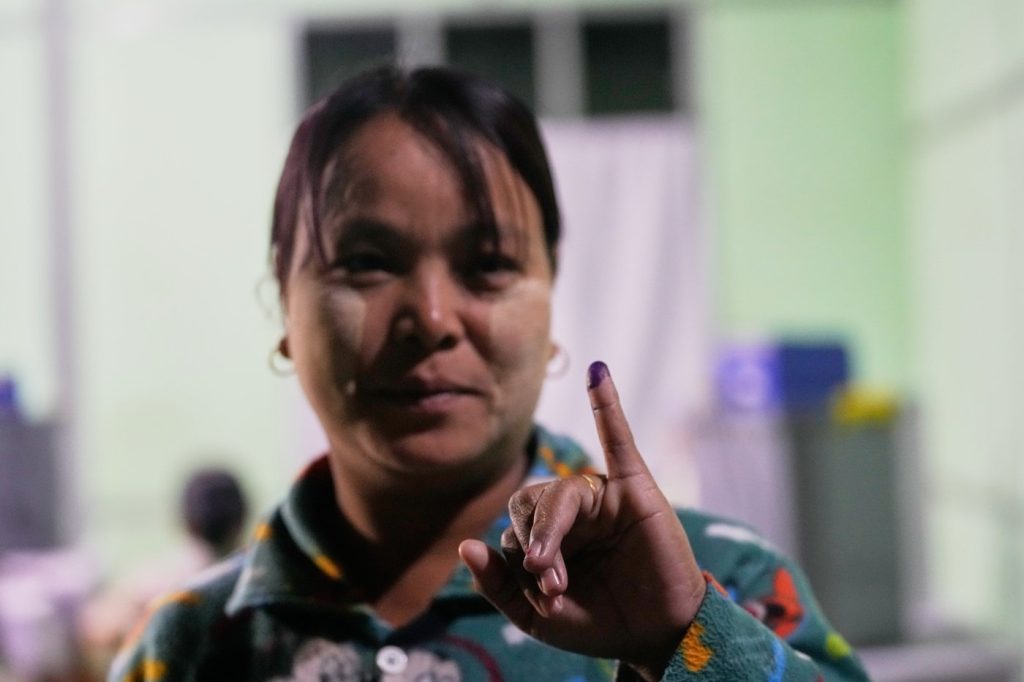
YANGON, Myanmar (AP) — Voting commenced on Sunday in Myanmar for the final round of a three-phase general election, wrapping up a process that has lasted nearly a month. This election ensures that the military rulers and their allies will secure a parliamentary majority, enabling them to establish a new government.
Critics argue that the elections lack legitimacy and are neither free nor fair, asserting that they are merely a façade to legitimize military control following the February 2021 coup that ousted the elected civilian government led by Aung San Suu Kyi. The army-backed Union Solidarity and Development Party (USDP) has already amassed a significant number of seats from the earlier two voting rounds.
According to electoral rules, 25 percent of the seats in both the upper and lower houses of the national Parliament are reserved for the military, which guarantees substantial legislative control for both the military and its affiliates. As per expectations from both supporters and dissenters, Senior General Min Aung Hlaing, who leads the military government, is poised to take on the presidency when the new Parliament convenes.
The elections have been conducted amidst strict restrictions on public discourse. The military’s efforts are seen as attempts to solidify its grip on power following the widespread opposition triggered by the coup, which plunged Myanmar into a civil war. Due to escalating violence, voting did not occur in over one-fifth of Myanmar’s 330 townships, further alienating the legitimacy of the electoral process.
Malaysian Foreign Minister Mohamad Hasan has publicly stated that the Association of Southeast Asian Nations (ASEAN) would not recognize the election results, reflecting grave concerns regarding the absence of free and inclusive participation. Observers from countries like Russia, China, Belarus, and other authoritarian regimes, as well as democratic nations like India and Japan, have been sent, but their presence is viewed skeptically amid claims of electoral manipulation.
Aung San Suu Kyi, now 80, and her party, the National League for Democracy (NLD), are boycotting the elections. She is currently serving a 27-year prison term on charges widely considered to be politically driven. The NLD was dissolved in 2023 after refusing to comply with new military regulations for party registration. Many other parties have also chosen not to run under the current conditions or have threatened a voter boycott.
The recently enacted Election Protection Law has imposed harsh punishments for public dissent about the elections, with authorities penalizing over 400 individuals for activities such as distributing leaflets or posting online content critical of the military regime. The first two voting rounds encountered interruptions from armed groups opposed to military governance, resulting in attacks on polling stations and administrative buildings.
The final round of voting resumed at 6 a.m. on Sunday across 61 townships in six regions and three states struggling with recent clashes. The phased electoral process was necessitated by ongoing armed conflicts, with previous rounds occurring on December 28 and January 11 across 202 of Myanmar's townships. Due to the violent unrest, a total of 67 townships did not participate, ultimately modifying the number of available parliamentary seats from 664 to 586.
The military government has indicated that final results would be disclosed later in the week, with Parliament expected to convene in March and the new government assuming its duties in April. The party achieving a majority in the combined upper and lower houses will select the next president, who will consequently appoint the Cabinet and lead the new government.
Initial figures released by the Union Election Commission reflected that the USDP won 233 seats in both Parliamentary chambers. Together with the reserved 166 seats for the military, they hold nearly 400 seats, significantly exceeding the 294 required to establish power. A total of 4,800 candidates from 57 political parties are vying for positions in national and regional legislatures, with only six parties competing on a nationwide scale. The military has reported more than 24 million eligible voters, marking a decline of approximately 35% compared to 2020, and the turnout for the initial two rounds of voting ranged between 50% and 60%.








