

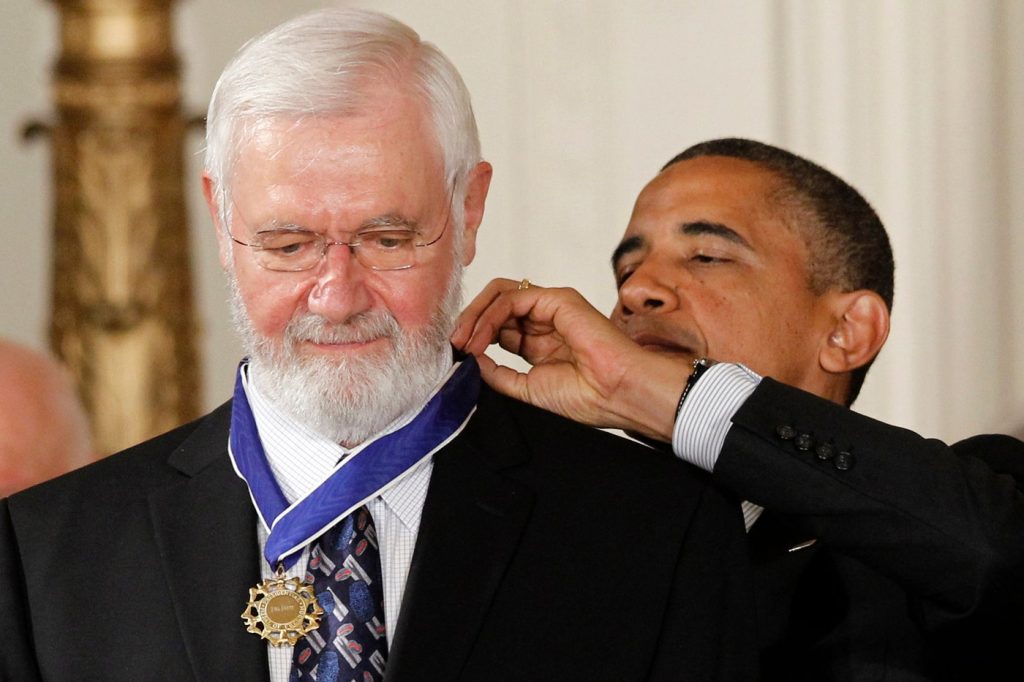
ATLANTA (AP) — Dr. William Foege, a prominent figure in one of humanity's most significant public health achievements — the global eradication of smallpox — has passed away at the age of 89. He died on Saturday in Atlanta, as reported by the Task Force for Global Health, an organization he co-founded.
Standing tall at 6 feet 7 inches, Foege was a distinguished medical doctor recognized for his intellectual prowess and composed demeanor. Throughout his career, he displayed an extraordinary ability to combat infectious diseases. He served as the director of the U.S. Centers for Disease Control and Prevention (CDC) during the late 1970s and early 1980s, and held various key leadership positions aimed at addressing international health challenges.
Foege's most significant contribution came through his work with smallpox, a disease notorious for its lethality, killing approximately one-third of those infected and leaving survivors with severe facial scarring from its pustules. By the time Foege became a young doctor, smallpox vaccination programs were well-established, and the disease was no longer prevalent in the United States. However, outbreaks continued elsewhere, and progress in eradicating the disease was stalling.
While working as a medical missionary in Nigeria during the 1960s, Foege and his colleagues devised a groundbreaking “ring containment” strategy. This method involved identifying smallpox cases and vaccinating anyone who may have had contact with those infected. This approach was essential because there was insufficient vaccine supply to immunize the entire population, as Foege recounted in his 2011 book “House on Fire.”
The ring containment strategy proved successful and became a critical component in the global effort to eradicate smallpox. The last naturally occurring case was recorded in Somalia in 1977, and in 1980, the World Health Organization officially declared smallpox eradicated from the planet.
Dr. Tom Frieden, a former CDC director who often consulted with Foege, acknowledged his impact, stating, “If you look at the simple metric of who has saved the most lives, he is right up there with the pantheon. Smallpox eradication has prevented hundreds of millions of deaths.”
Born on March 12, 1936, Foege was the son of a Lutheran minister and developed an interest in medicine at the age of 13 while working at a drugstore in Colville, Washington. He received his medical degree from the University of Washington in 1961, followed by a master's in public health from Harvard in 1965.
Foege served as director of the CDC from 1977 to 1983, and later took on international public health leadership roles. His positions included executive director at The Carter Center and senior fellow at the Bill and Melinda Gates Foundation. In recognition of his lifetime of work, President Barack Obama awarded Foege the Medal of Freedom, the highest civilian honor in the United States, in 2012. Additionally, in 2016, Duke University President Richard Brodhead referred to Foege as “the Father of Global Health” while presenting him with an honorary degree.
Dr. Patrick O’Carroll, CEO of the Task Force for Global Health, noted Foege’s unwavering dedication to improving global health through science and collaboration. “We try to honor that commitment in every one of our programs, every day,” he stated in a statement.
Jack Dura contributed to this report from Bismarck, North Dakota.
— Mike Stobbe, The Associated Press








