

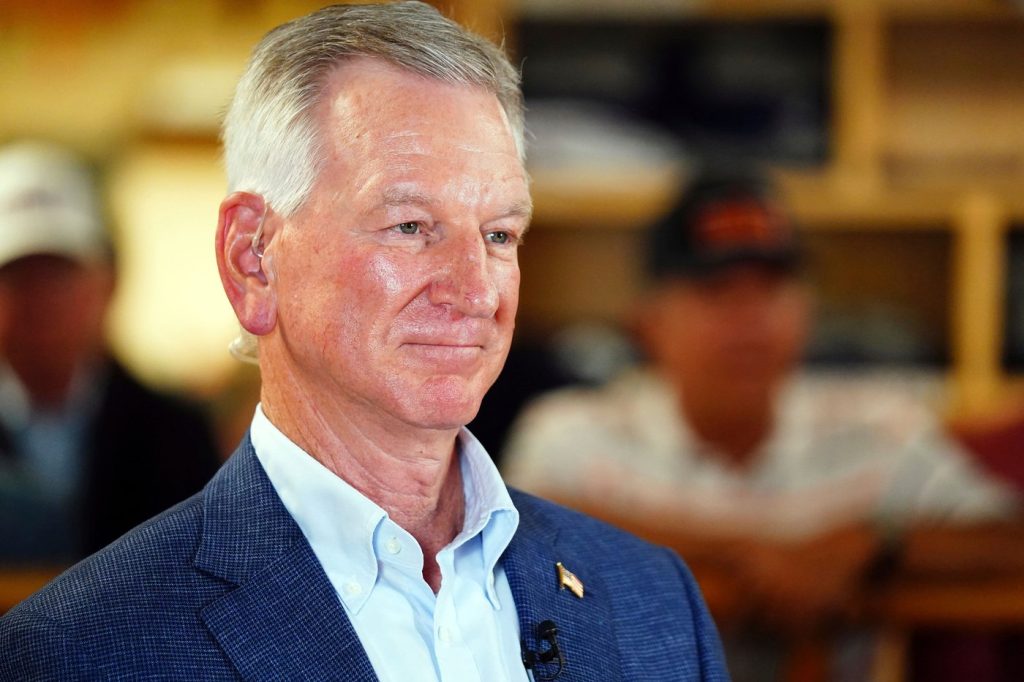
MONTGOMERY, Ala. (AP) — A Republican challenger, Ken McFeeters, has filed a claim with the Alabama Republican Party contesting U.S. Senator Tommy Tuberville's eligibility to run for governor. McFeeters argues that Tuberville has not fulfilled the legal prerequisite of residing in Alabama for the past seven years. He alleges that the senator primarily resides in a multimillion-dollar beach home in Florida while claiming to live at a significantly smaller residence in Auburn, Alabama.
According to property tax records, Tuberville owns a home in Auburn valued at approximately $291,780, for which he claims a homestead exemption. In contrast, his beach home in Walton County, Florida, is valued at around $5.5 million. Property records indicate that Tuberville's name was added to the Auburn property, which was originally purchased by his wife and son in 2017, while his son’s name was later removed. Recently, both properties appear to have been transferred into a revocable trust, with Tuberville's wife serving as the trustee.
In a phone interview, McFeeters expressed that it is misleading for Tuberville to expect the people of Alabama to believe he sincerely lives in a modest home amidst his ownership of an expensive beach house. He stated, "Where would you live?" highlighting the disparity between the two residences. McFeeters noted in his letter to the party that the existing records suggest that Tuberville may be using the Auburn address merely as a convenient location rather than as his true domicile. He pointed out Tuberville’s frequent travels to the Florida Panhandle as further evidence of his primary residence being in Florida.
Mallory Jaspers, a spokesperson for Tuberville, dismissed the challenge as a “ridiculous PR stunt from a desperate candidate.” She emphasized that Tuberville has effectively represented Alabama in the Senate for the past six years and stated that McFeeters' accusations did not hold weight during Tuberville's Senate campaign in 2019. According to Jaspers, Tuberville's Auburn home remains his primary residence.
These allegations are not new for Tuberville, as he faced similar criticisms during his Senate campaign when opponents referred to him as a "Florida man" and "tourist in Alabama." It's notable that the Senate has a less stringent residency requirement than the governorship. Earlier this month, Tuberville stated to the Associated Press that he believes he meets the necessary residency qualifications, adding that he would not be pursuing the gubernatorial race if he thought there was an issue. He indicated confidence in the Republican Party's perspective on the matter.
Tuberville, who served as the head football coach at Auburn University from 1999 to 2008, also coached at Texas Tech and the University of Cincinnati before working for ESPN. A promotional video from 2017 featured him discussing his move to Florida after retiring from coaching; the senator registered to vote in Florida in 2018 before changing his registration to Alabama on March 28, 2019—just weeks prior to announcing his Senate candidacy.
The Alabama Republican Party's spokeswoman, Jeannie Burniston, noted that any challenges are reviewed and decided by the party’s 21-member steering committee. She stated that the committee will assess whether there is sufficient evidence for a hearing where both sides can present their cases. The Alabama Constitution stipulates that the governor and lieutenant governor must have been U.S. citizens for ten years and resident citizens of Alabama for at least seven years prior to the election. McFeeters emphasized the importance of the party taking the challenge seriously and suggested that Tuberville should provide clear evidence of his seven consecutive years of residency in Alabama.
Legal expert Susan Pace Hamill from the University of Alabama School of Law commented on the ambiguity of the residency requirement. She noted that while it could imply seven consecutive years, it could also be interpreted as seven years with interruptions for time spent living elsewhere. However, Hamill contended that Alabama's historical context supports an interpretation that demands seven uninterrupted years of residency.








