

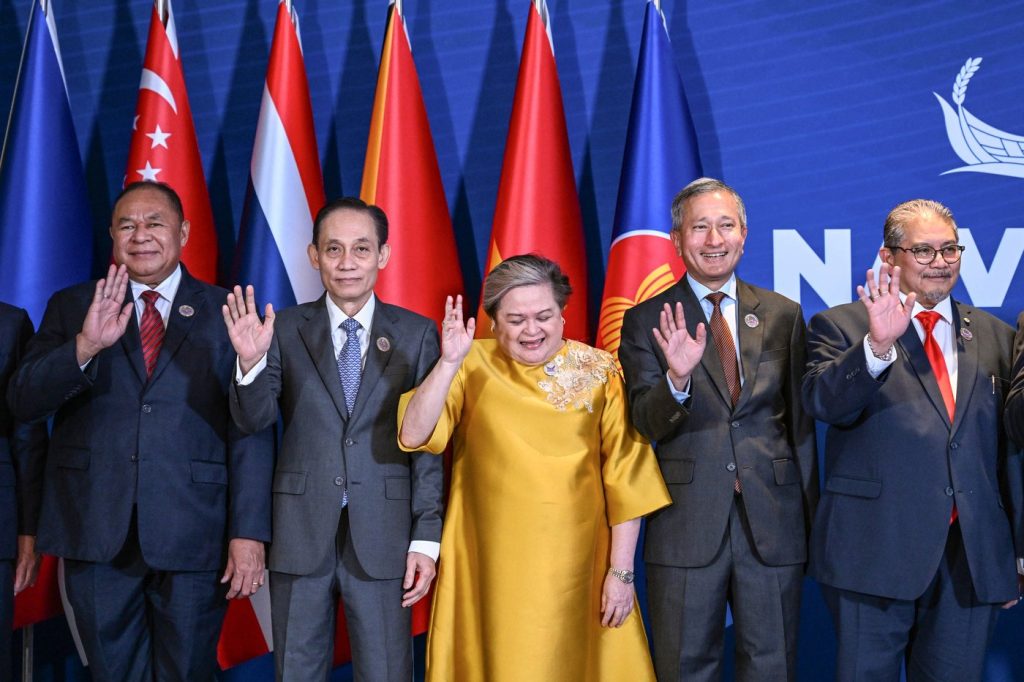
CEBU, Philippines (AP) — Southeast Asian nations are urged to persistently practice restraint and adhere to international laws, as escalating acts of aggression in Asia and unilateral actions elsewhere threaten the rules-based global order, according to Philippine Foreign Secretary Theresa Lazaro. Speaking on Thursday during the first significant closed-door meetings of the Association of Southeast Asian Nations (ASEAN) in the central seaside city of Cebu, Lazaro raised concerns about geopolitical tensions but refrained from providing specific details.
ASEAN members have voiced their apprehensions regarding a covert U.S. military operation that led to the arrest of Venezuelan leader Nicolás Maduro on the orders of then-U.S. President Donald Trump. Additionally, China's increasingly aggressive posture concerning Taiwan and its ongoing disputes in the South China Sea have been troubling regional security for years. Balancing diplomatic relations with both the U.S. and China, major trading and defense partners to ASEAN countries, has presented a considerable challenge.
“Across our region, we continue to see tensions at sea, protracted internal conflicts, and unresolved border and humanitarian concerns,” Lazaro stated during her opening remarks. She emphasized that developments outside Southeast Asia, particularly unilateral actions with regional ramifications, are impacting stability and undermining multilateral institutions and the international order.
Lazaro highlighted the crucial need for adherence to ASEAN’s foundational principles of restraint, dialogue, and compliance with international law to promote peace and stability in the region. As the Philippines currently holds the rotating chair of ASEAN for the year, it assumed this position in lieu of Myanmar, which was suspended from the chairmanship following the military coup that ousted Aung San Suu Kyi's democratically elected government in 2021.
Founded in 1967 during the Cold War, ASEAN comprises a diverse membership that includes vibrant democracies like the Philippines, allied with Washington, and authoritarian regimes such as Laos and Cambodia, which have closer ties with Beijing. The theme for ASEAN this year is “Navigating our future, Together,” but efforts to present a united front faced challenges last year when violent clashes erupted between two member states, Thailand and Cambodia, over a longstanding border dispute.
In addition to discussing the border conflict, the ASEAN foreign ministers are expected to negotiate how to advance a five-point peace plan concerning Myanmar, which was issued by the region's leaders in 2021. The plan calls for an immediate cessation of hostilities, yet has yet to deliver results in terms of stopping violence or fostering dialogue among conflicting parties.
There is also significant pressure on ASEAN foreign ministers to finalize negotiations with China by a self-imposed deadline this year regarding a so-called “code of conduct” aimed at managing disputes over unresolved territorial claims in the South China Sea. This body of water is vital for global trade and is subject to extensive claims from China that conflict with those of four ASEAN members: the Philippines, Malaysia, Vietnam, and Brunei.
In conclusion, the ongoing discussions at the ASEAN Foreign Ministers' Retreat reflect the complexities and challenges facing the region as member states navigate international pressures and internal conflicts, striving to uphold peace and stability in Southeast Asia.








