

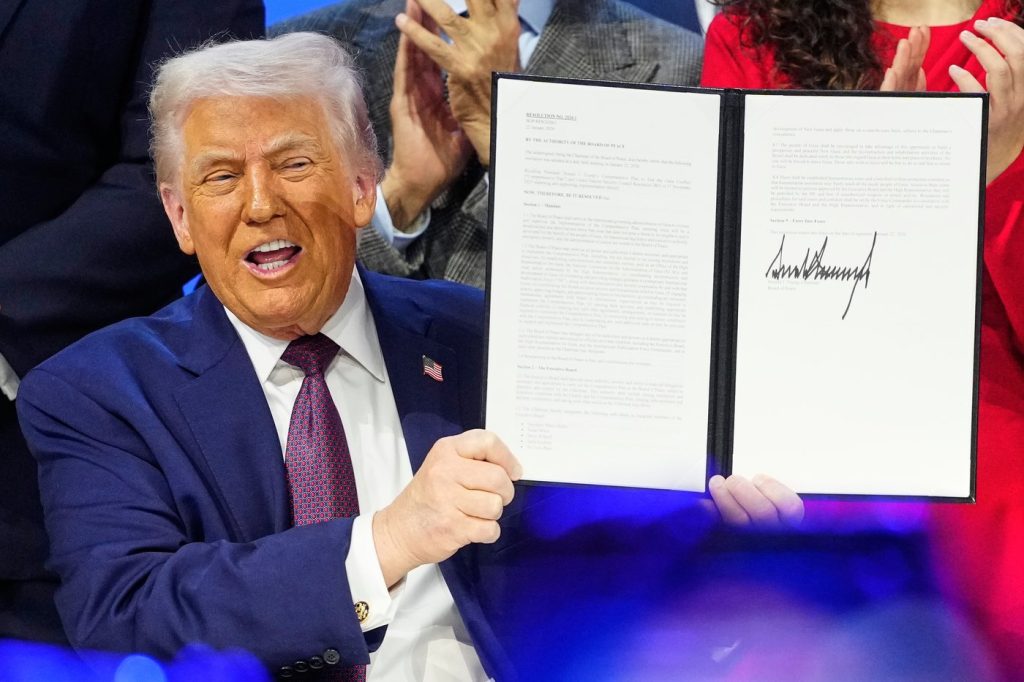
UNITED NATIONS (AP) – President Donald Trump's recent attempt to circumvent the United Nations with his new Board of Peace has unexpectedly resulted in significant pushback from major world powers. This initiative, which was initially intended to oversee Trump's plan for a ceasefire in Gaza, has faced rejection from several key nations, leading them to reaffirm their allegiance to the existing 80-year-old global institution.
The Board of Peace, chaired by Trump, was projected to be a small group of world leaders focusing on the future of Gaza. However, as Trump's ambitions expanded to include mediation in global conflicts, concerns arose regarding the board's potential to overshadow the U.N. Security Council, traditionally responsible for maintaining international peace and security. This expansion of vision has caused discontent among various nations.
Trump's charter for the board includes a clause stating that he will lead it until his resignation and maintain veto power over its actions and membership, alarming many stakeholders. To mitigate these concerns, Secretary of State Marco Rubio emphasized that the board would currently concentrate on phases of the Gaza ceasefire plan, asserting that it was not intended to replace the U.N.
Despite Trump's assurances, his proposal to broaden the board’s mandate and hints at possibly replacing the U.N. have alienated many countries. Public statements from U.S. allies and adversaries alike, both in formal Security Council settings and in private discussions, have indicated a dismissal of Trump’s efforts to challenge the post-World War II international order.
Richard Gowan, an expert on the U.N. from the International Crisis Group, remarked that the extensive rollout of the Board of Peace's charter may have turned it into a liability, suggesting that nations inclined to support Gaza’s interests perceived the board as cultivating an image akin to a "Trump fan club," which deterred participation. He speculated that retaining focus solely on Gaza might have attracted more European and other nations.
Key members of the Security Council, including China, France, Russia, and the United Kingdom, have either rejected or not yet indicated interest in joining Trump's board, a sentiment echoed by significant economic powers like Japan and Germany. Recent invitations sent to world leaders to be “founding members” of the Board of Peace coincided with an unsettling moment when Trump advanced a proposition to acquire Greenland, triggering sharp rebuttals from Denmark and Canada, among others.
Shortly afterward, Trump altered his stance on Greenland, claiming to have reached an agreement with NATO's secretary general regarding Arctic security. Amid this diplomatic turbulence, the UK Prime Minister Keir Starmer reaffirmed the nation's commitment to the U.N. following a meeting with U.N. Secretary-General António Guterres. The UK, along with France, Spain, and Slovenia, ultimately opted not to join the board, citing its conflicting agenda with the U.N.
President Emmanuel Macron of France expressed apprehension over the board, highlighting its potential to undermine U.N. principles. Likewise, Spanish Prime Minister Pedro Sánchez rejected participation due to the board's exclusion of the Palestinian Authority and its disassociation from the U.N. framework. Adversarial nations, including China, have similarly avoided Trump’s initiative, emphasizing the necessity to reinforce the U.N. rather than diminish its role.
As a result, only about 26 of the approximately 60 invited countries have joined the board thus far, with nine European nations declining involvement. One notable absentee at the signing ceremony held at the World Economic Forum in Davos, Switzerland, was India, which continues to contemplate its response. Trump's withdrawal of an invitation to Canadian Prime Minister Mark Carney further highlighted the tensions surrounding the initiative.
In the midst of these developments, eight Muslim nations, including Turkey, Saudi Arabia, Egypt, Jordan, Indonesia, Pakistan, Qatar, and the United Arab Emirates, expressed support for the Board of Peace in its mission for Gaza and the advancement of Palestinian statehood, though they did not address Trump's broader global plan. Analysts remain skeptical regarding the board’s longevity and impact, suggesting that the challenges of stabilizing Gaza will likely dominate its agenda rather than posing a serious threat to the U.N.'s standing.








