

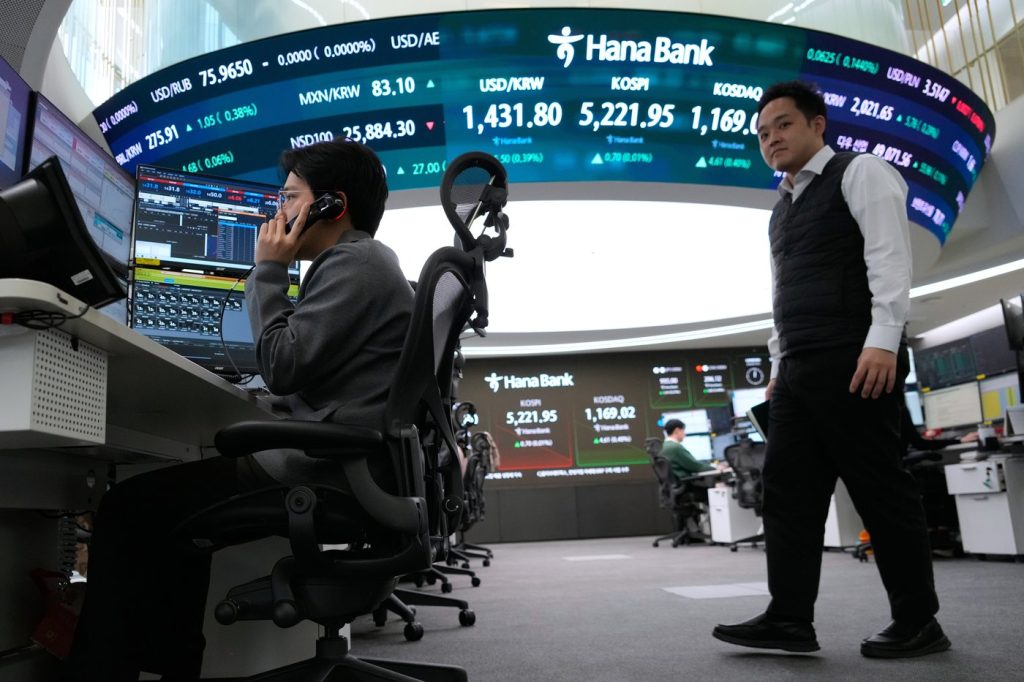
Shares in Asia experienced a downturn on Friday following a tumultuous day on Wall Street, marked notably by Microsoft's significant drop, which was its steepest decline in nearly six years. Oil prices also saw a decline exceeding $1, alongside weakening prices for gold and silver.
The Nikkei 225 index in Tokyo fell by 0.5%, closing at 53,119.18, driven down by declines in stocks related to artificial intelligence. Notable losses were seen in Advantest, a testing equipment maker, which dropped 5.4%, and Disco Corp., a computer chip equipment maker, which decreased by 2.4%.
Chinese markets similarly retreated, with the Hang Seng index in Hong Kong decreasing by 1.1% to 27,660.80, while the Shanghai Composite index slipped 1.2% to 4,109.36. Contrastingly, South Korea's Kospi index was an outlier, gaining 1% to reach 5,271.81, extending its series of record highs.
In Australia, the S&P/ASX 200 index experienced a downturn of 0.3%, settling at 8,904.10, and Taiwan's benchmark index lost 1.2%. Meanwhile, U.S. stocks concluded the day with relatively modest movements, as the S&P 500 fell by 0.1% after an earlier flirtation with record highs, closing at 6,969.01. The Dow Jones Industrial Average slightly rose by 0.1% to reach 49,071.56, while the Nasdaq composite dipped by 0.7% to 23,685.12.
Microsoft, in particular, had a heavy impact on the market, plummeting by 10%, despite reporting stronger-than-expected profits and revenue for the latest quarter. Investors remained focused on the company's spending on investments and potential slowing growth in its Azure cloud business. This marked Microsoft's worst trading day since the initial COVID-19 crash in 2020.
Tesla also weighed on market performance, experiencing a 3.5% drop. Even though it reported a larger profit for the latest quarter than analysts anticipated, the results were significantly lower compared to the previous year. CEO Elon Musk has been attempting to shift investors’ focus from declining car sales to the company's ambitions in robotaxis and robotics.
Across the market, companies face pressure to deliver robust profit growth following substantial increases in stock prices. Historically, stock prices align with corporate profits, making growth essential to offset criticisms of overvalued stocks.
Despite overall market declines, more stocks within the S&P 500 saw gains than losses. Meta Platforms emerged as a standout performer, surging by 10.4% after exceeding profit expectations, while planning to continue its extensive investments in artificial intelligence. Additionally, IBM benefited from surpassing analysts' profit and revenue expectations, rising by 5.1%. Southwest Airlines soared 18.7%, despite a disappointing profit forecast, following an optimistic outlook for 2026 fueled by improvements, including the imposition of baggage fees and the introduction of assigned seating.
In early trading on Friday, the price of gold dipped by 0.2% to $5,342 per ounce after reaching nearly $5,600 the previous day. Gold recently crossed the $5,000 mark for the first time and has nearly doubled in value over the past year. Silver also faced a decline, dropping 3.5% to $110.41.
Prices for precious metals have surged as investors seek safer assets amid various risks, including concerns over an overvalued U.S. stock market, political instability, tariff threats, and substantial government debt levels globally. The U.S. dollar has depreciated over the past year, impacted by these same risks. On Friday morning, the dollar was traded at 153.71 Japanese yen, a slight increase from 152.97 yen, while the euro fell to $1.1908 from $1.1967.
Oil prices also dropped following a surge exceeding 3% on Thursday, driven by concerns regarding U.S.-Iran tensions, which could impact crude oil supply. U.S. benchmark crude oil lost $1.15, settling at $64.27 per barrel, while Brent crude, the international benchmark, also shed $1.15, closing at $68.44 per barrel.








