

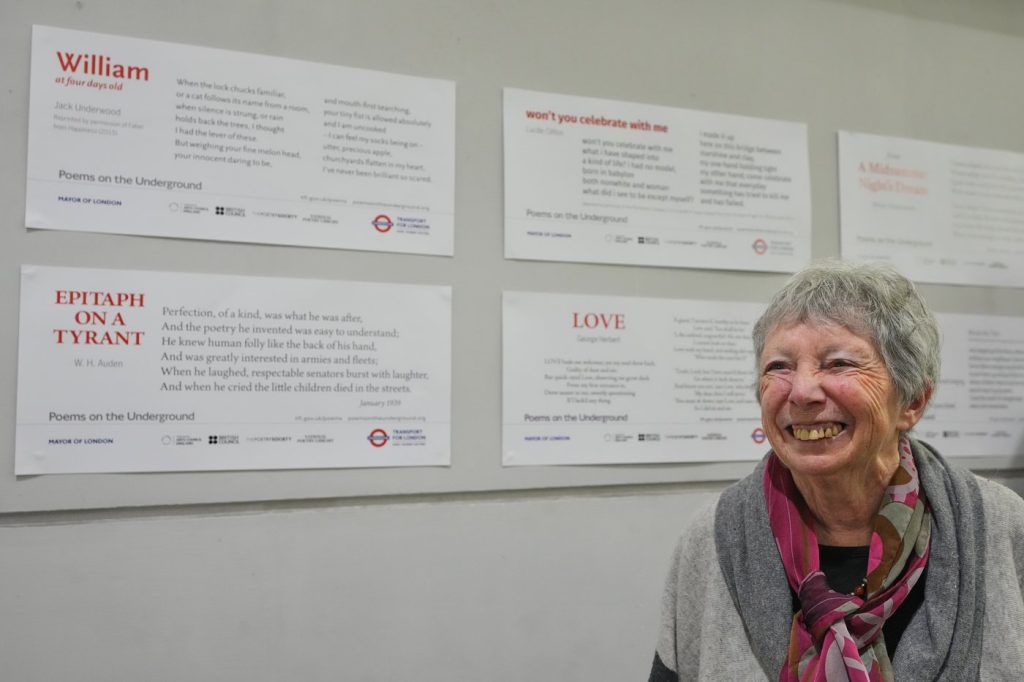
LONDON (AP) The initiative known as Poems on the Underground, founded by Judith Chernaik, poses the intriguing question of whether poetry can alleviate the woes of commuting. This project, which celebrates its 40th anniversary this year, began in London with the intention of enlightening, amusing, and inspiring subway travelers through poetry. Since its inception in 1986, millions of passengers on the London Underground have encountered posters featuring various poems, juxtaposed against the backdrop of advertisements during their daily commutes.
The milestone was commemorated recently when more than a dozen poets whose works have been showcased in the program gathered at a subway station. Chernaik, an American writer who relocated to London in the 1970s, found her affection for the city extending to its transport system, which she believed surpassed the New York subway in comfort and experience. Chernaik shared her perspective, stating, “I used the subway all the time in New York. It was not one of my pleasurable activities.” Her love for London's rich literary heritage inspired her to intertwine poetry with public transport.
In collaboration with her two poet friends, Gerard Benson and Cecily Herbert, Chernaik's plan to incorporate literature into transit was met with encouragement from the subway operators. Consequently, the first batch of poems was installed in January 1986. The inaugural year's selections featured works by renowned poets such as William Shakespeare, Robert Burns, W.B. Yeats, and Percy Bysshe Shelley, specifically his poem “Ozymandias,” which poignantly reflects on the fleeting nature of power. Other notable inclusions were William Carlos Williams' imagist poem “This is Just to Say,” with its memorable opening lines: “I have eaten the plums that were in the icebox.”
Over the years, the initiative has expanded its selection to encompass poems from diverse cultures, featuring voices like Wole Soyinka, Pablo Neruda, Derek Walcott, and Anna Akhmatova. The Poems on the Underground selection is updated three times annually, with Chernaik still actively involved in the poem selection process alongside poets George Szirtes and Imtiaz Dharker. The curated assortment includes a mix of both contemporary and classic verses, catering to a wide audience. Ann Gavaghan, who manages cultural projects at Transport for London, emphasized that the program features a spectrum of poems, from sonnets and haikus to humorous and relatable pieces, such as Katalin Szlukovényi's "Overcrowding."
Notable contemporary poet Nick Makoha remarked on how the project integrates poetry into everyday life, which often is mistakenly viewed as something requiring lofty intellectual engagement. He asserted, “Poetry belongs to the community; it should be part of our daily lives,” suggesting that the Underground serves as a conduit not just for physical travel but for emotional and intellectual connectivity as well.
Despite challenges within London's transit system, such as delays and overcrowding, the London Underground has consistently fostered artistic expression. Its iconic map is recognized as a design classic, and for more than a century, the system has enlisted prominent artists for poster designs. Today, Poems on the Underground has become a cherished component of the transport network, inspiring similar projects in cities globally, including New York, Dublin, Oslo, and Shanghai.
Gavaghan highlighted the essence of the project, explaining that it offers commuters a refreshing distraction amidst their daily struggles. She noted, “If you’ve had a hard day and you’re wrapped up in your own worries and cares, being able to see something on the Underground that makes you think... could make you laugh, could make you think. It really makes you empathize.” This impact has solidified the project's longevity and significance within the fabric of London's commuter culture.








