

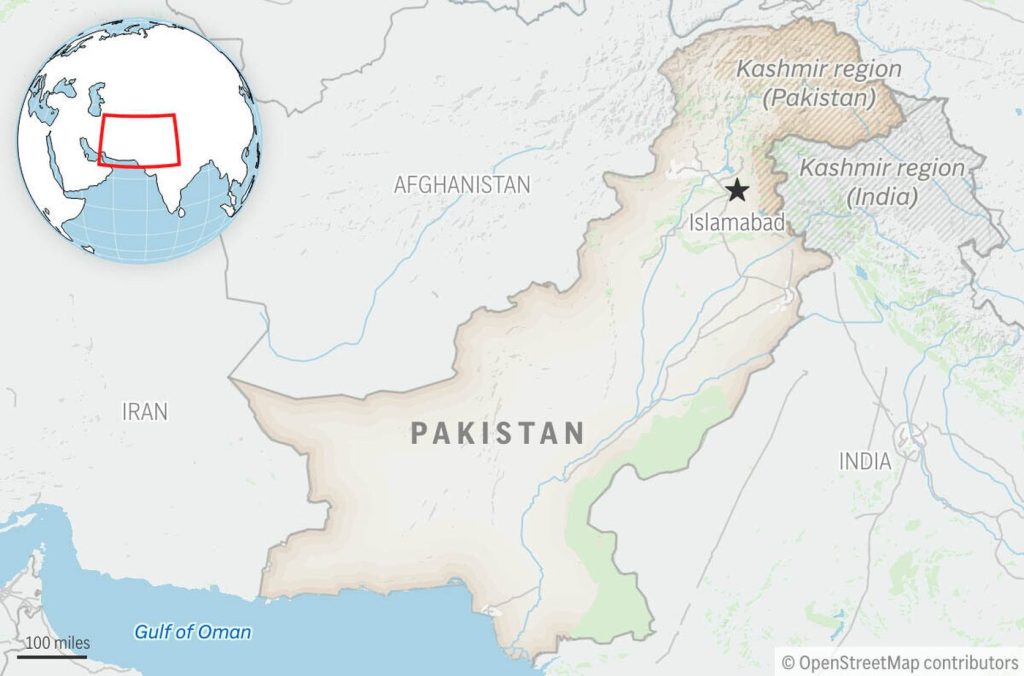
QUETTA, Pakistan (AP) – Early Saturday morning, assailants armed with guns and grenades executed nearly a dozen coordinated attacks across southern Pakistan, specifically targeting high-security locations such as a prison, police stations, and paramilitary installations. These assaults resulted in the deaths of at least 10 security personnel, while authorities reported that 37 insurgents were also killed during the ensuing gunbattles.
In Balochistan and other regions, militant groups, including Baloch separatists and the Pakistani Taliban, frequently target law enforcement and military forces. However, the scale of these coordinated attacks is considered rare. Pakistan's Interior Minister Mohsin Naqvi confirmed the fatalities among security officers and commended the forces for successfully eliminating 37 insurgents in multiple locations throughout the province.
Naqvi attributed these attacks to the Indian-backed group referred to as “Fitna al-Hindustan,” a term the government employs to describe the banned Baloch Liberation Army (BLA) and other separatist entities. Shahid Rind, a spokesman for the Balochistan government, reported that while many attacks were thwarted, they followed a day after the military conducted operations in the region, resulting in the deaths of 41 Insurgents.
State police and government officials indicated that approximately 37 assailants had been killed in retaliation to the nearly dozen attacks on Saturday. Earlier in the day, insurgents had destroyed rail tracks, leading Pakistan Railways to suspend train services linking Balochistan to other parts of the country. The attacks reportedly began almost simultaneously throughout the province.
Provincial Health Minister Bakht Muhammad Kakar noted that two police officers lost their lives in a grenade attack on a police vehicle in Quetta, the provincial capital. In response to the violence, the government declared a state of emergency at all hospitals in the province.
In Mastung district, a large group of insurgents attacked a prison, succeeding in freeing more than 30 inmates. Furthermore, militants made an attempt to storm the provincial headquarters of paramilitary forces in Nushki district; however, security forces managed to repel the attack. Locally, there were reports of insurgents throwing grenades at a government administrator’s office in the Dalbandin district, but a rapid response from security forces forced them to retreat.
Other thwarted attacks included numerous security posts in Balincha, Tump, and Kharan districts. In Pasni and Gwadar, there were attempts by insurgents to abduct passengers travelling by bus along highways. Kakar also implicated the BLA in these violent occurrences, reiterating that the group is banned in Pakistan and designated as a terrorist organization by the United States. This group has a history of orchestrating numerous attacks in recent years.
Pakistan consistently claims that Baloch separatists, alongside the Pakistani Taliban and other militant factions, utilize Afghan territory to launch incursions into Pakistan, a charge that has been denied by Kabul. The Baloch separatist groups and the Pakistani Taliban, known as Tehrik-e-Taliban Pakistan (TTP), have notably escalated their attacks within Pakistan in recent months. The TTP operates as a separate entity but remains allied with the Taliban regime in Afghanistan, which regained power in August 2021.
Balochistan has been a longstanding theater of insurgency, with separatist groups insisting on independence from Pakistan’s central government, situated in Islamabad.








